Sunday, December 11, 2005

I Spy with My Little Eye ...


Starship Troopers (1997) is a movie I keep revisiting. It has all along its surface a shine that I cannot resist; I want to run my hand along it, like the swoop of a 1950s car bumper. The movie has a lithe, garish glee that provides the viewer with ample opportunity to indulge in special effects that are alternately nubile and berserk.

Paul Verhoeven and his screenwriter, Ed Neumeier, who together gave us 1987's Robocop, pulled off a famous sly one here. Starship Troopers was greeted with mixed responses--prompting Neumeier in 2003 to write a letter to the Hollywood Investigator, which had drawn parallels between Starship Troopers and "post-9/11 war hysteria." Neumeier congratulated the writer who, as Neumeier put it, "clearly understood what we were up to"; he also admitted, though, that "we may have suffered when Starship Troopers was initially released because we were not willing to underline for the audience and critics that this was, in fact, a movie about the dangers of fascism." The impression he leaves is that he and Verhoeven thought the satire would be obvious--but this is disingenuous, albeit in a good way, because Starship Troopers moves just like their earlier venture, Robocop. That movie, too, plays it both ways: as a comfortably zero-brain-required ultraviolent action flick and a savage satire of post-1960s cop movies.

Is this fair? Are the filmmakers scolding our desire for the clear lines of--well, if not outright fascism, at least an orderly, healthy, brightly lit world--with one hand, while scooping up the green with the other? Well, yes and yes. I am attracted to Starship Troopers because of that double-duty manipulation. I'm glad to watch a movie nimble enough to amuse and dismay, excite and repulse. Starship Troopers keeps us on our toes, and reminds me once again we have to be very careful when we watch a movie.

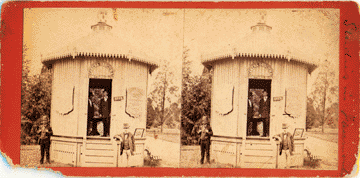
I love the term camera obscura, the "dark room" with a tiny hole in one wall that projects the outside world upside-down on the opposite wall. This goes all the way back to fifth century B.C.E. China, but Aristotle, Islamic scholars, Da Vinci, and finally Johannes Kepler, who gave us the term camera obscura, all fooled around with this optical dynamite. And considering that the device has often been used for safely viewing solar eclipses, I cannot ignore that the layers of metaphor here are satisfying.

Starship Troopers fits nicely into these layers, a trick of light that shows us objects clearly but inverted. Our job is to keep watching, but also do the hard work of craning our necks to see how the mirrors re-vert the image so that we can watch in misleading comfort. I have a cousin who, when he was a kid and wanted to stay up late to watch a movie, would sit in a cramped position so that he wouldn't fall asleep. There is a lesson here, especially if you're up past your bedtime to watch something as satisfyingly duplicitous as Starship Troopers.

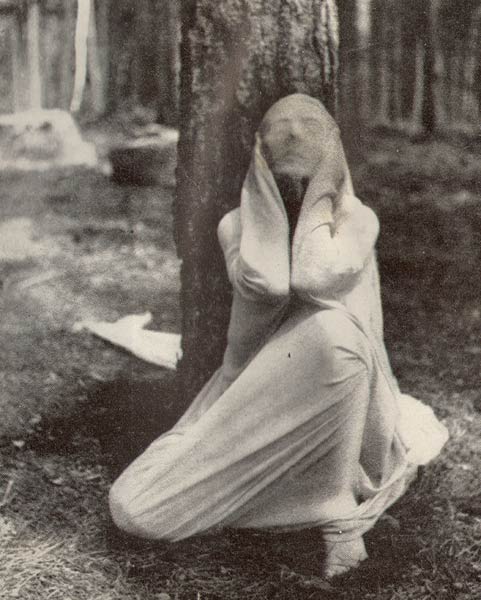
(Below: a stereoscopic slide of a camera obscura in Philadelphia's Fairmont Park, circa 1870.)

Saturday, December 10, 2005

"Where Did Hamlet Stab Polonius?"


"Behind the arras"; I never get tired of that joke, telling it for the umpteenth time today in the Introduction to Drama course I teach at our local correctional facility. If a classroom of students is a captive audience, my work at the prison is blackboard heaven.

Determined to remind them that plays are primarily performance experiences, we watched Hamlet on video: Lawrence Olivier's version--by default; we may have high drama of all kinds at the prison, but none of it is on DVD, and the other movie versions weren't readily available to us on VHS, including Kenneth Branagh's 1996 behemoth, or Michael Almereyda's almost-SF version with Ethan Hawke, not to mention Franco Zeffirelli's take with Mel Gibson--"Lethal Hamlet," more or less. Olivier. I shrugged, even sighed. I was "teaching" Hamlet, fer petessake, not "enjoying" it; what were we supposed to do with Olivier's Freudian pretzel-knot? Aside from the usual eye-rolling because it's B&W, my students also had to deal with Olivier's rapid-fire delivery, not to mention the textual leaps and bounds and global elisions, in effect telling the Bard where he so often got it wrong. I asked my students to follow the film with their texts in front of them; the riffling reached hurricano proportions.

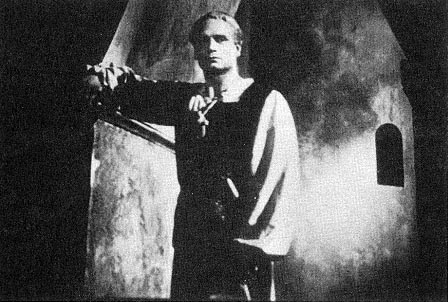
So as pedagogy it's in many ways a bust--but of course as a lesson in career-making acting, as well as a visual experience, it remains a constant pleasure. The visual style was particularly interesting for those of my students who had taken Introduction to Film Art (nice title) with me. We forgot for a while that we were in a drama class, and discussed how this was a noir Hamlet, with its rich chiaruscuro--many of them remember nothing at all from their time with me but that one word--and mood of inevitable doom. And we talked about how the story itself is a noir, albeit Val Lewton style, what with the ghost and weird locale). Hamlet, like so many noir heroes, is linked intimately to a crime, and becomes the sleuth, devising plots and traps, but still destined to see it all tighten like a noose until he's In a Lonely Place and there's No Way Out, the Force of Evil sneaking up on him Out of the Past; and, caught in the Crossfire, everyone faces the Big Sleep.

Of course, I'm drawing the noir cart before the Shakespearean horse; given the sickly descent, slow but vertiginous, of Hamlet--not to mention the madness and compulsions and degenerate scheming of Macbeth, King Lear, and Titus Andronicus, to name a few--it seems Olivier directed Hamlet at exactly the right time--1948--to give credit where credit is due: as usual, at Shakespeare's feet. He knew, as thoroughly as Sophocles, the queasy thrill of discovery, chase, and best intentions, all leading to revelation and those dreams that come at the untidy end of all effort. Olivier clamps his mitts on this with a vengeance--ha, ha--and delivers a moody, smoky, dim wonder, as much about the growing uncertainty of the post-World-War-II generation as Shakespeare's fear of the State literally losing its head, as it was wont to do. The result is typically modern, as Shakespeare can so easily be, if only because he reminds us that everything gets to be modern sooner or later, including the moody college kid from Denmark with too much time on his hands and a grudge to nurse and eventually fester.

Friday, December 09, 2005

The Gazing Game, Part 4

"The eyes of those who see will not be dim ..."

L'Age d'or (1930) The parted lovers cannot take their eyes from each other--so everyone else does, until all things conspire against them; and the man, enraged, buffeted by the clods of tradition, stares wide-eyed at even the innocents and violently tears the whole thing down, kicking and screaming like a terrible infant, a genius of irrational, intuitive convulsions and curses.

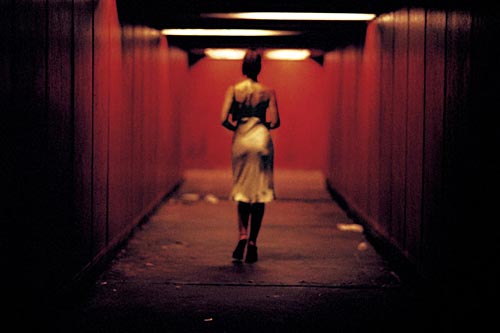
Irreversible (2002) Never ask can I have a look, just a peek, I want to see, because you cannot undo your gaze, no matter how much your thumbs rub at the charcoal smudges your eyes have become, blinking through tears that run up and into your eyes until they're dry and clear and the terrible sight recedes to the future, leaving a tunneling thud that echoes like your forehead on wet concrete.

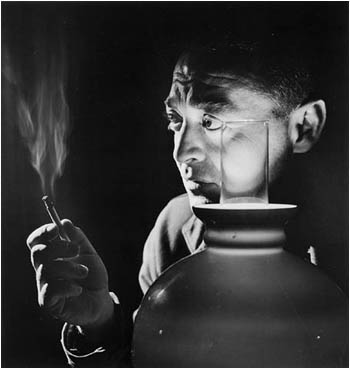
Quicksand (1950) There is something froglike in his eyes, but radiant, despite his two-bit arcade patter and decades-long anxiety over the purchase price he's certain he can set on every woman he's met, coupled with his lidded appraisal of the kid in trouble--two-for-one, he figures, the girl and the kid, buy one and sell out the other; this settles him more squarely on his haunches, and he spreads his mouth in a small indulgent smile.

Thursday, December 08, 2005

The End of Horror


I know how often I watch horror movies: too often. And I know how much I like them: too much. I had a conversation with a friend recently; he said he thinks horror films are immoral. Of course, I didn't pursue his comment, because I was too busy correcting it. I referred to Stephen King, who writes somewhere or other--in Danse Macabre?--that horror is actually the most moral type of fiction. As I remember it, his argument is that in horror the reader/viewer/listener is asked to consider individuals in peril, thus triggering sympathy and anxiety. The fact that you yell at the screen and tell those morons not to go into the cabin--or out into the woods, depending--proves that you have a sense of right and wrong. Even your disgust at how dumb the victims are is a sign of your moral sense at work: You get angry at them, not just because they're stupid--that's just you casting stones--but because you know deep down you'd do the same, and share in their doom. It's a slapdash approach to the evocation of fear and pity, but still pretty potent.

But how often is too often? How much is too much? There's a song by the Cramps--the original horrorbilly punks--called "How Far Can Too Far Go?" If you know Lux Interior, Poison Ivy and company at all, you know their answer: never far enough. The Cramps' catalogue is a What's What of exploitation trash culture, a fun-lovin heinous hootenanny that's the musical equivalent of an Elvis movie produced by William Castle and directed by Doris Wishman. (If you're lost, go to the Internet Movie Database. I can't do everything for you.) I must admit I'm a big fan, mostly because I can see the grin beneath the grimace. The Cramps generate all the moral dread of a Booster Club Halloween Haunted House, despite their misogynistic excess and Ride with the Devil glee.

Real evil, on the other hand, is not nearly as entertaining. You know it well: It plods along beside you, rolling that snowball that gets bigger every inch, the cold work of isolation, egoism, fear, and pride. Death isn't evil; it's just the messenger of your fears. And evil isn't monumental--although give someone enough toothpicks and she'll build you the Great Pyramid. I'm afraid, not because I have anything to fear, but because I don't know enough not to be afraid. So evil in movies is often like a Cramps song: a whisper of the scream, shadows playing along an expressionist corridor. I can deal with that.

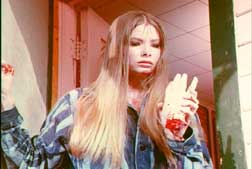
But I sometimes get tired of horror movies. I watched I Drink Your Blood (1970), and glanced at some of the DVD extras. There was poor old David E. Durston, the director, still wearily muttering "Roll 'em" like Sisyphus with his rock. And his misery loved company: He trotted out three of the movie's stars, their faces polite, their balding heads--or assertively dyed coifs--like dimming torches, as they sat awkwardly on patio furniture to be mercilessly videotaped. There was some good will, but mostly it all seemed more horrifying than the movie, rabid hippies and all. The movie itself wasn't all that bad, in a Mystery Science Theater kind of way, but as I went from one scene to another, one DVD "special feature" to the next, I began to realize something I'm sure at least some of my friends and Humble Readers must be all too well aware of: One can waste too much time with this junk. The more I watch, the more I feel the weight of that rock.

Like Sisyphus, though, I still go at it. In his famous essay on the myth, Albert Camus writes that he is not interested in what Sisyphus is thinking as he pushes the rock up the hill, but in the moment when he once more confronts the rock:

"It is during that return, that pause, that Sisyphus interests me. A face that toils so close to stones is already stone itself! I see that man going back down with a heavy yet measured step toward the torment of which he will never know the end. That hour like a breathing-space which returns as surely as his suffering, that is the hour of consciousness. At each of those moments when he leaves the heights and gradually sinks toward the lairs of the gods, he is superior to his fate. He is stronger than his rock."

I have to confess, sometimes I feel like this when I watch a bad horror movie, which in part is why I watch them: because the feeling is expended on an inconsequentiality, a stupid movie. It is a vacation from the real rock, the need for real strength. I have always been torn between faith and absurdity. I hold them in my hands, like roses and snakes, and sometimes I cannot tell if I'm feeling thorns or fangs. But I always try at the end of the day to live in love, if not with meaning--unless love is enough. I think I am wrestling it into a moral perspective--or wrestling in a moral universe, I sometimes can't tell. But I find Camus' essay irresistible, as I do the Beatitudes, because they both are born from sorrow, pity, and the need for strength. And when I watch yet another bad horror film, I can take a vacation from that need and let some other poor sap get flattened by the monster.

Have you ever seen an image of Mary, the Immaculate Conception? Her dainty foot treads on a snake.

House of D'Oh!


Sorry for the sophomoric title, but I find it difficult to even begin to explain why I performed what is for me an almost unthinkable act: turning off a movie before it was over. Something must be terribly wrong in David Duchovny's writing-directing debut, House of D (2004), for me to do so; after all, since then I've sat through Takashi Miike's interminable bloodbath, Izo (2004), in which a nineteenth century assassin is captured by his enemies and crucified--but it doesn't take, it seems; instead, his death propels him through space and time to mow down everything in his path that even hints at corruption (including schoolchildren and Buddhist priests). And I finished I Drink Your Blood (1970), featuring Satanist-hippies who are fed rabid-dog-blood-injected meat pies and go on a more or less--more less, I suppose--Cronenbergian killing spree, infecting everyone they can bite. AND I left on until the end Alone in the Dark (2005)--admittedly napping through bits n pieces; poor Christian Slater, fighting uninteresting monsters from beyond. (I won't even discuss the Law and Order: SVU episode that I'd already seen but still finished.) Sometimes I wonder if I should rethink this movie-watching effort and become Your Humble Reader instead; aren't there a lot of terrible books I can stop reading in under two hours?

I checked to see if it was just me. First, Ebert: He delivers one of those reviews that are withering precisely because he avoids actually reviewing the movie for about half his text, then ends the review abruptly, like a Three Stooges short. The website Rotten Tomatoes, which gathers reviews and presents an average score, is even more telling: It gives the movie a 10%. Imagine your worst performance in your entire academic career, and I am certain you got more than 10%. So maybe I'm in good company here.

But that doesn't quite explain it. I checked in the category of "contemporary drama" that received between 10% and 20% on the "Tomatometer," and it includes movies I've made it through all the way, and kind of liked: Against the Ropes (13%, 2003), Cold Creek Manor (12%, 2003), and The Chamber (14%, 1996), to name a few. I think we're looking at a thin line here. I noticed that Suspect Zero (2004) received a 16%; I was quite taken with this one, a dark tale with a moral weight. Now, 16% is, what, a 60% better score than 10% (I think; this is why I am not Your Humble Calculator); but jeez-oh-pete, it's still 16%! Again, I'm unsure what happened to House of D. Other reviewers can't help me--much--and arithmetic certainly has let me down.


So I think it's me. No, I know it's me. Duchovny's character is seen in flashback. He's twelve going on thirteen in 1973. I myself was sixteen then. The character attends a boys' Catholic high school. So did I. He's in New York; I was in South Jersey. This is a close enough match, so I can assure you that twelve-year-old boys in the early '70s did not discuss the size of their balls to girls they had crushes on. This is only one small (ha, ha) detail of a movie I found so embarrassingly wrong-headed, so flagrantly selective in its memory, that it proved unwatchable. Case in point: This is a PG-13 movie, and I can attest that, sexual anxiety notwithstanding--oh, that I wish--Catholic school boys may have kissed their mothers with those mouths, but that didn't stop them from cursing like--what can I say in the burgeoning years of the 21st century? Rap stars? The Real World housemates? Their language may be a small matter, but if I couldn't accept the surface reality of the film's world, its emotional reality--and I think there was some of that going on--can only futilely resist the weight of that unbelievable top-layer.

After all this, I must admit I regret not having finished the movie. Given some--OK, many--of my other full screenings, I could have hunkered down and put up with it. Because I also must admit I'm a fan of David Duchovny. Every other weekend or so I watch a DVD-full of X-Files episodes--my son and I are consuming the series in order, little by little--and he is excellent in Return to Me (2000), and doesn't hurt anybody (I couldn't think of anything else to say) in Evolution (2001). I wanted House of D to work. The fact that it didn't doesn't simply tell me it's a bad movie; it reminds me once again how deeply autobiography and memory serve to shape our responses to movies. When I teach, I encourage--implore, exhort, cajole--my students to approach a text objectively--actually, to be honest, from the text's point-of-view, subjectively, then, but from the inside. We aren't Willy Loman or Hamlet or Ethan in The Searchers or Rick in Casablanca; they are. We have to see their worlds as they see them, not as we do, or would like to.

But that is a lie, because it is the self that does all this work; so if the job is immersion in the text, it is the self who immerses--and brings itself with itself, yes? Like Heisenberg's Uncertainty Principle, the act of measurement is not a passive, objective activity, but an intentional action that changes the thing being measured. And to this action great "texts"--and by now this means everything, from a book to a movie to a face on the night train to plate tectonics to the falling of a sparrow--bring one more beautiful, terrible change: in the measurers ourselves. So we change the movie, but the good movie also changes us. It's just that House of D had no power to do the latter.

Monday, December 05, 2005

Where's Poppa?


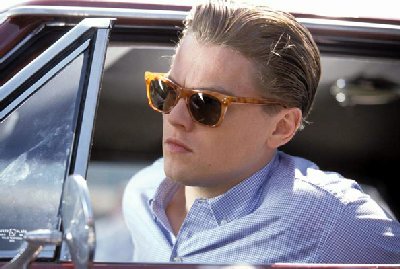
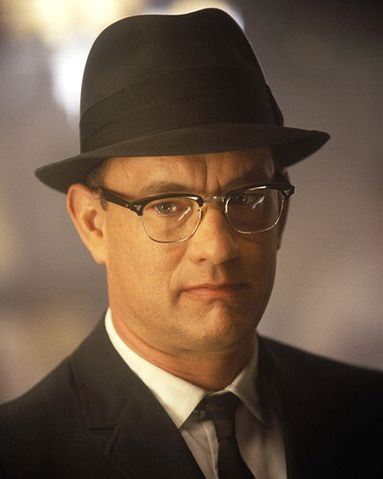
After a number of near-hits and missed opportunities, I finally watched Catch Me If You Can (2002), Steven Spielberg's movie about Frank Abagnale, Jr., a teenage Great Imposter depicted with enthusiasm and finesse by Leonardo DiCaprio, who proves--and this may seem painfully obvious, but I still think it's a real accomplishment--he will always be able to convincingly portray a sixteen-year-old. His performance draws us into Frank's slippery world, one that is breathless and giddy, but also "sad, sad, sad." I was happy simply to enjoy the hijinks and Tom Hanks' funny-freaky Carl Hanratty, the FBI man who pursues Abagnale and his paper-hanging across the US and Over There--and then, as happens so often in Spielberg movies, I was caught short by the pain he always inflicts on his protagonists, who find themselves cut loose from family, from father and/or mother. The pursued pursues, searching desperately for the lost parent.

It's a role-reversal of fabulous proportions, as Frank Junior becomes Hansel-Gretel, Snow White, maybe even (gulp) Oedipus, while the menacing forest clutches at the hem of the child hobbled with a crooked foot and faultless fate. Spielberg returns again and again to these lost children. There's Elliott in E.T. (1982), fatherless, trying to figure out how to grow up, until he rescues and is rescued by something that acts as both better self and parent. And also Celie in The Color Purple (1985), whose haunted wood is the American South, where she waits for her African angels to fly her home. And of course Pan in Hook (1991) and Jamie in Empire of the Sun (1987) and David in A.I. (2001), and even Indy, whose Last Crusade (1989) is to reunite with his father--all Lost Boys and Supertoys, alone and searching for themselves in their parents. Even Tom Cruise in Minority Report (2002) and War of the Worlds (2005) pitches in to build this fable, but from the parent's perspective, as he seeks to regain his own Lost Boy.

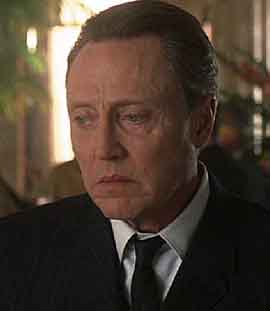
In Catch Me If You Can, Spielberg almost abandons the film's core--the cat-and-mouse of a great con artist and an equally great plodder trying to Get His Man--and asks us to stop and watch how Frank becomes what he is in an attempt to emulate his father, and how he raises the stakes to restore his divorcing parents, until he finally does find his father, in the person of Hanratty, the jubilant square who adopts his quarry, replacing the father (played by Christopher Walken, as usual completely satisfying in his self-assured ability to appropriate the role). As Hanratty closes in, he also gets closer to Frank, eventually becoming the protector, colleague, even, it seems, proud dad.

I was relieved Spielberg gives Frank a father. The anxiety DiCaprio projects seemed to me a preview of the OCD doom he would bring to The Aviator two years later for Scorsese, almost unwatchable in its sense of imminent, intimate nervous collapse. (It is a pain I think captured best in the image from The Aviator of Hughes washing his hands with such futile purgative fervor that he cuts himself. The urge to be complete expressed in extremis.) With his All-American American openness coupled with the most expressive eyes in Hollywood--at once capable of a hundred-yard stare and an aw-garsh twinkle--in Catch Me If You Can DiCaprio perfectly captures the requisite yearning one needs to play a Spielberg orphan. I think it's telling that the movie is based on a true story; it gives Spielberg the kind of journalistic "realism" lacking in his more heavily metaphorical attempts at telling his ur-story of abandoned children who search for home.

Saturday, December 03, 2005

A Full Heart


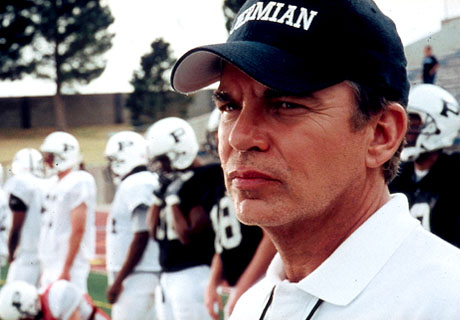
Billy Bob Thornton is cultivating a career marked by quirky but compelling firsts, from the sublime (Sling Blade, The Man Who Wasn't There) to the ridiculous (Bad Santa, of course). In Friday Night Lights (2004), directed by Peter Berg--an actor-turned director who seems to have done a good turn here, so to speak--he plays real-life Texas high school football coach Gary Gaines, and manages to deliver the oddest locker room pep talk in the history of movies, as far as I can tell. It begins by exhorting the team toward perfection, but is forgiving of the their shortcomings, almost eager to assure them winning doesn't matter, but only dignity and responsibility, and the capacity to love and carry each other in their hearts. Really. I will indulge and quote the speech as it appears on the Internet Movie Database:

"Being perfect is not about that scoreboard out there. It's not about winning. It's about you and your relationship with yourself, your family and your friends. Being perfect is about being able to look your friends in the eye and know that you didn't let them down because you told them the truth. And that truth is you did everything you could. There wasn't one more thing you could've done. Can you live in that moment as best you can, with clear eyes, and love in your heart, with joy in your heart? If you can do that, gentleman--you're perfect."

He goes on:

"I want you to take a moment, and I want you to look each other in the eyes. I want you to put each other in your hearts forever because forever is about to happen here in just a few minutes. I want you to close your eyes, and I want you to think about Boobie Miles, who is your brother [the star player who ruined his knee early on and had to sit out the season]. And he would die to be out there in that field with you tonight. And I want you to put that in your hearts. Boys, my heart is full. My heart is full."

"Live in that moment"? "My heart is full"? It is a remarkable episode in an otherwise straightforward film about The Only Game in Texas--which is a pretty clear accomplishment, to be an unadorned sports film that looks at most of the facets of this high-hopes, low-blow world without leaning too much either on the boys-to-men stuff or the cutthroat coaching parents angle. Those are in there, but mostly this movie wants to show us this world without telling us what to think.

Until we get to that speech. Berg shoots Thornton in closeup, that honest slab of a face itself in the moment, transcending all the cliches of every sports film, from the best (Hoosiers) to the worst (The Karate Kid?) until we feel he is talking to us, not his players, and exhorting us to fill our hearts with the joy of perfection. I tried out for football in high school, and was mercifully cut. But I was certain I could have held that joy in my own heart, regardless of my ability, because I knew--or wanted to know--the moment in which I could tell someone I had done everything I could, and had left nothing out. What a rare opportunity to shuffle off the embarrassed shrug, the rueful grin, and simplify one's life to a moment. And such a self-contained one: a silly game, silly enough to become a metaphor that can stand in for the real moments one has to face in adulthood.

And maybe better than a metaphor, but a myth, a story I could tell to explain myself to others as well as to me. I must admit I had forgotten why I had liked football as a kid--and not so much as a fan, collecting cards, cataloguing information. That seemed dull and lifeless. No, as bad as I was at it, I loved playing football with my friends. We were all about the same size, and owned pads and helmets--except Rob, rest his soul, who played without, a wiry muscle that slithered around our arms to escape, ball in hand--and for a while we played constantly, pretending we were on a team, suiting up and practicing every day, an older kid our self-appointed coach. Sitting in my seventh grade classroom, I was happy if it started to rain or snow, so we could play in the muck. It was, as I've said, pretend football played by a pretend football player, but I held an image in my heart of myself, not necessarily winning, but at least never giving up.

People assert that those who say winning isn't everything are the ones who usually lose. But when I listened to Thornton's speech, I realized that even if it were true, that losers console themselves with platitudes, that it's also true that seeking perfection is something you can hold in your hand, and actually do, like running, or throwing something, or tackling someone, or telling the truth.

Monster Sounds and Dance Music


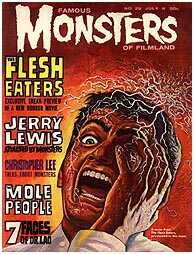
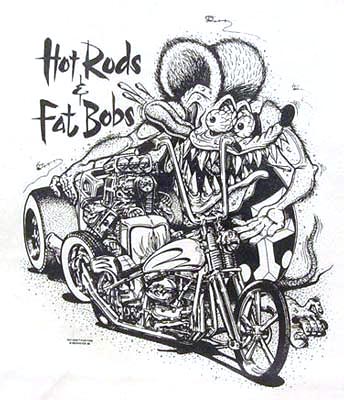
I own some albums Rob Zombie would covet: mid-1960s dance records with lots of reverb and warbling screams of terror. These are low-rent entries (and that's setting your sights pretty low) of the monster pop canon; I suppose the masterwork is Zacherle's "Monster Mash," which needs to be taken in context with a frayed tapestry tied together, in a Forry-Ackerman-Meets-Basil-Wolverton kind of way, with any number of threads of adolescent boy culture, from monster trading cards and stickers to Aurora plastic models and Herman Munster talking hand puppets, from Creepy Crawlers (often a kid's entree to the world of second-degree burns, fingertip division) to the Kustom Kar Kraze (R.I.P. Ed "Big Daddy" Roth and Ratfink). When I was nine or so, I plunged headlong into this humid, poorly reproduced world of bad puns and luridly curving claws, of profuse sweat-drops and clammy waxy surfaces--Topps-ed off with a deadly sharp piece of gum, powdered and pink like a dessicated tongue. It was a mess.

Just like The Devil's Rejects (2005). Although Zombie's movie is primarily an homage to 1970s travel-n-splatter movies--The Hills Have Eyes (1977) and of course The Texas Chainsaw Massacre (1974) spring immediately to mind--Rejects also has at least one horned toe dipped in the Herschell Gordon Lewis pool of Incredibly Strange Ideas That Stopped Being Movies and Became Mixed-Up Cult Classics, like Two Thousand Maniacs (1964) and Color Me Blood Red (1965), not to mention the subcategory of zonked-out corpse-grinders culminating in, I think, the dirtiest Satan-hippies of them all in the non-Lewis I Drink Your Blood (1970), who eat meat pies infected with rabid dog blood, and go off on one of those killing sprees. I actually have this movie, as yet unwatched, in my possession. Yech.

Rejects enjoys itself immensely, and I must admit I knew exactly what Zombie was up to, but the more I saw the movie rolled up in a big sticky ball with all those dregs of my childhood, the more I grew weary of it. I reminded myself once again that I prefer the past to stay the past, or at least itself, and whenever a film pays tribute or evokes something or other, there's always more than a whiff of self-congratulatory winking. As usual, I'm tempted to blame Quentin Tarantino for this. The Kill Bill double bill has yet to engage me in any significant manner--aside from drawing me to its sources. Sin City (2005) has the same effect; creative Xeroxing is simply not enough. Now, I won't entirely discount the basic impulse. From Dusk Till Dawn (1996) works well on its own, constant references to other movies notwithstanding. Sure, there's a nerdy appeal to such in-joking--"Hey! There's Tom Savini!"--and, looking at what I've written thus far, I must admit this entire piece in many ways has been an exercise in such smugness.

But let's move on.

A real music-lover I know used to disdain the whole idea of the Blues Brothers back when they were a hot bit on Saturday Night Live. He wanted people to buy the original records, not Jake and Elwood's covers, no matter the backup band's pedigree. I argued it might open the door to that music--and I think it did to a certain extent--but he was convinced that by and large people would remain satisfied with the hepped-up new model, irony included--and I also think by and large he was right. After all, it's been twenty-plus years and the Blues Brothers persist, if only as local car dealership pitchmen and high school halftime shows; but in all that time, I don't think anybody ever did a Sam and Dave impression.

I bring this up to figure out what to do with Rob Zombie. Now, we can easily argue that Zombie's sources don't need to be treasured or protected; they're alive and unwell on DVD. (And as far as the Angels of R&B are concerned, they seemed awful happy with their speaking roles, bit parts and cameos in 1980's The Blues Brothers.) Maybe, though, the effort to pay tribute to all that is creepy and kooky and altogether ooky (See? I'm doing it again; down, fanboy, down) is only marginally worth the trouble. Personally, I'd rather watch the originals or, better yet, use my conveniently selective and softly, almost imperceptibly fading memory--bolstered by the Web's bottomless image archives--to spread the past before me like a Tarot deck designed for reverse engineering.

Thursday, December 01, 2005

In a Panic


The mystical-psychological-surrealistical-comical-tragical filmmaker Alejandro Jodorowsky is one of those freakout cool cats of the old school who can say things like, "I ask of cinema what most North Americans ask of psychedelic drugs"; or, better yet, "The apocalypse is now! Americans know this, that the only hope is the flying saucers. Do you know how I see the world? Like a person who is dying. It's a worm who is dying to make a butterfly." Standing all on their lonesome like this, naked and exposed, such utterances seem, to put it mildly, screwy babblings. But the house has many mansions, and it would be a grave error to exclude Jodorowsky. Like David Lynch--and others; let's never forget the mad puppeteer of Prague, Jan Svankmajer--Jodorowsky has always insisted on an alchemical view of things, which means that he can be always be found scooping up dross by the fistful in anticipation of the day when it all turns gold. Hence the world as a worm, the idea of film as a drug: the center of the experience of making--and watching--films is transformation. And for the surrealists, it is a moment's work, a transubstantiation jumpcut. Don't blink or you'll stay a worm.

In 1968 he released Fando and Lis, a quest fable about a man and woman who seek the mystical city of Tar. The movie sprung directly, like Zeus' children, from his involvement in surrealist theater in Mexico: it is a filmed "memory" of a Francisco Arrabal play Jodorowsky had directed for the "Theater of Panic" (with an emphasis, I think, on "Pan"). He worked without a script, on weekends--like Night of the Living Dead, also released in 1968; so there: now stop asking whether the universe has meaning--and perhaps on drugs himself. It is a giddy, glorious mess about which I won't go into details, save two.

(1) Lis is unable to walk; we see this idea of disability, sometimes to the point of amputation, in other Jodorowsky characters--most notably for me in Santa Sangre (1989), in which an armless woman essentially enslaves her son, who stands behind her and acts as surrogate hands; this is the only other of his films I've seen. ( And I suppose that's a problem, since that excludes from my discussion El Topo (1970), which many seem to regard as his most extreme film; does that make it a masterpiece?) She is sometimes pushed along in a cart by Fando, but he also often carries her in a strange manner: he holds her horizontally behind him, like an oblong bundle, his arms crooked around her to keep her pressed against his back. It seems the least efficient way of carrying her, but Fando manages to bear the burden for long stretches, sometimes in surprisingly lengthy uninterrupted shots.

(2) Early in their travels, they come upon a devastated city--according to the DVD commentary by Jodorowsky, actually the site of a lunatic asylum that had been demolished. I want this to be the truth; it suppports my orderly universe theory. Amid the rubble, well-dressed people listen to a jazz combo, dance, play blind man's bluff. The central image of this episode is a man playing an upright piano that is on fire. Jodorowsky said it was his homage to Bunuel--and by the way, I'll be watching his film L'Age d'or (1930) tomorrow or Saturday; this is a pretty dizzying week for Your Humble Viewer--but as I watched, another image sprang to mind: In his concert film Big Time (1988), Tom Waits begins a song in closeup, holding upright a thin pole of some sort. The camera slowly recedes, until we realize he is holding onto an umbrella--which is on fire. He continues to sing, while the flames and smoke rise.

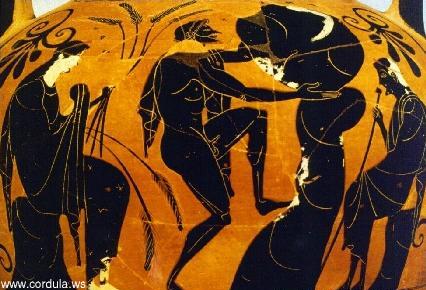
While the movie Jodorowsky made is sometimes a bit silly--like the man himself, from what I saw on the DVD extras--I found Fando and Lis compelling, just as I find Jodorowsky indispensable. Elements of surrealism have always peeked from the dark corners of art, from the masks and robes of Greek tragedy to the keening yelps of Japanese theater, from the cautionary grotesques of Bosch's paintings to the dancing bananas of Busby Berkeley's MGM musicals. Panic, indeed: Watching Fando and Lis is like witnessing Pan-rites: goofy but mythopoetic, pretentious but archetypical. Again, there's a line that stretches from the hidden rites of alchemy to Mullholland Drive (2001), and I think we break that line at our peril, because Jodorowsky's right: the world is a worm, but the butterfly is immanent; and when we let it slip away, the surrealists rush up with card tricks and fireworks, and rouse us to attention with stupefying non sequiturs.

Wednesday, November 30, 2005

"Learn That Poem, Learn That Poem"


I gave in to a fond indulgence: a DVD filled with Hal Roach's "Little Rascals" shorts, in all their cheerfully brutal glory, with enough nascent racism to make one squirm--but still enter laughing, buoyed by Stymie's doggedly insistent hunger that will never be sated, no matter how many sizzling frypans of eggs and ham or smorgasbord handouts--complete with Arty-choking artichokes and dog biscuits--or sagging sacks of candy--OK, here it comes: Yum, yum, eatumup--he can wolf down. Watching those long-gone children scampering around their nondescript edge-of-Hollywood early-morning locations--scraggly fields, stagnant ponds, dirt paths, alleys and culverts cluttered with handy brickbats suitable for bouncing off dog catchers' and truant officers' bald pates, and of course home to inexplicably available mules--I am once again filled with nervous excitement as they race between the legs of cruel adults, some of whom are actually armed, others merely squinting with Edgar Kennedy-esque certainty of delinquency; and I am filled as well with Stymie's hunger, broad and blatant, but real, even when he literally licks his lips in anticipation, because I understand the feeling: Anything--everything!--but mush.

When I was a kid myself, the Little Rascals were easily recognizable as real children, albeit inhabiting an idealized--or at least stylized--world, particularly because of their appetites: for food, of course, constantly, but also each other. They know how vital it is for children to, like good revolutionaries, hang together to avoid hanging separately. Exclusion from the gang is a bitter, tearful, panicky business; and their friendships demand a calm port after the storms of school and romance, capture and flight. While some adults extend affectionate or charitable hands--the nice ladies whose back porches Stymie approaches to beg for food, or shopkeepers and passers-by who indulge the children's whims--"borrowing" apples for an unsuccessful lesson in arithmetic (doomed to failure because of the apples' presence; they are, after all, food, not academic abstractions)--and of course the lovely Miss Crabtree, still the single most charismatic educator in film history (goodbye, Mr. Chips, you betcha)--most grownups in the Little Rascals world are active threats, far removed from the absolute values of childhood: appetite and loyalty.

The DVD I watched seemed determined to offer a thesis about those values: that they were best expressed in terms of the Rascals' relationships to dogs--particularly the phenomenal Petey, of course, but also a number of other crossbreeds tumbling around, fellow children--or at least creatures of the same world, pursued with ugly unrelenting violence by adults posing as dog catchers simply to make easier their acts of aggression in the War on Children. Petey is even featured in a weird silent short that chronicles in flashback his decision to commit suicide by hanging--assisted by a sympathetic fellow canine--in a telling turn of events, due to his master's betrayal. And true to form it's cherchez la femme, another appetite encountered--but the pursuit of the girl is an adult yearning; no wonder it spells doom. And Petey actually goes through with it, twisting at the literal end of his rope, but is rescued by his repentant master. If you want order--true, of a noisy sort, borne aloft by misunderstandings and a skewed child's-eye view, but order nonetheless--you have to turn your back on the adult world, or it can be lethal: Petey is gassed at the dog pound in another episode--and the fact that the gas canisters were empty does nothing to lessen the cruel extremes Hal Roach's series resorts to in order to test the absolutes that bind the Little Rascals.

The more I watch them, and the older I get--and doesn't that work out nicely?--I become convinced that, as stiff and formulaic as they are, these little films resonate. Yes, the Rascals are deeply caught up in bodily functions, material gain (Consider the truant wannabe, Brisbane, who, speaking out of the corner of his mouth--yet another Rascal visual trope--disdains his mother's plans for him to become President in favor of his own dream to become a street car conductor: "Boy, do they take in the nickels!" He listens to a hardworking man at his "grim forge" describing how he dutifully studied and was first in his class, all in the service of his own aspiration to reside in the White House. But as Brisbane observes with finality, "And you ended up a punk blacksmith."), and of course the joys of the chase. But they also seem to yearn for a perfected state, one that provides a justification for their appetites, a kind of vacant-lot-as-Pure-Form, a Rascal-ness, Professor, if you please, that places them out of the reach of starched shirts and outraged dowagers and allows them room to see the world as it is really is--or at least as they are always imagining it, which by the end of the second reel means a full belly, a safe pooch, and arms draped over each others' shoulders, as ready to give one another a kiss as a razzberry, in the safety and freedom of a partly hidden world at knee-level, little but not forlorn.

As Brisbane regrets his truancy, weeping as the Rascals often do--and not only because he has let down his mother and the radiant Miss Crabtree, but because, as an expelled student, he may be free but he is also divorced from the gang--he accepts his punishment: to recite a sickly sentimental poem, a rapturous ode to his teacher. He stands at the front of the room, torturously expelling the awful words, while the other kids howl their cleansing derision, drawing him back--and I don't think into simple conformity to adult authority, but to a far better place, where the clubhouse leans and Petey waits with Spanky--so fond of pointing out deviations from the Code of Loyalty with a sarcastic, drawn-out, "My pal"--and Stymie and Weezer and Farina, while that theme music, surprisingly plaintive, more goodbye than hello, reworks my childhood in its own grainy, mugging, double-take image.

Tuesday, November 29, 2005

A Year in Movies Begins


I've been writing pretty regularly this year; I started with the intent to write every week, and slacked off, then vowed to write every day, then slacked again. Eventually, I settled into a fairly regular schedule, intermittent but ongoing. I have come to realize that this current run has been a prelude to a kind of mission: to watch a movie a day for a year, and to write about that movie every day. Vanity, vanity, all is vanity. Fair enough; nonethless, I shall arise and go now, I shall strike the board and cry, "More!" I shall stand in the mead-hall and make my vow, swearing neither by my hand nor my head, neither by Jehovah nor Moses nor Allah nor the Buddha, neither by my mother nor my father--God rest them--nor wife nor children, but by my word, saying Yea. The rest is the opposite of silence.

I entertained the notion of beginning this journal with some sort of grand entrance--a discussion of Bruce Posner's Unseen Cinema seven-DVD collection, for instance; on the first disk, early motion picture cameras settle their gaze on direct and unadorned Life as it slides along a river or outside a train; or I could have raised a fitting paean to a classic film, touched unmistakably by the force of its own artistry as well as my memory of the experience of watching it. I thought of The Maltese Falcon, I believe the first movie I saw on the big screen after four or five scratchy viewings on television. I wanted to convey the sense of revelation I had, and how it has clouded the following decades of watching movies on TV, which I love to do, though it diminishes them - especially ones that deserve pilgrimage out of the damn house, like The Aviator or Eyes Wide Shut or Minority Report, all movies I have seen only on TV, what a shame. Some sort of fitting entree should occur; after all, I'm standing at the threshold of a movie a day, and of writing about each one; I'm already crowded with jobs and kith and kin, so I should open strong, at least for luck.

But I want this to have an element of the incidental about it, of the found--although I admit I'm getting all the movies through Netflix, lined up in a Queue I can unerringly manipulate with the aid of "Netflix Freak," a program that allows me to treat my Netflix account as though it were an iPod playlist--oh, the sleek and softly audible undertones of the Macworld, where everything's as smooth as a VW Beetle's behind and sharp as a Michael Graves teakettle. So I won't kid any of us with blather about accidental movie tourism. And yet: Here I go jumping off early, so to speak, writing today in late November, when I had planned to start January 1, run straight through to the last day of 2006's December. But I'm impatient for once; it is a rare enough feeling that I should take advantage of it, and start now. So I will.

Today I watched Time of the Wolf (2002), a French film about the post-apocalypse--nuclear, I think: I spotted a drawing on a wall that looked like a mushroom cloud; but the details are hazy. What is clear is that this film prompted me to start now. I’m weak-minded enough to appreciate the faux cleverness of beginning this journal with a movie about The End, and eager enough to get started, and to start with a sense of simultaneous discovery and intentionality. Time of the Wolf is a murky wander in the dark, a listlessly brutal and sonorous mediation on society's eagerness to slough off its civilized skin.

I won't get too smarmy and snide, but last weekend I watched Spielberg's War of the Worlds, twice (and one I did catch at the octoplex), and he covered much of the same ground as Time of the Wolf in two or three scenes that managed their own confluence of the brutal and the banal with intense and intimate attention. Time of the Wolf often seems disengaged; even its long-drawn-out scenes of tears and hoping against hopelessness failed to resonate, particularly because we were never asked to care about the people who passed through those dark vales. At one point I muttered, "This is why one can watch the evening news and not weep." This movie is like that: By keeping everything static, at arm's length, we are never asked to engage our moral sense. In fact, like the news, such an approach is immoral, allowing us to stare blankly while babies die and old women wail, as young men sit poleaxed at the crossroads, struck down and doomed.

I teach college classes at a nearby correctional facility. This term it's Introduction to Drama, and we began by spending many hours with Aristotle and Oedipus--exhausting company--and looking closely at the heart of tragedy, its bursting arteries clogged with irony, and I ask them to consider that the act of touching such a heart can break your own, what with all that fear and pity. I am always eager to present Oedipus to them, the story of a man who searches for the cause of all his troubles, and realizes it's him. It is something I leave hanging in the air before them as long as I can manage. And I find it now standing here in front of me; I have to look through it as I write about Time of the Wolf, and in all fairness I begin to see an effort at catharsis in its climax, as a young boy, driven to despair much too early in his life, grasps at suicidal straws, but is saved at the last moment by a stranger, who hugs the boy--whose father was shot and killed in the movie's opening scene in, I will admit, an affecting moment of shock and open-mouthed horror--and reassures him that everything could very well be restored, that perhaps even the dead will rise.

So wait a moment; where am I now? Time of the Wolf was a frustrating experience, so much so that I--the Will Rogers of movie-watchers--perversely wanted to use it to start this journal: a movie I met and didn't like. But here I am ready to accept it as tragedy, almost, its hamartia not hubris but hollowness--and, here it comes, hollowness immolated, as the boy intended, as a sacrifice to make things right again--but eating its own ashes to live again; and it emerges as a movie whose faults do not disappear but are transcended, the more I think about it (and I guess that was my first mistake), as the final shot unveils: a train makes its way through the countryside, which is beautifully quiet, but rushes past us because we are on the train, you see--and most of the movie is spent at an abandoned train station, a desperate locus of the urge to connect and establish order--and if we are on the train--which everyone wanted to get on, if only it would come--and, if the train did arrive, if only it would stop . . . Again, if we are on the train, then we are safe, and the world is coming back after all.

And we're off.

Monday, November 21, 2005

The Gazing Game, Part 3

Do you see what I see? Right here:

Solaris (1972)

The famous inky depths of outer space should reward the viewer with a solid emptiness that is so slow to change that one must hurtle through it to remember difference; but on Solaris one can simply stare at the curve of a hallway and everything moves, but at the periphery, and with a subtle hand at the elbow to drive one into the past, where a constant shifting seems necessary to keep the memories one step ahead of the anticipation of the next moment, which does not come, leaving only Solaris wherever one looks.

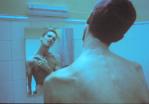
The Machinist (2004)

The face in the mirror advances like Romero's dead--but not with solipsistic cool; instead, the more the face approaches itself, the more its skeleton-stench fades in order to flesh out the necessary truth, until the self is nothing, the truth everything, and the forehead cracks the mirror.

Shadowlands (1993)

His bright and level eyes are fixed on God, but he does this without blinking, which is why they fill with blinding tears, and his gaze becomes a straining bursting mask of insistence and importuning, completely useless until he blinks and relieves the unnecessary effort, so that he can see again--if not so clearly, at least for longer stretches, and with joy.

Monday, November 07, 2005

It's a Wonderful Christmas Story

(NOTE: This is a revision of something I wrote last year for my previous website. File under "Redundancy Department of Redundancy")

In terms of decorating this blogsite with a Christmas piece, I know I'm as early as a Wal-Mart, but I want to be among the first to check in with my obvious picks for The Two Greatest Christmas Movies: It's a Wonderful Life (1946) and A Christmas Story (1983).

Let me quickly add Honorable Mentions: Miracle on 34th Street (1947), The Nightmare Before Christmas (1993) -- really more of a Halloween movie, though -- and the Chuck Jones version of How the Grinch Stole Christmas! (1966). Fine work all, but I think my two picks are the gems in the crown that shine more deeply, and tell us more about American Christmas and the thin red (and green?) line of the Season itself, than any others.

Any heft these movies possess comes from a dual source: (1) the brains of their creators--Jean Shepherd (and OK, the director, Bob Clark, who does get many things right) and Frank Capra--and (2) the faces of their protagonists--Ralphie (Peter Billingsley) and George Bailey (James Stewart).

In the Shepard/Clark movie, Christmas is bracketed and bookended by a variety of mishaps, malfeasances, and garden-variety meannesses. In fact, Christmas itself is forgotten for relatively lengthy stretches, as Flick's tongue gets glued to a flag pole -- and it hurts to watch, doesn't it? -- and Scut Farkus dishes it out (and takes it), and Randy roots among the cabbages, and a Major Award gets its fifteen minutes of fame, and lug nuts fly like sparks in the night air, while profanities bark and all of one's hard work results in a decoded "crummy commercial."

Despite these diversions, what places this movie on the list is its willingness to dip into Shepard's canon and fill out these mock-epic lives, to make us feel they deserve a perfect Christmas morning, with its granting of the wish for once --including of course an eye getting (more or less) shot out --as well as that amazing sequence that moves from innocent delight at a decapitated duck to a still and glowing and perfectly natural moment before the tree.

All of it becomes more than whimsy and farce--which good Christmas movies are wont to serve up--and more than heartstrings tugged, but an implanted memory, like all lasting family stories, retold so often the tale becomes the truth; and fiction, you need to know, is truer than fact.

Through it all, Billingsley's Hummel-figurine face, at turns beaten down by the adult world -- can anyone ever forget Santa's foot applying just the right pressure to Ralph's forehead to send him sailing down the Horrendously Happy Slide? -- and heart-breakingly confident it will all work out -- and he is right, after all -- reminds us that there is something at stake here: simply the rest of Ralphie's life, which I am convinced will take a course dependent on his foolish Christmas wish, ocular jeopardy or not.

All this, plus true hilarity, and flawless performances by Billingsley, Melinda Dillon, and that rough gem, Darren McGavin. I know you've seen this one way too many times, but I triple-dog-dare you to catch it once more between now and the Big Day, and treat yourself to a careful examination of all their faces. Not a single false note, just like a Christmas choir. As Shepard intones about the Official Red Ryder Carbine-Action Two-Hundred-Shot Range Model Air Rifle (with a compass in the stock, for some reason an ineffably beautiful detail), the movie itself becomes "the greatest Christmas gift I ever did or will receive."

As for It's a Wonderful Life, it too ignores Christmas for quite a while -- in fact, is in many ways not a Christmas movie at all. This is part of its greatness, in that Christmas is entwined in the fabric of George's story, where it becomes more than another episode, but the arena for the deciding moment in George's life. Unlike Ralphie, though, for George the moment is not the granting of a Christmas wish, but the relinquishing of a wish to be - actually, to have ever been at all. Ah, such Buddhistic bliss, to be allowed to meander off into stillness, quietude, and eventual nothingness, a cozy paradox where wakefulness is no longer required because there is no one to awaken. Like the clouds and the birds in "The Walrus and the Carpenter," one would not see George, for there would be no George to see.

Of course, George is not allowed to not be. He has lives to save, including his own. Somewhere or other, that sometimes-enlightening curmudgeon of a film critic, David Thompson, argues that It's a Wonderful Life is about the tenuousness of the American Dream, that a small sum of money can spell real ruin, and that George's violent panic, as wide-eyed and horrific as any Greek mask of tragedy, is averted only by a deus ex machina--or would that be populus ex machina, as his neighbors literally heap his salvation before him?

The moment is joyful, to be sure, but Thompson rightly points out its hysteria, with barely time to hear the bell tinkling out Clarence the angel's ascendancy. George must go on; the evidence of his necessity is too overwhelming, almost as shocking as George's earlier urge to tear it all apart.

I think, though, that this film is about something more than a close call. Like A Christmas Story, it insists that Christmas is a culminating moment, or better yet, a fitting space to work out wishes made with conviction AND in haste. For me there is something deeply attractive about the snow scenes of both movies, like Robert Frost's snowy woods--except their snow does not distract from the promises to keep, but punctuates those promises, with an exclamation point or an ellipses, and promises further promises, if you follow me. This is the faith to which these movies testify. Clarence and his twinkly eyes and all that are not where faith rests; they are cute catalysts to get George careening down Main Street, delirious, first with pain, and then joy. And as any moralist will tell you, it's always pain first.

I suppose what I love most about these two movies is their willingness to surrender to the notion that one can be both an idealist and a dope. Ralphie and George believe in what the poet G.M. Hopkins calls "the habit of perfection"; the fact that they walk into all kinds of walls because of that belief does not deter them--nor does it detract from the value of cultivating that habit in their drafty, perfect little living rooms.

The Last Man (Standing)

(SPOILER WARNING/APOLOGY: I'm sorry, but I cannot write what I want about this film without giving away the ending. I know I'm breaking The First Rule of Moviegoing, but I cannot avoid it. Feel free to Netflix this movie and watch it before reading; I'll wait. Humbly, as always.)

F.W. Murnau's The Last Laugh (1924) is one of those silent films you should watch if you (a) love movies but (b) are wary of silent ones. Let me assure you that there is a list--I should show you mine one day--of silent movies that will cure you of your not-entirely-unwarranted hesitation, and The Last Laugh is one of them.

Still, depending on your age, the silent era is two or three generations removed from your experience, so I will not be such a snob as to scold you for a perfectly natural apprehension. Let's keep in mind that plenty of avid, even serious readers have to take a deep breath before reading Shakespeare, or Chaucer, or Homer, let alone most poetry. So we'll agree that the problem exists. Now, let me try to solve it.

The director of The Last Laugh is best known for Nosferatu (1922), his "unathorized" version of Dracula. But he also directed other remarkable films, most notably a version of Faust (1926) followed by Sunrise (1927) and Tabu (1931), all noteworthy because of their collective commitment to fluid camerawork and expressive set design that work together to reflect his characters' personalities and perspectives.

Watching Murnau is a curiously "modern" experience, if only because, in a variety of classic and contemporary films, from Citizen Kane (1941) and Night of the Hunter (1955) to Scorsese's and Spielberg's restless cameras, we see Murnau's influence. Consider the sharp slanting light that cuts through the shot compositions of film noir, the subjective perspective as the camera moves smoothly through the bar scene in Mean Streets, or the swooping glance across the audience in The Age of Innocence. And let's not forget the giddy low-tech stunts that got Barry Sonnenfeld (as cinematographer for Raising Arizona) and Sam Raimi (Evil Dead) noticed, not to mention the dizzying tracking, dolly, and handheld shots that thrust us headlong onto the beach in Saving Private Ryan. One can see Murnau's hand at work everywhere a director wants to carry us with and into the action.

In The Last Laugh (German title: Der Letzte Mann, literally, "the last man"), Murnau brings his bold acrobatics to a painfully simple story. An anonymous hotel porter/doorman (played by the formidable Emil Jannings, who came to Hollywood, was made unemployable by talkies, and returned to Germany, where he became a leading figure in Hitler's film industry), whose identity derives exclusively from his position--even more specifically his uniform, with its heavy square shoulders, epaulets, and shining buttons. He lives among the working poor, but works among the gaiety of Germany's Roaring '20s. Preening, flirting, manfully hoisting luggage, he gains all his status via the irony of his job: He is the fanciest laborer in his neighborhood.

But he is getting on in years, and the hotel manager notices how he struggles with a trunk perched high upon a rain-swept taxi, and the bit of a sit-down he needs afterwards, and immediately demotes him. He is now a washroom attendant, spending his days underground, brushing dinner jackets, supplying towels, accepting small tips. He even takes his meals in the bathroom.

Ashamed, he attempts to keep his demotion a secret, stealing his confiscated uniform and donning it as he approaches home, where he climbs the stairs past the other tenants, who as usual cease beating rugs and emptying garbage pails in deference to his uniform. While his pride, his very identity, has been sullied and soiled, the uniform is spared.

Eventually, the truth emerges, and the neighbors who had given him such respect turn on him, jeering at his diminished state. He is now their equal, and the object of their scorn.

The ex-porter reels from these humiliations, casting himself down even lower than the hotel manager and his neighbors ever could. Alone, completely extinguished, he slumps in the dimness of the lavatory.

Murnau tells the story without the intertitles we often depend on in silent films--so that it is more fitting to state that he does not "tell," but truly "shows." The action occurs in a special kind of silence: All of the exposition and character development is physical, down to Jannings' remarkably expressive face.

It is a pantomime of epic proportions, set amid looming skyscrapers--at one point the hotel where he works, now an object of dread, literally bends toward him like a great, leaning monolith, threatening to crush him--and increasingly darkened streets and rooms. This alone is enough to give this movie a special place in film history.

Something else, though, occurs in its last ten minutes that struck me deeply the first time I saw it, when I was in college, and has haunted my attitude toward film ever since.

It is a turn of events that Roger Ebert finds "improbable and unsatisfying." The ex-doorman is alone in the bathroom, so still he might as well be dead, and the scene fades. Suddenly, the film's only intertitle appears, and states, "Here the story should really end, for, in real life, the forlorn old man would have little to look forward to but death. The author took pity on him and has provided a quite improbable epilogue." As Ebert tells it in his "The Great Movies" essay, "The doorman accidentally inherits a fortune, returns to the hotel in glory and treats all his friends to champagne and caviar, while his old enemies glower and gnash their teeth."

Ebert complains it is a painfully obvious tacked-on happy ending to soothe the sensibilities of the day. Perhaps; but even on its own, it is a remarkable sequence, filled with glorious excess, scenes of eating and gleeful consumerism, punctuated by not only gnashed teeth but the delighted, and I think condescending, smiles of the other hotel guests.

When I first saw this film I was stunned. But unlike Ebert I did not feel cheated by the ending; instead, it taught me a simple but fundamental lesson about film storytelling that I have never forgotten. In that moment when Murnau--better yet, as the intertitle puts it, "the author" (shades of auteur!) steps in and yanks the story out from under us, he completely undermines our trust in film narrative--a trust that is at once immediate but fleeting, because as the images roll on, we are forced to watch closely, lest we miss something. And we expect that attention to be rewarded with a recognizable narrative arc, rising and falling as all narrative has since we hunched around the fire and told our stories--and then of course drew the tale on the walls (I like to think of them as the first storyboards).

But the film punishes us for paying such close attention, for trusting "the author" so much, and reminds us of the power of storytellers to do what they please. It is unfair but, in a stinging Socratic way, instructive: The Last Laugh sets us up to thwart us. All of our intellectual and emotional investments derive from the choice we've made to be manipulated by the film; if so, we have no right to complain when the manipulation continues counter to our expectations. After seeing The Last Laugh I learned that I can trust myself as I watched movies, but need to be on guard. Dangers lurk in a great movie because it's freer than my needs; in fact, it may even have an agenda counter to those needs.

Over the years, I've found the caution that Murnau taught me to be a good thing. It has increased my pleasure when my expectations have been fulfilled, and thrilled me like a roller-coaster when thwarted. In either case, I'm reminded I'm merely one of those "little people out there in the dark"; but there's nowhere else I'd rather be.

Friday, October 28, 2005

The Gazing Game, Part 2

Once more I stop and stare. Like this:

Citizen Kane (1941)

He cannot believe what he sees: As he makes a gracious gesture of invitation to the wide world to love him--a kind of wave of the hand, almost like a magician--he is rebuffed, as though he had raised his hand to strike, not offer; and his outrage seethes and contests the verdict, certain someone has him all wrong, but there it is behind his eyes, the near-panic, while a simple but monumental thing, a child's moment, looms and burns.

Peeping Tom (1960)

You wonder what is that godawful thing you're looking at, that curving face, the whole thing like a blurry smile, concave--convex?--and leaning into you--and you realize it's you, your eyes wide, your mouth open, and without any breath left you know you should be screaming, because the sharp point has touched, and more than touched, and continues to approach.

Eyes without a Face (Les Yeux sans visage) (1960)

The car races, its headlights slicing the night like Dali's razor--or Bunuel's cloud--toward the girl in the mask, her eyes impassive as she watches the scalpel flash and the flesh fail beneath the weight of her father's desperate guilt, strong enough to fling him into the jaws of Cerberus.

Thursday, October 13, 2005

Good Luck, Last Night

Our fair town received a rare treat last night: We hosted the Midwestern premiere of George Clooney's Good Night, and Good Luck in the remarkable Orpheum Theatre. So here we are, finally exactly like New York and Los Angeles. At least as far as Clooney movies go. Galesburg is the home of Knox College, whose journalism program boasts Marilyn Webb among its faculty; one of her professors was Fred Friendly, played by Clooney in the film, and we were further honored to have it introduced by Knox's own Bob Jamieson. All in all, a regular single-entry movie festival.

The film itself has a beautiful consistency in terms of its subject matter and visual and acting styles. While Edward R. Murrow's on-air joust with Senator Joseph McCarthy is the stuff of TV journalism legend, it was played with an understatement that today seems almost morose. Good Night, and Good Luck is valuable because it reminds us of what American Cool really means. Like Miles Davis and Chet Baker, Murrow and associates perform straight-faced, level-eyed; nobody sweats, and the deadpan wisecrack becomes the only discernible measure of emotion. Watching the film, I was reminded of Apollo 13, another movie in which monumental acts of heroism are performed by semi- (and not so semi-) nerdy guys (and gals, in Clooney's movie) with horn-rimmed glasses and white shirts, people who know their jobs well and do them without drawing undue attention. These are rock-solid types who may be seething underneath, but on top give us only a square shoulder and a frank gaze. I once saw Miles Davis perform; he wandered around the stage, eventually making his way behind the drumkit, out of sight of the audience. The horn never wavered, but the performer slipped away, never missing a beat. This attitude is captured perfectly in Good Night, and Good Luck, particularly by David Strathairn. While he allows his Murrow an occasional tic of the eye or drawn corner of the mouth, mostly it all comes down to a deep concentration nothing can break. It is an attitude that seems long gone; and the film seems to imply that we are in trouble without this cool in the face of the marching morons of politics and cable news punditry.

There is so much to admire about this low-key movie; other reviewers will tell you of the beauties of its black and white--more like nuanced shades of gray--and the single exuberant touch of the vocal jazz combo whose musical numbers throughout the film punctuate key moments. What struck me last night was the movie's ability to make me long for a return to cool in the face of fire. We are always under one Blitz or another; I wish I could take mine with half of Murrow's reassuring immobility.

Wednesday, October 12, 2005

Bob Clark Shouldn't Play with Dead Things


It's instructive, I think, to note that the director of Children Shouldn't Play with Dead Things, Bob Clark, gave us A Christmas Story (1983), which is, along with It's a Wonderful Life (1946), among the greatest Christmas movies. But he has also helmed two Porky's movies, as well as Rhinestone (1984), Loose Cannons (1990) and a couple of Baby Geniuses movies. Yikes.

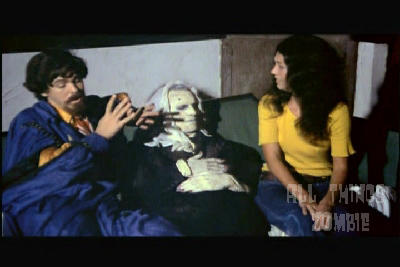
But Clark's checkered career is only the tip of this nasty little iceberg. Children Shouldn't ... may boast a great title in a genre that prides itself on titular extravagance--consider The Incredibly Strange Creatures Who Gave Up Living and Became Mixed-Up Zombies (1963)--but I'm afraid that's not enough. I'll admit I watch movies like this in part for the unintentional humor, but I have such a genuine affection for horror and SF films that, as much as I enjoy Mystery Science Theater's smug jibes, in the end they seem too easy. And I don't feel I have to lower my sights to appreciate low-budget films. Most fans agree that these movies are of the hand-made variety, so it's OK if a few seams are crooked, so to speak. And besides, to judge them by Hollywood fare marks a surrender to imposed "standards" that Hollywood itself is hard-pressed to live up to. Just ask anyone who's seen Battlefield Earth (2000). No, as many others insist, the Grade-Z genre pictures of the 1970s and before mark a true independent movement; by being cut off from big budgets, they had to rely on actual creativity and imagination.

Unfortunately, though, Children Shouldn't ..., well, doesn't. Have any creativity or much of an imagination, that is. I admit it did have just enough budget to produce Night of the Living Dead-style makeup effects (although Night's effects do look better, in large part because they're in B&W. See? Budget isn't the problem). And it had an intriguing story: An egotistical theater director (played by Alan Ormsby, who also wrote the screenplay and the one for Paul Schrader's remake of Cat People; how's that for a tangled web?) and his troupe go to a cemetary island, play with dead things, and naturally get more than they bargained for. There're just enough ideas here to get us through set-up, chills, and The Goods--that is, zombie massacre/just desserts. But I had the instructive experience of watching this last night with someone who has little patience with low-budget horror films, and her silent disapproval and impatience with it all influenced my own reaction. And I must admit she was right. Children Shouldn't ... is annoying, tedious, inappropriately hysterical, and self-indulgent. In a bad way.

Let me stress that low budgets and mediocre acting are NOT the problem. The semi-independents of the 1940s and '50s--Val Lewton, Ida Lupino--produced some real gems; and of course any number of filmmakers--George Romero, Tobe Hooper, Chris Kentis (Open Water, 2003), the Blair Witch phenomenon, to name the famous few--have done remarkable work with little time and less money. And let's not forget documentarians and animators, from Errol Morris to Mike Judge, who began their careers on the proverbial shoestring. So "quality" at the surface level is not the issue. Just look at Roger Ebert's list of Worst Movies. Most of them are Hollywood pictures with huge budgets. I agree with him that what we need to see on screen are living breathing imaginations at work.

Which is where Children Shouldn't ... falls apart for me. It didn't trust its premise enough and was too self-indulgent, spending much of its overly long (almost 90 minutes) running time hammering us with character "development" and "conflict," when all it needed to do was establish the mood, sketch out the characters, provide space for three short speeches--one for the egoist, another for the rebellious actor, a third for the submissive one--and keep hinting that things are going wrong. Then fifteen minutes of mayhem at the end. Clark only gets the last right; but by then we've been bored and frustrated by the need for his cast to chew up their particular corner of the scenery.

Maybe the real problem is timing: Right before Children Shouldn't ... I watched Val Lewton's The Seventh Victim (1943), about bored intellectuals in NYC who become Satanists. The director, Mark Robson, needed only 70 minutes to immerse us completely in a world dominated by a jaded disregard for life, where suicide hangs--literally--in the air, a constant promise and threat, and where no one wins. The movie kills three people in an almost casual manner that is both despairing and subtle, all in the service of a Poe-like concentration on its "single effect": the dreadful inevitability of death. I will at some point devote a separate posting to The Seventh Victim; I bring it up now only to remind we lovers of low-budget horror that one needs talent as well as desire, vision as well as determination. Look at poor Ed Wood. I think Tim Burton gets it right in his biopic: he portays Wood as a man completely dedicated to something for which he had no talent. The so-called "turkeys" that resulted were foregone conclusions, and although they might not deserve our scorn, I don't think they can be praised. I'm afraid I have to say the same for Bob Clark's debut film.

(NOTE: Believe it or not, someone seems to be backing a remake of Children Shouldn't ... . I look forward to being proved wrong.) ED/PUB:LM

Friday, October 07, 2005

When "International Cinema" Was "Foreign Films"

(Note: This is an essay that originally appeared on a website I used to manage. I'm trying to use this present blogsite as an archive for earlier writings.)
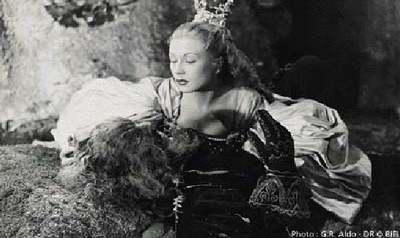
The first time I saw Fancois Truffaut's The 400 Blows (1959) was on television in the 1970s. During my high school years and the first few of college, I saw a number of films from France, Italy, Poland, and Japan that indelibly marked my halting departure from childhood and descent into what seemed at times a grinding emotional poverty, in which I cultivated disdain mingled with sentimental yearning; my friends at the time and I were of like minds--sardonic and spiritual all at once, self-righteous and -deprecating in a single breath. Amid this confusion I consumed revelatory films, all in the public space of our family room, in the rush and panic of various domestic tremors and a medley of uncertainties whose whimpers--if not whines--were drowned by Nixon's noisy mastication of the last scraps of civics class. How I clung to those foreign lessons in loss: aside from Truffaut's debut, there were Loves of a Blond (Forman/1965), La Belle et La Bete (Cocteau/1946), Knife in the Water (Polanski/1962), Rashomon (Kurosawa/1950) and La Strada (Fellini/1954). My memory of these films has been shaped by my post-adolescent mood of suppressed passion and idle threat; beyond that, I simply allowed the movies to handle all the rough stuff and heavy lifting.

It makes sense to begin with The 400 Blows, if only because, of the movies I watched, it sits closest to childhood. Truffaut's persistent alter-ego, Antoine Doinel, makes his first appearance here at age fourteen, essentially abandoned, both physically, at least to an extent, and emotionally by his parents. This abandonment, though not deliberate or even entirely conscious, allows him to enter, even propels him to, a life of careless, minor crime--but, more important, a miniature underworld in which he lives without adults, an anti-Romantic Huck Finn whose Mississippi is the vicissitudes of city life without a direction home. And while Huck had the force of the river, and of Jim's moral compass, to mark his way, Antoine flees indiscriminately, wandering through a nervous, gray, and ultimately unconcerned Paris, until he too arrives at water's edge; for him, though, it is merely the unresolved end of his journey, not its beginning and motivation.

At first I responded to Truffaut's movie with a great deal of discomfort. Doinel seemed "bad" in an unattractive way; most of the kids I'd seen in the movies were absolutely safe; they were "little rascals" who formed "our gang" and enjoyed noisy vacations from parents and school. Truffaut's boy would or could not recognize he was just fooling around; for him, his crimes and the resultant reform school became an integral part of his identity. And nothing came of it but an almost absurdist journey-quest away from nothing in particular and toward the same. A few years later, listlessly fooling around myself in graduate school, I encountered "The Wanderer," who also stood on the shingle and considered his lowly, lonely state. An image rises in my mind: Antoine Doinel on the beach, his gaze, anxious yet blank, staring at the end of his childhood and, like the Wanderer, keeping it to himself. At fourteen, his foot had slid, and the abyss into which he called did not call back. I was only a year or two older than Antoine when I watched this movie, and the word "discomfort," which I mildly placed at the top of this paragraph, belies the feeling, something almost like anger, but closer to knee-wobbling anxiety, with which I greeted this film. Surely that isn't all there is? Today, I say there's more and hope I'm right. At fifteen or so, it was tough to keep everything from falling off the shelf.

Still, the younger you are, the easier it can be to conjure hope, especially in terms of love. Now, let's be clear here: Actual love is not the issue. We all live in a secret, but the older secrets of childhood and adolescence are large and manifold, culminating, at least for me, in early adulthood, where for a brief time I held, or so I thought, a monumental open secret from others, one that the kinder, less confident of us can be trusted to keep: That we do not know how to be adults, and are simply imitating each other--and there's another irony for you--as we make our way; if we're lucky, eventually we can breathe a little easier, having cobbled together what will suffice as our identity, at least until some later shock to the system forces us into a second adolescence. God forbid; one was almost too much, yes? But before the wearying subterfuges of early adulthood come the richer secrets of love--or, to be more or less honest, its lies.
And the greatest lie we tell about love is that everyone is meant to have their portion, their "beautiful reward," as Springsteen puts it. About the time I first saw these films, I also was reading that master teller of small but devastating truths, Sherwood Anderson. I was stricken by the story of Alice Hindman, a woman who at twenty-five "began trying to force herself to face bravely the fact that many people must live and die alone." Anderson told such a convincing truth about loss that I rebelled and wished it a lie. Milos Forman in Loves of a Blond captures a little piece of that. His young Czech girl, trapped in a dull factory town, enamored of a young man from Prague, faces the truth of loneliness when she follows him to his home, arriving suddenly at the apartment he shares with his parents, who in his absence treat her to the most painful and simultaneously bitterly amusing--and protracted--cold shoulder in the history of film. Her dogged determination to be loved, and their stolid refusal--especially the mother--to provide even a crumb of false hope, sets her up for her dreary epiphany. All my life, I have entertained the hope that we do indeed deserve love, that it is one task in our job--the other, and perhaps the better, is to love, of course; but Forman's movie all too accurately portrays the world's general position on this: If one deserves anything, it's whipping. I must mention that Forman's film is not so violent in its approach. It's actually a rather quiet, matter-of-fact meanderer; nonetheless, it does arrive at a kind of humiliation, at least on the part of its viewers, in that one's assumptions about how much one is loved are tenuous at best. At nineteen or so, I was able to understand the blonde's assumptions and to feel horrified at her embarrassment of having to "face bravely the fact that many people must live and die alone," and sometimes in the presence of strangers.

Pardon the disgusting imagery, as Woody Allen says somewhere, but that plunge into love has the force of an archetype, and the rough-stroke feel of a fable. Both Cocteau's La Belle et La Bete and Polanski's Knife in the Water gave me a language for the dangers of such a force. I must admit, though, that much of Cocteau's version of the fairy tale impressed me because of its style: he used the camera aggressively to generate an air of the fabulous. The images glowed, the camera followed Beauty down those surreal corridors with insinuating familiarity. Magic occurred simply by reversing the action, allowing figures to fall with unnerving smoothness up into the midst of the story's simple but deep conflicts and resolutions. Along the way, Beauty had to drop from her hands things she loved--family, home--to pick up the Beast, to lean into his breath. The tale gives her hard choices, but I wished I had the same opportunity to bargain away everything just to be loved. I have revisited this movie only once since then, and my memory of its details is aptly limited to its famously arresting images, but what remains is a conviction that in Cocteau's world, a hungry heart can be satisfied only after one is willing to surrender and sacrifice.
One difficulty with watching these films during my post-adolescence was that they sometimes posited problems that were at least two steps ahead of me. I had too narrow a frame of reference, for instance, for Knife in the Water. How could I understand the murder of fidelity when I had not yet lived inside such fidelity? The bored and irritated wife who sides with the young stranger--whom the overbearing, bourgeois-assertive husband thought he had killed--and the young man himself, his knife always out, so to speak, his confidence both a perceived threat and a promise; these were people I did not know, except in the abstract, or by inclination. (After all, many teenagers stand every day--at least I did--on the narrow deck of a pleasure boat, ready and willing, albeit often alone.) Like La Belle et La Bete, Polanski's film lays out a stylized space in which to work out these concerns, a neverland that is Minimalist/Abstract to Cocteau's Romantic/Gothic. Just a few years later, I would watch the bad craziness, as Dr. Thompson would put it, of Polanski's Repulsion (1965), the Freudian hybrid of La Belle et La Bete and Knife in the Water, in which the anxieties of both films are pressure-cooked in Catherine Deneuve's homicidally repressed brain. I am thankful that I was almost old enough to watch this without cracking, because with the previous two films lurching around in there, my own brain seemed a little squeezed.
I was not, however, always alienated from these films. I understood with frustrating clarity the loss of truth in Kurosawa's Rashomon. I knew that the world is a haunted forest, and under those "dark, wet boughs" we do evil to one another, and once again often in full sight of witnesses. But their presence does not provoke justice; in fact, some of them turn out to be perpetrators, while the rest are so afraid, they lie--first to themselves, to make easier the lying to others. These were the political lessons of the 1970s, as well as the personal lessons of my life back then. I knew that the truth was both powerful and elusive, but I was too uncertain to make use of that power and too confused to grasp it firmly. It is fitting that the print I saw of Rashomon was faded and damaged; it matches the mood of the film and its post-adolescent viewer.

Felinni's La Strada is aptly titled here: for me it is the end of the road, the last way, where fading memories assert, not the details, but the lasting impression. The more I reflect, the more I must admit that this movie has become my cinematic acid test. If a film does not move me as La Strada did, it diminishes. I was most struck by two things in Felinni's movie: the cruelty of Anthony Quinn's Zampano, a strong man who bullies the diminutive Gelsomina, played with mime-like perfection by Giulietta Masina; and his love for her, repressed and deflected, until he loses her and is left alone, like Antoine Doinel before him so many years ago in this present foreign film autobiography, like that Anglo-Saxon Wanderer and Forman's Blonde--even, for a time, like La Bete and Polanski's foolish bourgeoisie, not to mention Rashomon's panicked truthful liars.

I have nothing new to say here: this loneliness simply breaks one's heart. Again, whenever a movie catches me by surprise and dizzies me with a sudden drop, it is the same howl of impotent rage I heard in La Strada. It is beyond Brando's "Stella!" and Welles' "I'm Charles Foster Kane!" but I feel it in those films, and some that came afterward, even if only in a long shot or short burst. Scorsese knows this moment, and has approached it many times, from Taxi Driver to The Aviator. To be honest, I think I keep insisting that Scorsese is our greatest living director because he hears clearly the sound of loss, and tries to ring its changes when he can.

Having written all this, I have come to realize that I still haven't watched The Passion of the Christ from the fear that it is a two-hour version of the last ten minutes of the films I've been discussing. I hesitate to offer any real commentary on a movie I haven't seen, but I would suggest that the sadism and gore that many have complained of, been repulsed by, jeered at, are nothing more than Gethsemane's legacy. All those lonely people staring blankly, raging, wandering off, lost in one Mirkwood or another, have asked for the cup to be taken from them--have asked, in the universal Last Temptation, to be human only, and left out of the business of God, which can seem cruel, divorced from what we want. And, of course, it often is just that, which is why in my adolescence I was drawn to those foreign films, whose images--of the water's edge, the menacing clearing in the wood, the road, the dimly lit corridor--provided "special mirrors," as Brecht says of the theater, of my own imploring posture and eventual, albeit partial, surrender to the dangerous joys of the will to love.

(9/20/2004)
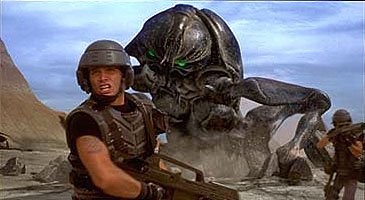
Copyright Notice

Content copyright © 2005-2011 by Paul J. Marasa. No part of the written work displayed on this site may be reproduced, linked or distributed in any form without the author's express permission. All images, video, audio and other materials used are deliberately and solely for illustrative purposes connected with each article. Each accompanying element is intended as a research and reference tool with relation to each article. No challenge to pre-existing rights is implied. Aside from The Constant Viewer, the author claims no responsibility for websites which link to or from this website.