Tuesday, December 20, 2005

20. A Sick Rose


In his Playboy interview a year or so before his death, Jackie Gleason begins a story with something like, "I was in Toots Shore's joint with Salvador Dali. He had that cane with a sword inside, and ..." I don't remember exactly what happened; it doesn't matter. But I say you can't consider yourself "cool" unless you can start a story this way. It's a measure of a celebrity, I guess, but also of the artist, who often places him/herself consciously--if not always purposefully--in a separate world, a "protected station" that allows artists to play and fight with each other in relative isolation--barring the occasional spillover into the square world, where you and I are trying to get to work but are thwarted by some Merry Prankster whose Happening keeps the trains from running on time.

Of course, such disruption can be a good thing. I remember catching John Cassavetes' Husbands (1970) on TV, and being stunned by the seeming disconcern that anyone was watching it, and the hypnotic effect of ignoring me. Cassavetes, Peter Falk and Ben Gazzara spontaneously combusted--but it was a cool blue fire, an enchanted ring. And Edward Hopper's paintings also poleaxed me, as they turned their shoulders from my eyes, forcing me to be satisfied with what they allowed me to see, their steady breath as sad as it was measured. Or Raging Bull, the last noir, as confused and lost as John Garfield in Force of Evil, keeping everybody blind except the audience, if they would only see.

Thinking about these artworks, I return to my irritation with the self-absorption necessary to be an artist. The demands of not only the artists but their artworks is intrusive; again, I'm often just trying to keep moving forward, but this stuff stops me short, and I am suspended between hypnosis and derision. After all, artists make demands on those around them, as do athletes. You better love helping out if you're going to live with either, because they're busy creating, so clean those brushes and replace those divots. This point is driven home for me in Frida (2002), as Frida Kahlo (Salma Hayek) and Diego Rivera (Alfred Molina) trade demands disguised as needs, tossing everything and everyone out with the bathwater. Again and again, I grew irritated by their insistence that the other--or, worse yet, innocent bystanders--make way for whatever Creation was brewing at the moment. I confess there's something conservative in my heart that begrudges such self-absorption. Am I wrong in asserting that the best lives are passed in service?

But Frida, like Cassavetes, Hopper, and Scorsese, cracked its elbow through the window, another burglar of my bluster and indignation. Frida was badly injured when a girl, and suffered numerous operations--and this during the first half of the twentieth century, so you know how much good they did, and how much harm. She was wracked by pain, losing strength, mobility, her baby, some toes, as the years went by. The more I saw her soldier on, drawing in bed, slow with pain, the more I realized she really wasn't asking anything of me. I had no need to feel inconvenienced by the tantrums and double-standard arrogance. It was none of my business. I just needed to look at the paintings, and allow her her pain. A lifetime of illness can begin to look like an artist's life, you know, with its constant demands on those around the sick person, its insistence that everyone see the world through Malady's eyes. When the pain becomes the artwork, I feel ashamed that I complained about the noise and smell. Because if you watch carefully and lay your hands softly but firmly, you are given a life to serve, and can draw strength from the tortured muscles straining beneath your grip.

Monday, December 19, 2005

19. Miracle on Market Street


No one sends customers to Gimbel's anymore--because there is no more Gimbel's. The 1947 version of Miracle on 34th Street always reminds me of this; I can remember Gimbel's in Philadelphia--and later, in the malls of South Jersey. When I was a kid the economy of the Delaware Valley could support a startling number of department stores (all gone now, of course; for a quick eulogy for Philadelphia's past retail glory, go here): not just the King, John Wanamaker--with its giant eagle, the standard Center City meeting-place--but also Strawbridge and Clothier, Lit Brothers (with its impossible wrought iron facade on Market Street), Bamberger's (Macy's South, more or less) and of course Gimbel's. These were big fellows, filled with not just clothes but furniture and pharmaceuticals, fine china and pets--I can remember going up the escalator in Wanamaker's and hearing the distant "cheep" of canaries and Australian finches, and smelling the cedar chips for the hamsters. My mother was a bargain hound, always able to find that magic number: 75% off! We maneuvered through those stores like special forces on a search-and-purchase mission.


We'd troll Market Street, passing street-corner Santas, peeking at the department store versions--perched amid the greenery and dazzle of the toy floors--yes, entire floors of toys, with a monorail, I kid you not--circling one of them (Lit Brothers?). My confusion over all these Kringles became a Family Story, how I asked my Mom which one was the real Santa Claus, and she answered, "They're his helpers," allowing her forever after to affirm that she told the truth, that they did keep Christmas moving along--and also providing me with a pretty impressive image of elves, big strapping fellows dressed like the Big Man among us, but back in their toy-making togs at the Pole. Everybody was happy, not the least of which the proprietors of all those city-within-a-city establishments.


I was particularly fond of Wanamaker's. Aside from the pets and toy floor, it also boasted a dual-level book store--the lower level was for paperbacks, in the '60s adding some posters. I remember it was adjacent to the beauty parlor, so for me paperback SF books always bring with them the whiff of hair sizzling under dryers. I still have most of those Ace Specials, Dells, and Bantams, as well as a number of other bargain finds: two massive coffee table books, one on Edward Hopper and the other a complete collection of the newspaper strip, Buck Rogers in the 25th Century ("with an introduction by Ray Bradbury"), as well as a number of film-related books, including paperback scripts of Monkey Business, Greed and A Clockwork Orange; I shopped there all the way through college. I've been currently re-reading another Wanamaker find, David Curtis' Experimental Cinema: A Fifty-Year Evolution, published in 1971. I got it on sale--the price sticker is still on it--fifty-nine cents!--so I must've bought it a few years later, maybe when I was a senior in high school or starting college. Old friends, together forever.

So I have a special fondness for Miracle on 34th Street, with its comforting black and white glimpses of the Lost World of my childhood. But more than that, I get suckered in every year by Edmund Gwenn's and Natalie Wood's performances. When Gwenn lifts the little war orphan to his lap and speaks Dutch with her, ending with a song--about himself, of course, soft and yet affirmative, I fall apart. That right jolly old elf knew what he was doing; jeez, he even kept me from panicking during Them! (1954), calmly laying out the giant-ant apocalypse scenario, and how best to avoid it. A man of many talents, all of them directed toward the innocent--there's a little traumatized girl in Them! who, for my purposes, looks a bit like Natalie Wood.

And of course there's Wood's little jaw-jutting, scowling, puzzled, finally--I think with some relief on her part--widely smiling face, as the reasonable world slips away and Christmas asks her, and her startled mother--ah, Maureen O'Hara; somebody give that casting director a raise--to say Yes, like reformed Blue Meanies, and accept a fond dream. While It's a Wonderful Life and A Christmas Story achieve perfection, there is more than enough room at the table for Miracle on 34th Street. Just ask Thelma Ritter, whose befuddled shopper is slow to follow Kris' lead, but agrees to play along, if only because it means her kid's happy.

Sunday, December 18, 2005

Island Style


After The Polar Express, I saw another supersized film, The Island, in which rich people and guys with British accents screw up everything, then let nothing stand in their way to remain in a position to continue screwing up everything. Yes, I know: It's called Capitalism; but I'm not sure how much we can learn about its perils from Michael (Bad Boys/Pearl Harbor/Armageddon/The Rock) Bay. I didn't know much about this movie beforehand, except that it was a big-budget SF affair with A Secret. So I thought it might be fun, and avoided trailers and articles and TV Guide Channel featurettes and so on. I wanted to be surprised.

Be careful what you wish for. While the idea of clones for spare parts has been done a few times--many times in print SF, and occasionally on film, as with the whiz-bang of The Sixth Day (2000)--which proved that two Arnolds equals two times the Arnold acting power, which is more than one time the acting power, but less than three times. Ahem; where was I? Oh yeah: clones as spare parts. The idea has real potential for drama and dread, if only because I'll betcha a nickel it'll happen by mid-century. If it can be done it will be done, and all that. Unfortunately, The Island only proves that such an idea will have glitches, goofs n gaffes--but no moral nausea will be suffered, just a kind of one-upsmanship as the clones supplant the originals, as ready to live it up on yachts and dispatch their enemies as the evil accented millionaires who made them. This is a Bay movie all the way (once again validating the auteur theory), in that it substitutes the survival imperative for the moral one. Of course Ewan McGregor and Scarlett Johansson shouldn't be killed. But dozens of innocent bystanders are, to insure that My Pretty Clonies live to flash brighter-than-white smiles another day.

The above seems a bit snippy, but the longer this long movie ran, the less I sided with the clones. Not that the quasi-cannibalistic capitalists were any better. It's just that nobody paused to mull over anything; they simply zipped around in impossibly engineered sports cars until the original capitalists were impaled and the new ones ensconced on the sundrenched deck of a yacht. Somewhere along the way the Theme of Freedom glances along the surface of the movie, like a fleeting finger on one's cheek. But it is freedom without anything worthwhile to do with it, and no earned victories. Just fortunate explosions.

By the way ...

1. I am, for better or worse, stuck with a ghost image of Leonardo DiCaprio whenever I think of this movie. That's right, because Leo starred in The Beach (2000). Mongo like movies.

2. Here's a picture of Michael Bay. Just thought you should know.

17. Hearing Bells


The digitally captured Conductor (Tom Hanks) of The Polar Express tells the digitally captured Boy (Tom Hanks), "The thing about trains, it doesn't matter where they're going. What matters is deciding to get on." I agree; it was with some hesitation that I decided to board Robert Zemekis' IMAX'd to the max reinvention of Chris Van Allsburg's 1985 book, which I fondly remember reading to my children. If one were prone to the snide, one could see it as a deeply yuppified book, pretty and buttery and smooth, self-assured in its graphics, almost deadpan in its affirmation of the virtues of sharing, memory, and faith. But that's all right. It is a pretty book, with some redemptive, evocative moments--my children sharply remember the wolves, and I vividly recall the roar that went up from the assembled elves when Santa arrived. It is a relatively effective dream-story, in the vein of Maurice Sendak's Outside Over There, but not as eerie. And it does quietly affirm its virtues without guile, like a Chronicle of Narnia.


But the movie is a goggle-eyed thrill, quiet as dts 6.1, dreamy as The Transporter. Now, I've gotten extra good at separating movies from their sources, so I won't mourn the loss of the unassuming solemnity of the book. The movie has enough problems on its own, not the least of which is the strange fluidity of its digitization. Digital cartoons always seem to be shot underwater. Everything floats, as Pennywise the Clown says in It--and the result is almost as creepy as Stephen King's book, at least to my eyes. The faces seem to come at you, slowly, hovering a bit. Sometimes this works, as when the children gaze at the world unfolding before them in the train or at the North Pole. But otherwise it's distracting, unless you need some zip and slide; then the digital format sweeps you up like leaves in a gale.


The movie works, though, only when it slows down--or holds back, as in some of the North Pole scenes, when the children explore the innards of the world's biggest toyshop. As I've mentioned earlier, those Christmas oldies floating on the soundtrack during this sequence are my favorite thing about the movie. They evoke the sense of quiet you get even in the smallest snowbound back yard, or in the dust-suspended calm of the best week of the year, between Christmas Day and New Year's Eve, as you loll around in a house devoid of the panic and rush of getting there--unlike Zemekis' Express, which slams around like a last-minute shopper clawing for that one remaining Xbox 360, even though he knows it'll be obsolete by summer. Feh. You can have it; if you need me, I'll be outside, over there.

Saturday, December 17, 2005

This Pressure Got to Stop


I recall seeing pieces of The Seven Year Itch here and there over the years, and the weirdest thing about it for me was the image of Tom Ewell, a really old guy, hound-dogging Marilyn Monroe, his eyes bulging, his voice wheezy, his whole posture full of creaks and groans. I didn't get it. I know Hollywood movies demand with a Prom Queen's insistence that you enter the moment, paste a grin on your mug, and dance, dammit, everyone's looking. But I wasn't able to get myself onto the floor; this was one date I couldn't buy.

After a while I just gave up trying to watch it. This was difficult, because, like so many others, I find it a chore to keep my eyes off Marilyn. She will always be the duskiest, dewiest grape on the vine, a not-so-secret indulgence, one for the road. Pick your metaphor, I don't care; despite my happy life and settled path, I allow Marilyn to be a movie I still like to watch. And I didn't want crummy old Tom Ewell horning in, his pointy little nose twitching like a dumb bunny darting across the road.

Naturally, it is mea culpa once more. I was simply too young to get it, even when I was forty--Ewell's character, Richard Sherman, is supposed to be thirty-nine when Marilyn steps into his apartment and his shivery dreamlife. But come on, he looks fifty at least; like Walter Brennan or Michael Jeter, God rest him, Ewell has always been old. So I half-unconsciously waited until I was approaching geezerdom myself before I'd watch Itch.

It was worth the wait. At forty-nine the whole setup makes dismayingly obvious sense, from Sherman's self-delusion to the unnamed Girl's oblivious attitude toward her own flabbergasting power. I understood why he would stare, knowing better, and why she would let him, not knowing any better. You reach a kind of invisibility at a certain age. No one wants to know you're still under lots of pressure; they just flounce on by and leave the terminal swooning to you.

I wondered briefly if The Girl knew she was va-va-va-vooming Sherman into gaga-land. (Given the pastel world of martinis and hi-fis of this 1955 movie, I think I'm using the right kind of language here.) Marilyn, though, plays her, not as clueless, but guileless. She's happy to see you, and hot--literally; the movie's set during a sticky-steamy NYC summer. She loves a tall cold drink and air conditioning, but the rest of it--Sherman's hectic parody of suave, the double-backflip-entendres of every other line, even her own precision engineering--is incidental to her desire for a nice talk and a cigarette.

So while Tom Ewell, at last in my eyes behaving perfectly normally, wrestles with the billowing sails of the Good Ship Marilyn, avoiding the rocks at the last moment--actually never in danger, as far as Marilyn is concerned; she's too busy smiling wide-eyed at every bit of fun available--I came to terms with my own jittery fits and starts, happy (as much as possible) that The Seven Year Itch, while not Billy Wilder's crowning moment, did serve up a passable slice of life, as loaded with as much whipped cream and guilt as my plate could bear.

Friday, December 16, 2005

Godot Arrives


I watched James Fotopoulos' Back Against the Wall (2002), then went online and read comparisons between his work and that of the two Davids of sexual anxiety and body dread, Cronenberg and Lynch. It is a more or less apt comparison, especially as I consider the nervous stasis of Eraserhead, the intermittent teeth-gnashing of Videodrome, the grainy peek at the truly, deeply gnarly in The Elephant Man and The Brood, and the sudden screeching hysterics of Rabid (or They Came from Within) and Twin Peaks--except Fotopolous, at least for now, seems dedicated to minimalism. I write "seems" because, according to what I've been reading of his work, each film has become increasingly expansive, in terms of camera movment, scene shifts, character development, and subject matter. I am tempted to think he just needs more money--and is getting it, little by little; and the films he makes show it--but I suspect budgetary restraints are not the only ones he suffers under.

At the core of Back Against the Wall is a frustrating dogmatism--or maybe it's just me who was frustrated, waiting for something to fulfill the Harold Pinteresque mood of menace, some last straw to thumb its nose at its Samuel Beckett stubbornness and finally break those backs against the wall, including the "lingerie model" and her dyspeptic first boyfriend (J. Hoberman in The Village Voice calls him "a grim slab of middle-aged beef jerky"; now that's writing); followed by his girlie-club-owning replacement, a kind of low-rent Paul Giamatti; and in his turn replaced by the first boyfriend's neckless buddy (when I saw him I thought of Sydney Lassick, Cheswick from One Flew Over the Cuckoo's Nest, except without a personality, and not as good-looking). Well, there were some payoffs to all the interminable, flatly geometric scenes (in his description Hoberman evokes Edward Hopper; close, but Fotopoulos ignores the sadly unrealized potential for life in Hopper's compositions), the sudden bursts of sound and light, and the occasional beating. But despite the blood and sickness, the methodically repetitive cursing, and general atmosphere of slow boil, I found myself impatient and empty.

OK, I got it: That may be the point. And I'm glad to write about a movie like this, because as I keep going the thing comes to life, sort of, and rises like a remembered dream. I had watched The Polar Express the night before, where, as in 3-D movies like Creature from the Black Lagoon, you can spot those IMAX "experiences" comin' right atcha. It was often exciting, but nothing about it remains like the burned-in images of Back Against the Wall. I'll write about The Polar Express elsewhere, but for now I'll note that its best feature is the use of Christmas oldies at the North Pole. Everywhere you go, Perry Como and Company waft in the background, a kitschy-poignant reminder that some things want to last, no matter how much life tells them otherwise. I thought of that while watching Fotopoulos' movie, because I think he too hears distant music, only his is made of dirges that root his characters in stiff clay. I think I forgive him for making me fidget; entropy can do that to you.

Wednesday, December 14, 2005

Ten Reasons to Watch a Jean Rollin Movie

Every once in a long while I turn my weary head toward Jean Rollin, the Ed Wood of France--turnabout is fair play--for a number of pubescent, tumescent, prurient, prodigal reasons (for the sake of the title of this piece, ten of them):

1. He has the French knack for extended shots of nothing in particular. If someone is going to drive up to a house, get out of the car, make it to the door, fish around for keys, and go in, it's happenin' in real time, bebe, in a flat, stationary medium shot that tells us only that someone has driven up to a house, gotten out of the car, and so on.

2. He will employ the exact same static real-time approach to girls standing around naked.

3. Sometimes vampire girls.

4. OK, lesbian vampire girls.

5. He does the above without much visual imagination, and yet he fancies himself a surrealist. This paradoxically makes for some truly surreal sequences, since they're so matter-of-fact and mondo weirdo at the same time.

6. The English titles of his films often verge on the astounding (and are often simply translations of their equally desperate-living French titles): Once upon a Virgin (1975), Requiem for a Vampire (1971), The Shiver of the Vampires (1970), The Grapes of Death (1978)--or, more precisely, in terms of the French title, The Raisins of Death--The Living Dead Girl (1982), or--and this is the one I most recently saw--Night of the Hunted (1980), which the Internet Movie Database parenthetically informs us is the "informal literal English title." C'est vrai!--that is, I kid you not. Notice how, as in pornographic movies (and, quel surpris, given some titles, he does seem to have made some (softcore?) porn films), his titles slink around the feet of their betters. But with Rollin, it almost seems an afterthought. It is as if he honestly figures that both Wrath and Death have grapes.

7. Watching his movies explains Anne Rice better than any LARPer ever could. Rollin's movies may have much to answer for, but they also answer much.

8. Back to the nudity. His women are simply there, like clouds or buildings. This allows for close scrutiny of the non-enhanced version of the pinup model, gone forever--except for the internet, but you're on your own with that line of research. You watch your keywords, you naughty naughty thing.

9. Like Wood, he manages plots that are often both perfunctory and delirious. Case in point:

Night of the Hunted begins almost like Les yeux sans visage, Georges Franju's 1959 surrealist-indebted surgical horror film: the road at night, headlights, sudden plunges in medias res. But instead of a disorienting mood of dread, as soon as he can Rollin gives us the bijou of a naked woman. She is rescued by a man who takes her home and has sex with her--and along the way treats her a bit roughly; he seems angry she's an amnesiac, despite her nudity and pliable personality--but this is the French way, again and again in their films--and he manages to fall in love with her. But her amnesia gets in the way; even her time with him slips from her mind as she sits in his apartment. While the man is at work she is taken away to a huge "Tower"--a kind of industrial park of highrises; as someone points out, you can see L'Arc de Triomphe from the upper stories. Anyway, the Tower is filled with people in the woman's condition: catatonic, short-term-memory-stripped, eventually-winding-down automatons. There's more sex, some murders, and an eventual explanation: A nuclear power plant malfunction had zapped passers-by, who have been spirited away to the Tower, there to allow the debilitating effects of being zapped to run its course until they're considered "dead," at which point they're redundantly killed. The man seeks out the woman, and in the course of their attempted escape he is shot in the head, a grazing wound, one that puts him in the same zombie-like state as his girlfriend. In a long--and I mean LONG--closing shot, they wander away from the camera, hand in hand, shuffling and stumbling toward death, like Milton's Adam and Eve, but not really. Finis.

This synopsis actually does the film justice, and Rollin adds some interesting touches: the denizens of the Tower invent memories, as well as relationships with each other; there's some internal debate among the Tower's administrators as to whether they should be in the covert euthanasia business; and did I mention the nudity? But the overall impression is of an aimless hand fumbling at clay it never commits to shaping.

10. The distance between one viewing and the next of a Rollin picture is great enough that I convince myself he's worth one more shot. I'll admit that those long, silent takes can be kind of fascinating, and that his world is just disjointed enough to create enough low-level anxiety to disjoint the patient viewer. But I think what really makes me return to Rollin is that I keep mistakenly crediting him as the director of Vampyros Lesbos (1971), a truly unhinged extravaganza of eurotrashploitation, actually helmed by Jesus Franco of Spain. If only I'd keep these guys straight, I could waste my time more productively.

Ein Berliner


I wanted to title this, "Bruno Ganz Is Hitler!" but no one (I give a tinker's damn for) would want that said about him, even if he did play Hitler in 2004's Der Untergang (Downfall)--and with documentary precision, in a completely invisible "performance" that looked more like the "trite facts" of history than a movie. But the facts are only the beginning. In his book, Re-Thinking History, Keith Jenkins makes the epistemological assertion that "through hindsight, we in a way know more about the past than the people who lived in it." Shine on, you crazy historiographer. Downfall seems to run with Jenkins' statement, smoothly, surely, confidently, leaving me exhausted after hauling Hitler's final days in the bunker across the blasted heath of the second half of the twentieth century--blasted, I hope we know, more by Der Feuher than anything else (before the globalized market, of course; but that's for another blog)--and laying them at my feet, clear and cold.

OK, so maybe Bruno Ganz is Hitler. At the least, he draws your eye inextricably--although one should note that Hitler has that ability; he was, of course, the programming bedrock of the young History Channel, before it discovered sex. Still, Ganz is impossible to ignore. I recall Christopher Walken discussing Danny DeVito when they worked together on Batman Returns (1992). He was commenting on DeVito's portrayal of the Penguin, and how silly it all could've been, but that the real strength of an actor is in the eyes; and, according to Walken--and I think he's right--DeVito had the Penguin's eyes. No Danny left, just that snapping, slobbering ball of damp rage. Ganz does Hitler like this, all the way to the eyes, which makes sense: Hitler and the Penguin have a lot in common, especially the sense of abandonment and isolation, and, as hammered into our skulls again and again in Downfall, the will to be cruel.

Speaking of cruelty, it's interesting that Downfall runs more than half its length before Hitler says anything about Jews. And when he does, it is with the calm satisfaction that he did one thing right: He cleaned Germany's house. One less thing, as Forrest Gump might say. And the more we watch, the more we see Hitler tallying the six million-plus score, adding it all up--then watching it slip away. As he does so, he goes perfectly insane, cursing everyone, except the women and children. These he takes with him to Valhalla.

Except Traudl Junge, Hitler's secretary, who died in 2002 and frames the film. She gets the last word: "All these horrors ... these six million Jews ... who perished ... shocked me deeply. But I hadn't made the connection with my past. I assured myself with the thought of not being personally guilty. And that I didn't know anything about the enormous scale of it. But one day I walked by a memorial plate of Sophie Scholl in the Franz-Joseph-Strasse. I saw that she was about my age and she was executed in the same year I came to Hitler. And at that moment I actually realized that a young age isn't an excuse. And that it might have been possible to get to know things." The English phrasing of that last sentence is fitting. Junge proves Jenkins' argument via autobiography and hindsight: she not only lived through it, but lived long enough to finally get to know it.

I've read that the film has been criticized for "humanizing" Hitler. According to an April, 2005 posting on Studio Briefing, "Efraim Zuroff ... of the Simon Wiesenthal Center, said he had no plans to see it. 'I normally prefer that censorship not be employed in issues like this,' Zuroff said. 'I would hope people will vote with their feet and prefer not to see the movie.' This makes sense; Hitler's blood-smear has darkly marked the Jewish lintel, inviting not Passover but one plague after another. You'd think the last thing we need is to see Hitler agonistes.

But I return to the Penguin. Bruno Ganz "humanizes" Hitler in the sense that he allows us to see the arch-nemesis all the way down to the eyes. Let me admit that as a pure performance it's remarkable. Ganz could have been playing any last-days dictator and he would have been irresistible. But we cannot ignore that he is portraying Hitler, assertively, with a bunker witness present. Given that, I still believe one has to look into those eyes, that a filmed performance can allow us to "get to know things," not the least of which is the mess Hitler made on history's floor, one we're still cleaning up after.

Tuesday, December 13, 2005

If It's a Good Picture, It's a Marvel

Mark Frost was a screenwriter for Fantastic Four (2005). He also wrote for Twin Peaks, not to mention the screenplay for The Believers (1987), the Martin Sheen movie that introduced santeria--well, at least the voodoo-ey version--to American pop culture. Before then, he worked on Hill Street Blues and The Six Million Dollar Man. Taken together, it all makes sense, especially the clear connection between his most recent turn of the big Marvel wheel and the Lee Majors show.

And that connection is the too-frequent awkward/dull touches. I'll admit Fantastic Four sometimes echoes the old comic book. In terms of the characters, there's Ben Grimm's anguish and Johnny Storm's showboating--especially his refreshingly honest recognition that to have superpowers is to be a celebrity; no Batmanesque brooding for this firebrand (sorry). And they have that big-budget high-tech lair--practically open to the public; these are superheroes without secret identities. But again and again the movie seems lazy in its writing, painting by the four-color numbers of the sloughed-off bad years of comic books, when no one was paying attention to them, so no one making them worked very hard.

That seems to be the problem here; but it's understandable that everyone's getting tired, including the viewer: Just type in the keywords "Marvel Comics" on the Internet Movie Database and, between the TV series, cartoons, video games, and movies, you'll get an even 110 titles, from a Captain America serial in 1944 to more than a dozen titles upcoming in 2006-07. 'Nuff said yet, Stan?


To be honest, I grew up a DC comics kid--I know, uncool squares from Smallville, DC fell prey to a cultural shift that glommed onto the edge and angst of Marvel's perennially insecure and uncertain quasi-heroes. But this is unfair. Let's not forget Batman in the '40s toting that gun, orphaned by crime, a bona fide noir code hero. And isn't Puny Peter Parker, photojournalist, simply a not-so-subtle goof on Clark Kent? So maybe I had deep-seated prejudices against Marvel; however, these were substantially altered when I was in high school and college in the '70s, when the comic book renaissance, for better or worse, re-transformed the comic book until everybody looked like Marvel. Between "events" like special (high-priced) issues of Spider-Man and the Neal Adams-ization of DC, I found myself in a world which marginally mirrored my own adolescent tremors via a completely cozy medium, the comic book. Existentialism lite had arrived.

But after a generation and a half of such tortured shenanigans, it seems the Mighty Marvel Marching Society might forfeit its charter, if Fantastic Four is any indicator. We'll see; it's just that as time goes by I may not want to make any real commitment to the comic book movie--aside from that which comes from having a twelve-year-old son, who knows better than I can remember the value of these movies, and whose enthusiasm--or at least tolerance--for them might allow me to sit still for clobberin' time once more.

Sunday, December 11, 2005

I Spy with My Little Eye ...


Starship Troopers (1997) is a movie I keep revisiting. It has all along its surface a shine that I cannot resist; I want to run my hand along it, like the swoop of a 1950s car bumper. The movie has a lithe, garish glee that provides the viewer with ample opportunity to indulge in special effects that are alternately nubile and berserk.

Paul Verhoeven and his screenwriter, Ed Neumeier, who together gave us 1987's Robocop, pulled off a famous sly one here. Starship Troopers was greeted with mixed responses--prompting Neumeier in 2003 to write a letter to the Hollywood Investigator, which had drawn parallels between Starship Troopers and "post-9/11 war hysteria." Neumeier congratulated the writer who, as Neumeier put it, "clearly understood what we were up to"; he also admitted, though, that "we may have suffered when Starship Troopers was initially released because we were not willing to underline for the audience and critics that this was, in fact, a movie about the dangers of fascism." The impression he leaves is that he and Verhoeven thought the satire would be obvious--but this is disingenuous, albeit in a good way, because Starship Troopers moves just like their earlier venture, Robocop. That movie, too, plays it both ways: as a comfortably zero-brain-required ultraviolent action flick and a savage satire of post-1960s cop movies.

Is this fair? Are the filmmakers scolding our desire for the clear lines of--well, if not outright fascism, at least an orderly, healthy, brightly lit world--with one hand, while scooping up the green with the other? Well, yes and yes. I am attracted to Starship Troopers because of that double-duty manipulation. I'm glad to watch a movie nimble enough to amuse and dismay, excite and repulse. Starship Troopers keeps us on our toes, and reminds me once again we have to be very careful when we watch a movie.

I love the term camera obscura, the "dark room" with a tiny hole in one wall that projects the outside world upside-down on the opposite wall. This goes all the way back to fifth century B.C.E. China, but Aristotle, Islamic scholars, Da Vinci, and finally Johannes Kepler, who gave us the term camera obscura, all fooled around with this optical dynamite. And considering that the device has often been used for safely viewing solar eclipses, I cannot ignore that the layers of metaphor here are satisfying.

Starship Troopers fits nicely into these layers, a trick of light that shows us objects clearly but inverted. Our job is to keep watching, but also do the hard work of craning our necks to see how the mirrors re-vert the image so that we can watch in misleading comfort. I have a cousin who, when he was a kid and wanted to stay up late to watch a movie, would sit in a cramped position so that he wouldn't fall asleep. There is a lesson here, especially if you're up past your bedtime to watch something as satisfyingly duplicitous as Starship Troopers.

(Below: a stereoscopic slide of a camera obscura in Philadelphia's Fairmont Park, circa 1870.)

Saturday, December 10, 2005

"Where Did Hamlet Stab Polonius?"


"Behind the arras"; I never get tired of that joke, telling it for the umpteenth time today in the Introduction to Drama course I teach at our local correctional facility. If a classroom of students is a captive audience, my work at the prison is blackboard heaven.

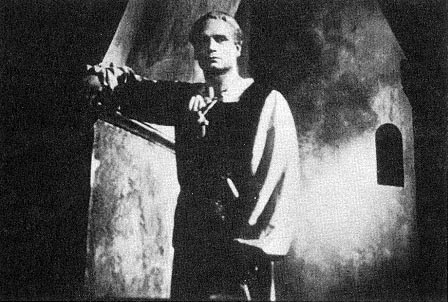
Determined to remind them that plays are primarily performance experiences, we watched Hamlet on video: Lawrence Olivier's version--by default; we may have high drama of all kinds at the prison, but none of it is on DVD, and the other movie versions weren't readily available to us on VHS, including Kenneth Branagh's 1996 behemoth, or Michael Almereyda's almost-SF version with Ethan Hawke, not to mention Franco Zeffirelli's take with Mel Gibson--"Lethal Hamlet," more or less. Olivier. I shrugged, even sighed. I was "teaching" Hamlet, fer petessake, not "enjoying" it; what were we supposed to do with Olivier's Freudian pretzel-knot? Aside from the usual eye-rolling because it's B&W, my students also had to deal with Olivier's rapid-fire delivery, not to mention the textual leaps and bounds and global elisions, in effect telling the Bard where he so often got it wrong. I asked my students to follow the film with their texts in front of them; the riffling reached hurricano proportions.

So as pedagogy it's in many ways a bust--but of course as a lesson in career-making acting, as well as a visual experience, it remains a constant pleasure. The visual style was particularly interesting for those of my students who had taken Introduction to Film Art (nice title) with me. We forgot for a while that we were in a drama class, and discussed how this was a noir Hamlet, with its rich chiaruscuro--many of them remember nothing at all from their time with me but that one word--and mood of inevitable doom. And we talked about how the story itself is a noir, albeit Val Lewton style, what with the ghost and weird locale). Hamlet, like so many noir heroes, is linked intimately to a crime, and becomes the sleuth, devising plots and traps, but still destined to see it all tighten like a noose until he's In a Lonely Place and there's No Way Out, the Force of Evil sneaking up on him Out of the Past; and, caught in the Crossfire, everyone faces the Big Sleep.

Of course, I'm drawing the noir cart before the Shakespearean horse; given the sickly descent, slow but vertiginous, of Hamlet--not to mention the madness and compulsions and degenerate scheming of Macbeth, King Lear, and Titus Andronicus, to name a few--it seems Olivier directed Hamlet at exactly the right time--1948--to give credit where credit is due: as usual, at Shakespeare's feet. He knew, as thoroughly as Sophocles, the queasy thrill of discovery, chase, and best intentions, all leading to revelation and those dreams that come at the untidy end of all effort. Olivier clamps his mitts on this with a vengeance--ha, ha--and delivers a moody, smoky, dim wonder, as much about the growing uncertainty of the post-World-War-II generation as Shakespeare's fear of the State literally losing its head, as it was wont to do. The result is typically modern, as Shakespeare can so easily be, if only because he reminds us that everything gets to be modern sooner or later, including the moody college kid from Denmark with too much time on his hands and a grudge to nurse and eventually fester.

Friday, December 09, 2005

The Gazing Game, Part 4

"The eyes of those who see will not be dim ..."

L'Age d'or (1930) The parted lovers cannot take their eyes from each other--so everyone else does, until all things conspire against them; and the man, enraged, buffeted by the clods of tradition, stares wide-eyed at even the innocents and violently tears the whole thing down, kicking and screaming like a terrible infant, a genius of irrational, intuitive convulsions and curses.

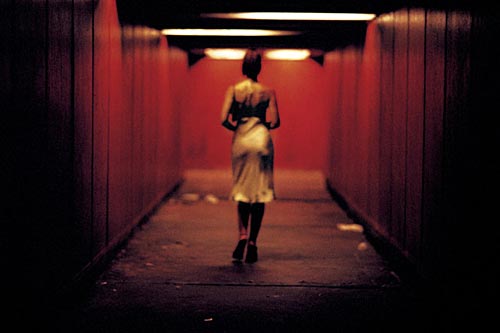
Irreversible (2002) Never ask can I have a look, just a peek, I want to see, because you cannot undo your gaze, no matter how much your thumbs rub at the charcoal smudges your eyes have become, blinking through tears that run up and into your eyes until they're dry and clear and the terrible sight recedes to the future, leaving a tunneling thud that echoes like your forehead on wet concrete.

Quicksand (1950) There is something froglike in his eyes, but radiant, despite his two-bit arcade patter and decades-long anxiety over the purchase price he's certain he can set on every woman he's met, coupled with his lidded appraisal of the kid in trouble--two-for-one, he figures, the girl and the kid, buy one and sell out the other; this settles him more squarely on his haunches, and he spreads his mouth in a small indulgent smile.

Thursday, December 08, 2005

The End of Horror


I know how often I watch horror movies: too often. And I know how much I like them: too much. I had a conversation with a friend recently; he said he thinks horror films are immoral. Of course, I didn't pursue his comment, because I was too busy correcting it. I referred to Stephen King, who writes somewhere or other--in Danse Macabre?--that horror is actually the most moral type of fiction. As I remember it, his argument is that in horror the reader/viewer/listener is asked to consider individuals in peril, thus triggering sympathy and anxiety. The fact that you yell at the screen and tell those morons not to go into the cabin--or out into the woods, depending--proves that you have a sense of right and wrong. Even your disgust at how dumb the victims are is a sign of your moral sense at work: You get angry at them, not just because they're stupid--that's just you casting stones--but because you know deep down you'd do the same, and share in their doom. It's a slapdash approach to the evocation of fear and pity, but still pretty potent.

But how often is too often? How much is too much? There's a song by the Cramps--the original horrorbilly punks--called "How Far Can Too Far Go?" If you know Lux Interior, Poison Ivy and company at all, you know their answer: never far enough. The Cramps' catalogue is a What's What of exploitation trash culture, a fun-lovin heinous hootenanny that's the musical equivalent of an Elvis movie produced by William Castle and directed by Doris Wishman. (If you're lost, go to the Internet Movie Database. I can't do everything for you.) I must admit I'm a big fan, mostly because I can see the grin beneath the grimace. The Cramps generate all the moral dread of a Booster Club Halloween Haunted House, despite their misogynistic excess and Ride with the Devil glee.

Real evil, on the other hand, is not nearly as entertaining. You know it well: It plods along beside you, rolling that snowball that gets bigger every inch, the cold work of isolation, egoism, fear, and pride. Death isn't evil; it's just the messenger of your fears. And evil isn't monumental--although give someone enough toothpicks and she'll build you the Great Pyramid. I'm afraid, not because I have anything to fear, but because I don't know enough not to be afraid. So evil in movies is often like a Cramps song: a whisper of the scream, shadows playing along an expressionist corridor. I can deal with that.

But I sometimes get tired of horror movies. I watched I Drink Your Blood (1970), and glanced at some of the DVD extras. There was poor old David E. Durston, the director, still wearily muttering "Roll 'em" like Sisyphus with his rock. And his misery loved company: He trotted out three of the movie's stars, their faces polite, their balding heads--or assertively dyed coifs--like dimming torches, as they sat awkwardly on patio furniture to be mercilessly videotaped. There was some good will, but mostly it all seemed more horrifying than the movie, rabid hippies and all. The movie itself wasn't all that bad, in a Mystery Science Theater kind of way, but as I went from one scene to another, one DVD "special feature" to the next, I began to realize something I'm sure at least some of my friends and Humble Readers must be all too well aware of: One can waste too much time with this junk. The more I watch, the more I feel the weight of that rock.

Like Sisyphus, though, I still go at it. In his famous essay on the myth, Albert Camus writes that he is not interested in what Sisyphus is thinking as he pushes the rock up the hill, but in the moment when he once more confronts the rock:

"It is during that return, that pause, that Sisyphus interests me. A face that toils so close to stones is already stone itself! I see that man going back down with a heavy yet measured step toward the torment of which he will never know the end. That hour like a breathing-space which returns as surely as his suffering, that is the hour of consciousness. At each of those moments when he leaves the heights and gradually sinks toward the lairs of the gods, he is superior to his fate. He is stronger than his rock."

I have to confess, sometimes I feel like this when I watch a bad horror movie, which in part is why I watch them: because the feeling is expended on an inconsequentiality, a stupid movie. It is a vacation from the real rock, the need for real strength. I have always been torn between faith and absurdity. I hold them in my hands, like roses and snakes, and sometimes I cannot tell if I'm feeling thorns or fangs. But I always try at the end of the day to live in love, if not with meaning--unless love is enough. I think I am wrestling it into a moral perspective--or wrestling in a moral universe, I sometimes can't tell. But I find Camus' essay irresistible, as I do the Beatitudes, because they both are born from sorrow, pity, and the need for strength. And when I watch yet another bad horror film, I can take a vacation from that need and let some other poor sap get flattened by the monster.

Have you ever seen an image of Mary, the Immaculate Conception? Her dainty foot treads on a snake.

House of D'Oh!


Sorry for the sophomoric title, but I find it difficult to even begin to explain why I performed what is for me an almost unthinkable act: turning off a movie before it was over. Something must be terribly wrong in David Duchovny's writing-directing debut, House of D (2004), for me to do so; after all, since then I've sat through Takashi Miike's interminable bloodbath, Izo (2004), in which a nineteenth century assassin is captured by his enemies and crucified--but it doesn't take, it seems; instead, his death propels him through space and time to mow down everything in his path that even hints at corruption (including schoolchildren and Buddhist priests). And I finished I Drink Your Blood (1970), featuring Satanist-hippies who are fed rabid-dog-blood-injected meat pies and go on a more or less--more less, I suppose--Cronenbergian killing spree, infecting everyone they can bite. AND I left on until the end Alone in the Dark (2005)--admittedly napping through bits n pieces; poor Christian Slater, fighting uninteresting monsters from beyond. (I won't even discuss the Law and Order: SVU episode that I'd already seen but still finished.) Sometimes I wonder if I should rethink this movie-watching effort and become Your Humble Reader instead; aren't there a lot of terrible books I can stop reading in under two hours?

I checked to see if it was just me. First, Ebert: He delivers one of those reviews that are withering precisely because he avoids actually reviewing the movie for about half his text, then ends the review abruptly, like a Three Stooges short. The website Rotten Tomatoes, which gathers reviews and presents an average score, is even more telling: It gives the movie a 10%. Imagine your worst performance in your entire academic career, and I am certain you got more than 10%. So maybe I'm in good company here.

But that doesn't quite explain it. I checked in the category of "contemporary drama" that received between 10% and 20% on the "Tomatometer," and it includes movies I've made it through all the way, and kind of liked: Against the Ropes (13%, 2003), Cold Creek Manor (12%, 2003), and The Chamber (14%, 1996), to name a few. I think we're looking at a thin line here. I noticed that Suspect Zero (2004) received a 16%; I was quite taken with this one, a dark tale with a moral weight. Now, 16% is, what, a 60% better score than 10% (I think; this is why I am not Your Humble Calculator); but jeez-oh-pete, it's still 16%! Again, I'm unsure what happened to House of D. Other reviewers can't help me--much--and arithmetic certainly has let me down.


So I think it's me. No, I know it's me. Duchovny's character is seen in flashback. He's twelve going on thirteen in 1973. I myself was sixteen then. The character attends a boys' Catholic high school. So did I. He's in New York; I was in South Jersey. This is a close enough match, so I can assure you that twelve-year-old boys in the early '70s did not discuss the size of their balls to girls they had crushes on. This is only one small (ha, ha) detail of a movie I found so embarrassingly wrong-headed, so flagrantly selective in its memory, that it proved unwatchable. Case in point: This is a PG-13 movie, and I can attest that, sexual anxiety notwithstanding--oh, that I wish--Catholic school boys may have kissed their mothers with those mouths, but that didn't stop them from cursing like--what can I say in the burgeoning years of the 21st century? Rap stars? The Real World housemates? Their language may be a small matter, but if I couldn't accept the surface reality of the film's world, its emotional reality--and I think there was some of that going on--can only futilely resist the weight of that unbelievable top-layer.

After all this, I must admit I regret not having finished the movie. Given some--OK, many--of my other full screenings, I could have hunkered down and put up with it. Because I also must admit I'm a fan of David Duchovny. Every other weekend or so I watch a DVD-full of X-Files episodes--my son and I are consuming the series in order, little by little--and he is excellent in Return to Me (2000), and doesn't hurt anybody (I couldn't think of anything else to say) in Evolution (2001). I wanted House of D to work. The fact that it didn't doesn't simply tell me it's a bad movie; it reminds me once again how deeply autobiography and memory serve to shape our responses to movies. When I teach, I encourage--implore, exhort, cajole--my students to approach a text objectively--actually, to be honest, from the text's point-of-view, subjectively, then, but from the inside. We aren't Willy Loman or Hamlet or Ethan in The Searchers or Rick in Casablanca; they are. We have to see their worlds as they see them, not as we do, or would like to.

But that is a lie, because it is the self that does all this work; so if the job is immersion in the text, it is the self who immerses--and brings itself with itself, yes? Like Heisenberg's Uncertainty Principle, the act of measurement is not a passive, objective activity, but an intentional action that changes the thing being measured. And to this action great "texts"--and by now this means everything, from a book to a movie to a face on the night train to plate tectonics to the falling of a sparrow--bring one more beautiful, terrible change: in the measurers ourselves. So we change the movie, but the good movie also changes us. It's just that House of D had no power to do the latter.

Monday, December 05, 2005

Where's Poppa?


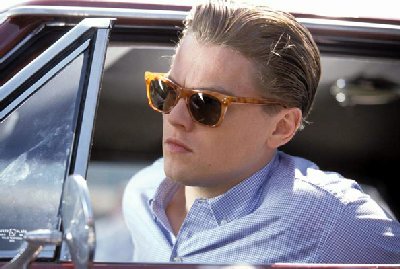
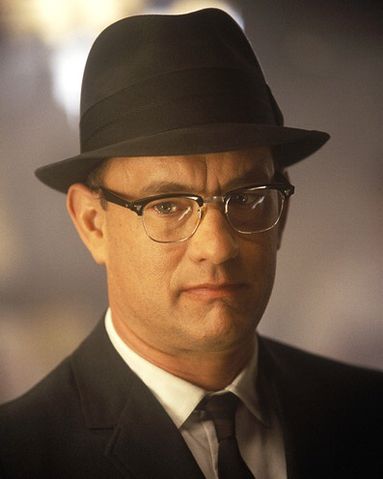
After a number of near-hits and missed opportunities, I finally watched Catch Me If You Can (2002), Steven Spielberg's movie about Frank Abagnale, Jr., a teenage Great Imposter depicted with enthusiasm and finesse by Leonardo DiCaprio, who proves--and this may seem painfully obvious, but I still think it's a real accomplishment--he will always be able to convincingly portray a sixteen-year-old. His performance draws us into Frank's slippery world, one that is breathless and giddy, but also "sad, sad, sad." I was happy simply to enjoy the hijinks and Tom Hanks' funny-freaky Carl Hanratty, the FBI man who pursues Abagnale and his paper-hanging across the US and Over There--and then, as happens so often in Spielberg movies, I was caught short by the pain he always inflicts on his protagonists, who find themselves cut loose from family, from father and/or mother. The pursued pursues, searching desperately for the lost parent.

It's a role-reversal of fabulous proportions, as Frank Junior becomes Hansel-Gretel, Snow White, maybe even (gulp) Oedipus, while the menacing forest clutches at the hem of the child hobbled with a crooked foot and faultless fate. Spielberg returns again and again to these lost children. There's Elliott in E.T. (1982), fatherless, trying to figure out how to grow up, until he rescues and is rescued by something that acts as both better self and parent. And also Celie in The Color Purple (1985), whose haunted wood is the American South, where she waits for her African angels to fly her home. And of course Pan in Hook (1991) and Jamie in Empire of the Sun (1987) and David in A.I. (2001), and even Indy, whose Last Crusade (1989) is to reunite with his father--all Lost Boys and Supertoys, alone and searching for themselves in their parents. Even Tom Cruise in Minority Report (2002) and War of the Worlds (2005) pitches in to build this fable, but from the parent's perspective, as he seeks to regain his own Lost Boy.

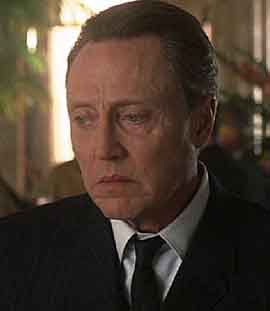
In Catch Me If You Can, Spielberg almost abandons the film's core--the cat-and-mouse of a great con artist and an equally great plodder trying to Get His Man--and asks us to stop and watch how Frank becomes what he is in an attempt to emulate his father, and how he raises the stakes to restore his divorcing parents, until he finally does find his father, in the person of Hanratty, the jubilant square who adopts his quarry, replacing the father (played by Christopher Walken, as usual completely satisfying in his self-assured ability to appropriate the role). As Hanratty closes in, he also gets closer to Frank, eventually becoming the protector, colleague, even, it seems, proud dad.

I was relieved Spielberg gives Frank a father. The anxiety DiCaprio projects seemed to me a preview of the OCD doom he would bring to The Aviator two years later for Scorsese, almost unwatchable in its sense of imminent, intimate nervous collapse. (It is a pain I think captured best in the image from The Aviator of Hughes washing his hands with such futile purgative fervor that he cuts himself. The urge to be complete expressed in extremis.) With his All-American American openness coupled with the most expressive eyes in Hollywood--at once capable of a hundred-yard stare and an aw-garsh twinkle--in Catch Me If You Can DiCaprio perfectly captures the requisite yearning one needs to play a Spielberg orphan. I think it's telling that the movie is based on a true story; it gives Spielberg the kind of journalistic "realism" lacking in his more heavily metaphorical attempts at telling his ur-story of abandoned children who search for home.

Saturday, December 03, 2005

A Full Heart


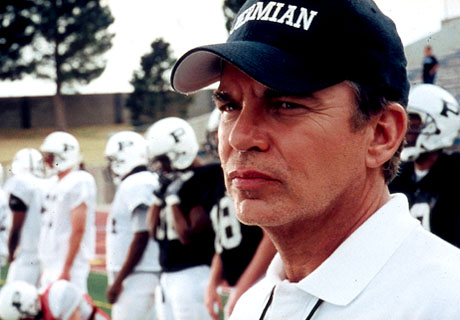
Billy Bob Thornton is cultivating a career marked by quirky but compelling firsts, from the sublime (Sling Blade, The Man Who Wasn't There) to the ridiculous (Bad Santa, of course). In Friday Night Lights (2004), directed by Peter Berg--an actor-turned director who seems to have done a good turn here, so to speak--he plays real-life Texas high school football coach Gary Gaines, and manages to deliver the oddest locker room pep talk in the history of movies, as far as I can tell. It begins by exhorting the team toward perfection, but is forgiving of the their shortcomings, almost eager to assure them winning doesn't matter, but only dignity and responsibility, and the capacity to love and carry each other in their hearts. Really. I will indulge and quote the speech as it appears on the Internet Movie Database:

"Being perfect is not about that scoreboard out there. It's not about winning. It's about you and your relationship with yourself, your family and your friends. Being perfect is about being able to look your friends in the eye and know that you didn't let them down because you told them the truth. And that truth is you did everything you could. There wasn't one more thing you could've done. Can you live in that moment as best you can, with clear eyes, and love in your heart, with joy in your heart? If you can do that, gentleman--you're perfect."

He goes on:

"I want you to take a moment, and I want you to look each other in the eyes. I want you to put each other in your hearts forever because forever is about to happen here in just a few minutes. I want you to close your eyes, and I want you to think about Boobie Miles, who is your brother [the star player who ruined his knee early on and had to sit out the season]. And he would die to be out there in that field with you tonight. And I want you to put that in your hearts. Boys, my heart is full. My heart is full."

"Live in that moment"? "My heart is full"? It is a remarkable episode in an otherwise straightforward film about The Only Game in Texas--which is a pretty clear accomplishment, to be an unadorned sports film that looks at most of the facets of this high-hopes, low-blow world without leaning too much either on the boys-to-men stuff or the cutthroat coaching parents angle. Those are in there, but mostly this movie wants to show us this world without telling us what to think.

Until we get to that speech. Berg shoots Thornton in closeup, that honest slab of a face itself in the moment, transcending all the cliches of every sports film, from the best (Hoosiers) to the worst (The Karate Kid?) until we feel he is talking to us, not his players, and exhorting us to fill our hearts with the joy of perfection. I tried out for football in high school, and was mercifully cut. But I was certain I could have held that joy in my own heart, regardless of my ability, because I knew--or wanted to know--the moment in which I could tell someone I had done everything I could, and had left nothing out. What a rare opportunity to shuffle off the embarrassed shrug, the rueful grin, and simplify one's life to a moment. And such a self-contained one: a silly game, silly enough to become a metaphor that can stand in for the real moments one has to face in adulthood.

And maybe better than a metaphor, but a myth, a story I could tell to explain myself to others as well as to me. I must admit I had forgotten why I had liked football as a kid--and not so much as a fan, collecting cards, cataloguing information. That seemed dull and lifeless. No, as bad as I was at it, I loved playing football with my friends. We were all about the same size, and owned pads and helmets--except Rob, rest his soul, who played without, a wiry muscle that slithered around our arms to escape, ball in hand--and for a while we played constantly, pretending we were on a team, suiting up and practicing every day, an older kid our self-appointed coach. Sitting in my seventh grade classroom, I was happy if it started to rain or snow, so we could play in the muck. It was, as I've said, pretend football played by a pretend football player, but I held an image in my heart of myself, not necessarily winning, but at least never giving up.

People assert that those who say winning isn't everything are the ones who usually lose. But when I listened to Thornton's speech, I realized that even if it were true, that losers console themselves with platitudes, that it's also true that seeking perfection is something you can hold in your hand, and actually do, like running, or throwing something, or tackling someone, or telling the truth.

Monster Sounds and Dance Music


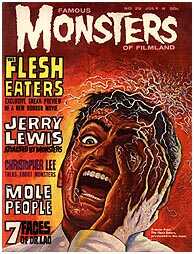
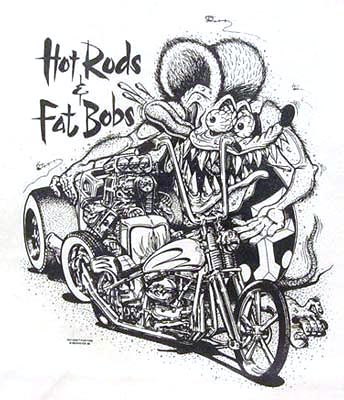
I own some albums Rob Zombie would covet: mid-1960s dance records with lots of reverb and warbling screams of terror. These are low-rent entries (and that's setting your sights pretty low) of the monster pop canon; I suppose the masterwork is Zacherle's "Monster Mash," which needs to be taken in context with a frayed tapestry tied together, in a Forry-Ackerman-Meets-Basil-Wolverton kind of way, with any number of threads of adolescent boy culture, from monster trading cards and stickers to Aurora plastic models and Herman Munster talking hand puppets, from Creepy Crawlers (often a kid's entree to the world of second-degree burns, fingertip division) to the Kustom Kar Kraze (R.I.P. Ed "Big Daddy" Roth and Ratfink). When I was nine or so, I plunged headlong into this humid, poorly reproduced world of bad puns and luridly curving claws, of profuse sweat-drops and clammy waxy surfaces--Topps-ed off with a deadly sharp piece of gum, powdered and pink like a dessicated tongue. It was a mess.

Just like The Devil's Rejects (2005). Although Zombie's movie is primarily an homage to 1970s travel-n-splatter movies--The Hills Have Eyes (1977) and of course The Texas Chainsaw Massacre (1974) spring immediately to mind--Rejects also has at least one horned toe dipped in the Herschell Gordon Lewis pool of Incredibly Strange Ideas That Stopped Being Movies and Became Mixed-Up Cult Classics, like Two Thousand Maniacs (1964) and Color Me Blood Red (1965), not to mention the subcategory of zonked-out corpse-grinders culminating in, I think, the dirtiest Satan-hippies of them all in the non-Lewis I Drink Your Blood (1970), who eat meat pies infected with rabid dog blood, and go off on one of those killing sprees. I actually have this movie, as yet unwatched, in my possession. Yech.

Rejects enjoys itself immensely, and I must admit I knew exactly what Zombie was up to, but the more I saw the movie rolled up in a big sticky ball with all those dregs of my childhood, the more I grew weary of it. I reminded myself once again that I prefer the past to stay the past, or at least itself, and whenever a film pays tribute or evokes something or other, there's always more than a whiff of self-congratulatory winking. As usual, I'm tempted to blame Quentin Tarantino for this. The Kill Bill double bill has yet to engage me in any significant manner--aside from drawing me to its sources. Sin City (2005) has the same effect; creative Xeroxing is simply not enough. Now, I won't entirely discount the basic impulse. From Dusk Till Dawn (1996) works well on its own, constant references to other movies notwithstanding. Sure, there's a nerdy appeal to such in-joking--"Hey! There's Tom Savini!"--and, looking at what I've written thus far, I must admit this entire piece in many ways has been an exercise in such smugness.

But let's move on.

A real music-lover I know used to disdain the whole idea of the Blues Brothers back when they were a hot bit on Saturday Night Live. He wanted people to buy the original records, not Jake and Elwood's covers, no matter the backup band's pedigree. I argued it might open the door to that music--and I think it did to a certain extent--but he was convinced that by and large people would remain satisfied with the hepped-up new model, irony included--and I also think by and large he was right. After all, it's been twenty-plus years and the Blues Brothers persist, if only as local car dealership pitchmen and high school halftime shows; but in all that time, I don't think anybody ever did a Sam and Dave impression.

I bring this up to figure out what to do with Rob Zombie. Now, we can easily argue that Zombie's sources don't need to be treasured or protected; they're alive and unwell on DVD. (And as far as the Angels of R&B are concerned, they seemed awful happy with their speaking roles, bit parts and cameos in 1980's The Blues Brothers.) Maybe, though, the effort to pay tribute to all that is creepy and kooky and altogether ooky (See? I'm doing it again; down, fanboy, down) is only marginally worth the trouble. Personally, I'd rather watch the originals or, better yet, use my conveniently selective and softly, almost imperceptibly fading memory--bolstered by the Web's bottomless image archives--to spread the past before me like a Tarot deck designed for reverse engineering.

Copyright Notice

Content copyright © 2005-2011 by Paul J. Marasa. No part of the written work displayed on this site may be reproduced, linked or distributed in any form without the author's express permission. All images, video, audio and other materials used are deliberately and solely for illustrative purposes connected with each article. Each accompanying element is intended as a research and reference tool with relation to each article. No challenge to pre-existing rights is implied. Aside from The Constant Viewer, the author claims no responsibility for websites which link to or from this website.