
Thursday, October 19, 2006

136. Halloween Roundup (7):
Things to Come


As I settled in to watch The Sentinel (1977), Michael (Death Wish) Winner's post-Rosemary's Baby vulnerable-waif-in-creepy-brownstone effort, I asked myself why I had it in my head that this was a good movie, one I was getting ready to watch for maybe the third of fourth time. On the surface, it was the same old story for me: the memory of a striking image, a mood, a feeling. For The Sentinel it is the effect of a ghostly naked old man passing silently through a darkened room, inches from the heroine, close enough to give us all the shivers. The Ghostly/Ghastly Visitation, the matter-of-fact appearance of the hellish. Good enough?*

Well, once the movie started, I was assured--and not so sure. It chaffed with everything itchy about those polyester '70s, from the giant posters and pastel upholstery to the chrome and indoor fronds. And everyone looked a bit ill, photographed with that crappy (Kodak?) filmstock that seemed worn-out when it was new, ready to fade and fall apart at the slightest change in barometric pressure. And everybody's attitude was slightly nasty, so ready to disdain and dismiss. (There's something to be said for '90s PC-ness, despite all its bad press; at least it urged us not to be so rude.) I figure being in a horror film's bad enough; does the poor heroine (Cristina Raines) really need Ava Gardner and Chris Sarandon (and although I remember him fondly--if that is the right word to describe a vampire--from Fright Night (1985), my view of him will now always be tainted because my wife commented, "He doesn't have a nose!" I think it was the camera angle, but things won't be the same again--between me and Chris, that is; my wife is another matter) getting all abrupt at her? Overall, I found plenty that irritated.

But then I suddenly recalled why The Sentinel was such a guilty pleasure: It was situated right there at a great and grating turn of the Hollywood wheel of fortune, as the last remnants of the studio era gave way to actors who would soon burn--at various levels of brightness and heat--some even now, others at least for a while (and it surely is a sign of age to be an adult witness to rising stars' falls). So there was the aforementioned Ava Gardner flouncing around while Jeff Goldblum acted like a fashion photographer; and Martin Balsam puttered about his professorial digs while Beverly D'Angelo panted in autoerotic ecstasy (oh, those hapless '70s; more on this in a bit); and Eli Wallach grumbled cop-talk while Christopher Walken(!) stood in the background, receiving a number of closeups I can only explain by assuming that Michael Winner, like the rest of us, couldn't stop looking at Walken's friendly, feral face; and Arthur Kennedy and Jose Ferrer and John Carradine guarded the gateway to Hell while Tom Berenger and Nana Visitor (Kira from Star Trek: Deep Space 9) innocently moved in to the new apartment building/gateway to Hell. I suppose this kind of thing still goes on, especially in made-for-cable movies, but the '70s seemed to be a particularly campy-depressing promenade of last gasps and first cries--although, and this should be no surprise, Burgess Meredith rises triumphant, cat in arms and birdie on his shoulder, as the indulged elderly gay man who, for a time, seems so charming.

For a time. Because the other thing that struck me (like a low blow) about The Sentinel was its attitudes towards the sexual. Of course, sex equals death in horror films; but in this masochistic movie it seems that sex equals degeneration. The heroine's aged father drives her to attempted suicide after she catches him in bed with two prostitutes; when she sees his shade wandering around the Old Dark Apartment Building, she tells a priest it makes her think she should try suicide again. And, as I mentioned earlier, Beverly D'Angelo, Sylvia Miles--and even the de-gendered cutie-pie Meredith--all signal not only sexuality but homosexuality-as-depravity--and damnation, since we find out they are all souls on some kind of shore leave from Hell. Not to be too obvious about the emerging metaphor here, but I can't help seeing this film as a record of '70s self-loathing gravitating toward self-destruction; after all, 1977 is just a few helpless breaths away from AIDS, and in retrospect The Sentinel seems ready to lay some nasty blame. Feh; I think I've just found the least savory Halloween Roundup entry so far--and if you glance at the previous six, that's saying something--and, with its cold heart and homophobic little mind, I say to Hell with it.


*Writing this sentence, I was reminded of a friend's email about seeing the documentary Henri Langlois: Phantom of the Cinematheque, and recounting Langlois' comment about Vincente Minelli's The Four Horsemen of the Apocalypse, that it may not have been a good picture, but there were a couple of memorable scenes, so for him "the rest doesn't matter." I am in good company--and I just Netflixed the doc to bask in the glow. Thanks, Mike.

Wednesday, October 18, 2006

135. Halloween Roundup (6):
If I Were a Carpenter

I'm not entirely sure it's all that much fun being John Carpenter. I don't mean as a person; for all I know, life is a cheery affair for him, filled with warmth and love and so on. And I also don't mean as a "Master of Horror" (as Showtime calls him, one among a number who directed a series of more-or-less Tales from the Crypt for the channel)--at least, not exactly. You know, that "Oooh, it must be scary being you!" gag interviewers pull on professional Gothicists. I'm just thinking of the need to keep at it, regardless of vocation, while dealing with a bright past, a mushy middle, then ... What? Fingers crossed, hopes springing eternal? Or just made-for-TV short subjects? And then there's the issue of a long life and a short rope: How many more of these things, one wonders, can Carpenter manage? I just saw "Cigarette Burns," his Showtime entry, and it seems to be, if not spelling out the terms of a weary capitulation, at least gazing at the long walk down the dark corridor, with the distance receding but never disappearing, and the end, while always in sight, seen not in relief but exhausted surrender.

A collector of rare films (played by Udo Kier; now there's another tired fellow-traveler; still, he manages to keep that doll's-eye glisten while talking his way around his accent, oily charm mingled uneasily with just-below-the-surface panic) asks a movie-theater director, Kirby Sweetman (I kid you not) to find a print of a short film, Le Fin Absolue du Monde, which purportedly turns its viewers into homicidal/suicidal maniacs. This is meta-narrative at its unwholesome "best": a short film about a short film about death. End leading to end. Carpenter does a good job of capturing the insistent demands film makes on the cinephiliac--culminating on Udo Kier's final sacrifice for--well, not art, but the art-lover's wish to be overwhelmed by art, to enter it, to become it. I will not give away the moment--not that it's something you should look forward to--but be warned: Like all Grand Guignol exhibitions, this one is at once supremely silly and thoroughly damning, as always a haymaker, but also a sucker punch. "Cigarette Burns" indicts the viewer, laughs at--while feeding--the voyeur, and discourses with surprising clarity on obsession.

So I'm still left with an image of John Carpenter slogging through what has become a Halloween fog, filled with princes of darkness, ghosts, things, body bags, and the damned, all cradled in the mouth of madness like one last bitter treat--and way in the background, the first King of this long cinematic trail, Carpenter's Elvis, "slumped up against the drain," as Springsteen puts it, "with a whole lot of trouble running through his veins." "Cigarette Burns" proves Carpenter can still name that tune, while piercing our ears with excessively high notes. A nasty little business, but it seems the only one he has.

Monday, October 16, 2006

134. Halloween Roundup (5):
Brain Dead


Those closest to me are sometimes fond of pointing out that I tend to be anal-retentive. This is something I must admit--at least privately (give no quarter in the family feud!); after all, why else do I find it difficult to relax and watch a movie until the room is picked up? As though a half-glass of juice and some socks on the floor are going to matter as I sit there in the dark watching Will Ferrell yell at Ben Stiller. In my cloudier moods I fear my old friend AR may actually be OCD--and then I really am in trouble: Imagine trying to pay attention to a film while chanting "bring in the milk, bring in the milk, bring in the milk." And as far as the cause of this thing goes, I continue to hope I can blame all my problems on my parents. Botched toilet-training has a dark and terrible poetry to it; the imagery alone is desperately intimate. But consider the biochemical explanation, one that fingers low levels of neurotransmitters like norepinephrine or serotonin as the culprit. Feh; where is the delirious, festering beauty in that? I will not expend all this energy being crazy simply to fill the coffers of Lilly and Pfizer; and while receiving a Positron Emission Tomography scan seems fraught with Asimovian frigidity, accompanied by the wire-sharp whiff of ozone and the impassive ratchet of spiking readouts, nothing beats the blind and lumbering approach of The Past, a neurotic puppeteer insisting that you better stack those dishes just so, or else.

Or else what? Freud tellingly defines the desire for "order" as a "compulsion to repeat," a deflection from the fundamental discomfort with facing life's messes, a basic sense of disgust. This feeling is of course universal: all peoples in all cultures at all times have their gross-out lists. On the home front, back in 1994 the researcher Jonathan Haidt developed a series of "disgust scales" to test the American gag reflex.

Here are a few of the statements the scale asks you to mark true/false (and by the way, I admit I may be nuts, but if none of the following "bothers" you at all, I'd suggest immediate attention):

It bothers me to see someone in a restaurant eating messy food with his fingers.
It bothers me to hear someone clear a throat full of mucus.
It would bother me to be in a science class, and to see a human hand preserved in a jar.
It would bother me to see a rat run across my path in a park.
If I see someone vomit, it makes me sick to my stomach.
It would not upset me at all to watch a person with a glass eye take the eye out of the socket.
It would bother me tremendously to touch a dead body.
I probably would not go to my favorite restaurant if I found out that the cook had a cold.
It would bother me to sleep in a nice hotel room if I knew that a man had died of a heart attack in that room the night before.

Others are statements you rate from "not disgusting at all" to "slightly disgusting" to "very disgusting":

You see someone put ketchup on vanilla ice cream, and eat it.
You see maggots on a piece of meat in an outdoor garbage pail.
You see someone accidentally stick a fishing hook through his finger.
Your friend's pet cat dies, and you have to pick up the dead body with your bare hands.
A friend offers you a piece of chocolate shaped like dog doo.
You are about to drink a glass of milk when you smell that it is spoiled.
You are walking barefoot on concrete, and you step on an earthworm.
You see a bowel movement left unflushed in a public toilet.
You see a man with his intestines exposed after an accident.
You accidentally touch the ashes of a person who has been cremated.

I left out some of the "morally disgusting" ones dealing with same-gender or varied-age/species sex; I'll leave those hangups to you and your dank little doubts and anxieties. I must admit, though, that the ones I have mentioned squat within a personal padded room of my own, daring me to keep looking and to quell the rising gorge as I deal with the untidy aspects of the body, especially the wetter, looser ones--in particular the idea of severed or damaged parts, or exposed innards. (I'll ignore the food and poop items for now.) Which brings me to The Brain (sometimes Head) That Wouldn't Die (1962), one I'm almost sure I saw sometime soon after its original release. And checking it out on the IMDb, I read a "user comment" from someone who saw it when he/she was five years old (a year younger than I would've been in 1962) and it was amusing to see all the capital letters and exclamation points used to indicate how CREEPY! and VERY SCARY! it was back then. Well, maybe not "amusing"; more like "revealing." I, too, remember being afraid--but more than that, disgusted. A woman is decapitated in a car accident, and her husband/researcher bundles it up in his jacket and puts it in a shallow pan filled with Some Liquid and sticks tubes into it. So there it/she sat, bandaged and bound, voice raspy, asking to be allowed to die more times than I wanted to hear. And the end of the movie also slopped over the rim of the disgust pan, as the mad doctor's previous experiment--a misshapen creature with the requisite googly eye--tears off the assistant's arm, with all kinds of attendant wetness and black smears. (And speaking of doubts and anxieties, I had forgotten that the doctor, in his search for a suitable replacement body, visits a burly-q joint and also cruises town, adding all kinds of discomfort to the already-troubling voyeurism at the heart of the nervous, the lonely, and the involuntarily disgusted. You know, watching horror films really isn't the best coping strategy for adolescence. But I digress--or do I? Hmm.)

This most recent viewing of The Brain That Wouldn't die, though, came, to my relief, as a Mystery Science Theater 3000 entry--I believe Mike Nelson's first appearance--and, bless him and the 'bots, they dis-disgusted the movie for me almost all the way. Except: Their own disgust, albeit less visceral, was more Freudian, and I was able to examine the wet end, so to speak, with some dispassion, while laughing at what is even more deeply unsettling about this movie, and that is one odd, repeated shot: closeups on the scientist--"from another dimension!" the 'bots scream every time--as he ogles the strippers or salivates over his wife's head (sorry). So one kind of body-disgust is replaced by puerile sniggering over another. This does not seem the most salutary turn; still, it's better than the last nauseous dregs of childhood, and the thought of severed limbs and all the gooey business of life literally cut off and turned inside-out. No wonder as an adult I found myself drawn to David Cronenberg. He understood that, while it may indeed all come down to The Body, it can still remain something that stirs in The Head, and, wisecracks aside, it dies hard.

Thursday, October 12, 2006

133. Halloween Roundup (4):
Game Over


When I first saw Weird Science (1985), I was happy whenever I saw two actors on screen: First of all, I must confess, Kelly LeBrock, whom John Hughes photographed in such an iconic way that--like Betty Grable in the '40s stretching her legs out, just so, for all those G.I.s--she grew to represent the '80s ideal of the American Beauty--which oddly enough included a British accent. But the second welcome sight was Bill Paxton's Chet, Hughes' grinning-est teen nemesis, splay-footed in his skivvies, "gettin' off" on his own evil. At once manipulative and malleable, Chet drew me into the off-center middle-west knuckleheaded world Paxton would fool around with for a while: A year after Weird Science, he earned his own niche in the wall of movie immortality with his freaked-out Pvt. Hudson in Aliens; I can even remember downloading an early home-made video game in which, when you lost, you heard Hudson's famous exclamation as the inexorable aliens left them stranded and hemmed in: "It's game over, man, game over!" Good ol' boy Bill: a cigar-chomping bully until his bluff was called.

His first triumph along these lines is in Kathryn Bigelow's redneck vampire road movie, Near Dark (1987), in which Paxton gets to say things like, "We keep odd hours." It's a ruthless, smirking performance, full of dark fun and adolescent menace. And should be the focus of a Halloween Roundup. But I play 'em as they come, and last night I watched Frailty (2001) again--and by the way, Paxton's second career as a producer-director has been interesting; check out Traveller (1997), which he co-produced. And while that film does have a Southern Gothic feel around the edges, in Frailty the gothicism is, to put it mildly, head-on and up-front.

I'm afraid I won't be able to do too much here with the plot: This is the kind of movie I like to consider a "mule," if only because, once you get to the back end, it kicks. But in its tale of an amiable single Dad (Paxton) with two boys (Matthew O'Leary and Jeremy Sumpter; as an adult--we receive the story in flashback--one of them is played by Matthew McConaughey, another actor who makes good choices; go watch Thirteen Conversations About One Thing, released the same year as Frailty), all seems well until the father wakes up the boys one night to inform them that God's angel has spoken to him, and they must seek and destroy demons, who are of course disguised as (more or less) ordinary people. What follows is a frank discourse on Hell--if Hell is a place in which someone you depend on asks you to watch him become a monster, and demands you do the same. While surprisingly free of blood and gore, Frailty disturbs because of that demand.

When I was a kid I remember being told by one of the nuns at my school that you had to follow the commandment to obey your parents--unless they told you to sin. I used to imagine my parents deciding to enter a life of crime--bank holdups, as I recall--and telling me I would have to go along. And while the thought of my mother and father, wearing masks and turtlenecks, startling the patrons with cries of "Stick 'em up!" made me uneasy--after all, they must've been lying to me all along if they had that in them--a part of me relished the thought of saying No, and having God on my side for once.

Ahem. Frailty pretty effectively puts the kibosh on that strange little daydream. And I'm wrong to be joking about it, because the movie refuses to compromise its vision of Hell on Earth. As the older son digs a gigantic hole in their back yard (the future "dungeon" to hold the demons before death by lead pipe and ax)--part punishment, part prelude to his own scary version of fasting in the desert--I saw with Gothic clarity the terror of obedience and the nausea of defiance. One son accepts the father's world--claiming to see the demons beneath their human disguises--but the other, his hands torn by his work, then flung into the hole (now covered with a shed) to sweat out his lack of faith, faces the need to avoid sin, and ... but I will not give away too much. Those with the stomach for it can watch it themselves, and observe that the "error of one's ways" can be as difficult to see as the way out of error. If Frailty works as a title, then, it is because of the tenuousness of love and understanding in a world of sharp turns and sudden drops.

Tuesday, October 10, 2006

132. Halloween Roundup (3):
Sad, Sad, Sad

Not to be too cute with the title of this, but watching The Wolf Man (1941) and Frankenstein Meets the Wolf Man* (1943) I was reminded of another, slightly similar title, Edward Albee's Who's Afraid of Virginia Woolf?, made into one rough night of a movie in 1966 by Mike Nichols, in which Dick and Liz--and a suitably hapless George and Sandy--do some pretty thorough tearing and rending themselves, as "sad, sad, sad" as they may be. The similarity, then, goes beyond the W-word, because Larry Talbot (Lon Chaney, Jr.) wins hands-down the title of Saddest Monster of Them All, sadder than all those creepy-creaking child-ghosts in J-horror movies, or--and this is saying a lot--Karloff's haunted face, even in its most extreme bouts of loss and descent in Bride of Frankenstein (1935).

Chaney the Younger had a strange face--I always want to use the word "mug"--whose dull despair had made him a good choice for poor Lennie in the 1939 film version of Of Mice and Men. (It was Broderick Crawford on stage in 1937.) In The Wolf Man, the last thing he looked like was a Scottish gentleman--and while the plot tries to cover that up a bit, his Larry Talbot still seems straight out of Brooklyn (circa 1935), a weary schlump trudging back and forth from depressing job to threadbare existence. It is a Depression face, beaten but only realizing it after the fact, the big galoot who doesn't get his as much as someone else's.

In other words, a perfect werewolf, a victim of another's violent spree--Bela Lugosi's, in fact; the werewolf (actually named "Bela") who bites Larry. It's interesting to watch Talbot's split reactions in these movies, as he seeks death with all the energy of a convalescent-home inmate while his werewolf counterpart/stunt double rolls around with reckless glee through glade and glen, nimble as a faun, hungry as a satyr. But even more, notice how all that energy does not lead to "eternal delight"; no, we'll save that for some postmodern Goth-werewolf who finds liberation in consumption. Larry is only miserable, and the werewolf is simply scary. My sixteen-year-old daughter still remembers when she was little, up and itchy-hot with chicken pox, sleeping on the sofa bed under a penguin-patterned counterpane, watching The Wolf Man late at night with me. And sharing her first viewing, I was reminded how frightening Larry was as the Wolf Man, how perfectly at home in the thick fog, always snarling sotto voce, the only sign we needed that he meant business, and that business was booming--and shrieking, at least for a moment, until his slavering embrace cut it off short.

Like Lugosi's Count, Chaney's lycanthrope produced no blood to speak of; but he seemed at once the most unwholesome, unstoppable and also least understood of Universal Studios' monsters, a cruel cipher that everyone, Larry included, knew needed killing. (Some day I'd like to write about T.R. Hummer's poem, "The Rural Carrier Stops to Kill a Nine-Foot Cottonmouth," the most arresting thing I've ever read about "things in this world a man can't look at without / Wanting to kill." And I suppose, this being the Halloween Roundup and all, over the next few weeks such a poem should pretty easily come to mind again.) I'm reminded of The Misfit in Flannery O'Connor's own little tale of death in the woods, "A Good Man Is Hard to Find," and the mopey-yet-teeth-gnashing progress through his "meanness"; and how still, at the end, all the loose ends tied up in bloody knots, he too must wearily admit, "It's no real pleasure in life." Now there, kiddies, is a fitting motto for the Talbot family crypt.


*I was calling it Frankenstein vs. the Wolf Man, but my son corrected me. He didn't stick around to watch it, but he was right: Between Larry's kindred-spirit rescue of the Monster (Lugosi at last accepting the neckbolts) and dogged (sorry) insistence that Dr. Frankenstein's work must somehow hold the secret to a cure for what ails him, it is definitely more a matter of meet rather than vs. Indeed, their spirited tussle at the end almost seems an afterthought; the crumbling dam already ensures mutual destruction. Still, my memory of it as a kid is much more pugilistic, and I'll hang onto that when no one's looking.

Monday, October 09, 2006

131. Halloween Roundup (2):
Not in Kansas Anymore


For years I thought that the abandoned amusement park in Herk Harvey's Carnival of Souls (1962) was in Kansas; but this morning I checked the IMDb, which informs us that it was actually something called the Saltair Amusement Park, located outside Salt Lake City. And watching the movie again, the place does have a salt-flat feel to it, with a broad oily pool of water stretching at its feet. Utah it is, then.

Of course, though, what matters most about Carnival of Souls is the almost entirely internalized geography it spreads before us, the shadowland of Mary Henry's*--not "mind," because, from the moment of her cooly observed emergence from the water--the drag-racing car she rode in plunging over a bridge--Mary slips away from us, closer to the pallid face and pale invitation of the Other Side. So maybe it is the geography of her refusal to die, to admit she is not so much being pursued by ghosts as reclaimed by them. A church organist without faith, she fades (as do the sounds and human contact of the world around her), fluttering like a small bird held in soft, cold hands.

Where did this movie come from? Well, if you go to Herk Harvey's entry in Wikipedia, you'll discover he was a theater major who entered the industrial/educational film business in Lawrence, Kansas (and so this is why I thought Carnival's abandoned pavilion was located in Lawrence). He worked for Centron films for over thirty years, first as an actor and then as a director and/or producer, with titles such as The Sound of a Stone (1955) (Methodist-Church-funded anti-McCarthy film), Why Study Home Economics? (1955) (I'm sure they offered numerous convincing reasons), Manners in Public (1958) (short answer: You should have them), Oxidation Ditches: One Answer to Manure Disposal (1970) (some titles write their own jokes), and, with a title almost as unsettling as his one feature film, Pork: The Meal with a Squeal (1977). Carnival of Souls, though, was an intensely personal project, and his fascination with the idea of a dance of the dead allowed him to build a mood piece of surprising resonance. I will not dwell on its high reputation as a "cult film"; what matters for me is that I first saw it with little fanfare--an image of the white-faced Man was enough to get me interested--and immediately saw both its flaws (for my taste a bit too heavy on the organ music--then again, it fits the plot in a way other horror-movie organ scores do not--and some stiff (heh-heh-heh) acting) and its lasting strength: as an almost cruelly impartial observation of a nightmare, with its matter-of-fact slow decline, its relentless delivery of Mary into the hands of her fellow dead. It begins with the simple fact of universal mortality, and refuses to provide any reprieve.

And it is beautifully shot (make sure that you're watching the Criterion DVD; Netflix sent me an inferior print), its lighting and camera placement remarkable--well, OK, perfect. This is a movie that looks exactly the way it needs to, that manages to bypass its weaknesses--even overcome them--simply by looking at its subject without blinking. As the dead rise from the black water, or dance in fast-motion--without any attendant silliness--and as Mary flees under the dark skies and shadowed streets, as the camera looks over, down and up, always holding just long enough to see, but not to break the mood, Carnival of Souls joins the short list of films that move like dreams. Its very detachment becomes an invitation to the danse macabre, and its slim resources force us into the narrow passage Harvey demands we follow, back to the car wreck, the spit of sand, and the thing we've known all along, but had to be told--because we want it so little: that Mary needs to go the way of all flesh. It is a movie that, like Thomas Gray's poetry, tells me to see the world as a graveyard, and ultimately is not so much cruel as clear in that vision; in the end, almost with kindness, it "leaves the world to darkness and to me."


*Played by Candace Hilligoss, looking, don't you think, like Judith O'Dea, the immortal--and equally stunned--"Barbra" in the original Night of the Living Dead. Always coming to get you, yes?

Friday, October 06, 2006

130. Halloween Roundup (1):
A Kiss Before Dying


As I believe I've mentioned before, my son and I are dutifully watching every X-Files episode in order. The implicit promise is two-fold: to satisfy the compleatist's urge and to free us from ever having to watch the show again. I can remember watching M*A*S*H reruns until they took on the consistency of a thin gruel, with small bits of cardboard thrown in for bite. I am on the verge of this with Seinfeld as well; and I will be sorry when the day finally comes that I cannot bear to watch any episode one more time. (This point of no rerun has occurred with quite a few already, and I fear for the rest.)

I did not want that to happen with The X-Files, in part because it already did, and while the show was on its first run. As David Duchovny went on to bat around .225 in movies--pretty good if you're swattin' at the ol' horsehide, but in movies a hit for every three or more strikeouts is a sorry sight--and slipped away from the series (that image of him in the opening credits fading away like the Twilight Zone clock is as good a jab at his departure as he deserves), I,too, began to grow weary of The X-Files. But the mood of the show remained original, and the subject matter was just ooky enough to keep me jittered; so I hung on. Besides, Gillian Anderson was able to make it work on a regular basis, carrying herself with all the cool charm of a Joseph Singer Sargent m'lady in The House of Mirth (2000)--and slightly surreal as a trailer-trash chick in The Mighty (1998)--while continuing to slip through the dark passages to which Mulder led her. And as Dana Scully, with all those classic closeups they gave her, Anderson never lost her old-time Hollywood cool, even when she was having a decidedly unwilled religious experience.

In short, like Scully the show had legs (sorry), and we've been good about looking (at the episodes, that is), so it is fitting that we began the Halloween Roundup with some X-Files episodes (from season 7)--and with one in particular, "Millennium," which (just like in The Beverly Hillbillies and Petticoat Junction) revealed that Mulder and Scully lived in the same TV universe as Frank Black (three cheers for Lance Henrickson) from Chris Carter's other creepfest (creepier, actually) Millennium, which ran for 67 episodes, according to the IMDb. And every one was more deeply weird than the previous. I remember it vaguely, even though it ran only a half-decade ago, which is fitting, because the show itself moved like a thick-muscled, jagged-toothed sea creature in a dream's murky water, slippery and muffled, its bite lethal but its direction occult (in every way).

Belatedly, Carter tried to wrap up the series with a New-Year's-Eve X-Files episode. And it works, to some degree, if only because of the way Henrickson glides from one awful decision to the next, with his trademark deadpan (accent on the first syllable) and all-but-unreadable cool. He appears in the episode like the promise of evil confronted that the X-Files always seemed to make, but which it almost never fully kept. However, with Frank Black as the only link to a man--a "necromancer"--resurrecting the corpses of ex-Millennium Group agents to form a homebrewed Four Horsemen of the Apocalypse, Mulder and Scully are forced to tag along, watching someone who plunges headfirst into the brine work with clean precision, as capable of being thrown off-guard as Big Blue. Even the reckless Mulder must stand within a protective circle of salt, wounded and in the dark, as Black storms in to the rescue.

The episode ends with Black's reunion with his young daughter (a little something for the Millennium fans) while Scully and Mulder kiss--and I had always thought for the first time; but earlier, in the finale of a two-parter, there they went, and with a remarkable combination of relief, fear, and passion. Afterwards, the two seem relieved that the kiss was over--but also that it happened. Sweet and long overdue.

Two episodes later, though, they conflate New Year's Eve and Halloween, and the zombie Horsemen seem much more impending than romance. Again, a good start for this year's Roundup, in which for thirty days or so love and death prove what strange bedfellows they make.

Thursday, October 05, 2006

129. Play Time's Over


Before the Halloween Roundup begins, I need to clean the cinematic house and write about a movie that even now, four days after watching it, continues to grow in my head--no, echo, a low reverberation of sweet melancholy and last glimpses, a middle distance sound that does not want to fade away. I once heard a recording--I think I downloaded it from a site called epitonic.com (I've been trying to get to it this morning, with no luck)--made by lowering a musician--a trombonist, if I recall--into a big empty cistern or water tower, a circular one, to play single notes. The acoustics of the space generated something like a 90-second reverb, so each note played within that interval overlapped with the previous for a long time, and so on. It was sonorous, a little mysterioso, almost silly, even irritating, but in its way beautiful.

Jacques Tati's character, Monsieur Hulot, part Chaplin, part Keaton, an essentially silent character in a world of increasingly complex and subtle sounds, appears in three films: Monsieur Hulot's Holiday (1953), Mon Oncle (1958), and Play Time (1967). Tall and almost blocky, with his hat and long raincoat and umbrella and pipe, Hulot, like that trombone in the cistern, stretched his note long, but with an inevitably diminishing tone. Just look at the titles. The first seems to belong to him, but even at the start it is his vacances on which the film focuses. In the second he is not primarily himself, but someone's uncle. And in the third, nine years later, he has all but disappeared, that 90-second reverb gone at last in the midst of another kind of holiday, a single long Parisian night, a "play time" that begins in a lengthy first act of blue steel and geometric severity, leading toward a chaotic symphony for jazz nightclub and tourism, and ends with perfect calliope diminuendo (if such a thing is possible) as Paris, which in the film had been cold and impassive throughout the day, then raucous and grating in the nightclub--while joyfully falling apart, chair by chair, garment by garment, wall by wall--suddenly comes to life at dawn, transforming itself into a rush-hour carousel, a country fair that fades as the tourist bus leaves the city; at this last moment, Hulot finds one more opportunity for the gentle offering of a gift (a scarf for a young woman, a tourist he had befriended during the long night of free jazz and dismantled architecture), and the curve of a spray of small flowers he had put in the giftbox mimics the branching ultramodern streetlights marching outside the bus's windows, a last fond dream that Paris (that is, the modern--heck, the American--world) just might have hidden in its monolithic polish and metallic hiss a memory of the plaintive-but-happy notes of a cafe accordion, accompanied by a fine but thin--and a little tipsy--voice singing, after everything closes down.

Someone out there wrote that watching Play Time takes the same kind of patience one needs for Kubrick. An apt comparison, if only because the film was released one year before 2001, and both share a leisurely pace and almost cold and--as Terry Jones mentions in his fine introduction to Play Time on the Criterion DVD--alienating tone. The nightclub scene, for instance: A jazz ensemble takes the stage, and plays almost constantly throughout the sequence, a half hour or so, with peppy but grating percussiveness. I'm tempted to be reminded of the opening of Scorsese's New York, New York, in which De Niro's Jimmy Doyle insistently tries to pick up Liza Minelli's Francine Evans, while "Opus Number one" plays in the background; the music follows the rhythms of Doyle's efforts to win over Francine, as in Play Time, where the band falls apart as the nightclub does. Still, perhaps the better musical comparison would be to the "Jupiter and Beyond" squeaks and howls of Kubrick's 2001.

In any case, Play Time refuses to fade away. I am not as lucky as Hulot, who gets to stay behind, perhaps lost in a France that looks almost nothing like the strolling ease of Monsieur Hulot's Holiday, but still able to recede (maybe to some last corner of his Paris-that-was, a city as small town, all winding streets and stray cats and children), his owlish half-smile tentative but secure. No, I travel with the bus, back toward the airport where the movie began (let me add in passing, a pre-Spielberg Terminal of confusions and missed connections of all kinds), having never seen Paris' old-time charms except in plate-glass reflections, more a memory of a memory. It is a long goodbye from Tati, from 1953 to 1967, but we can still see Hulot waving, smaller as we move away, but never disappearing.

Tuesday, October 03, 2006

128. Screen and Scream Again (with any luck)


In the spirit (heh-heh-heh) of this post I will provide a grisly explanation for my dearth of postings: Lately, I had been wearing so many hats--father sending daughter off to college, website builder, New Student Orientation assistant, weekend visitor host (but of course, love and kisses to Mimi and the Monkeys Three), teacher (X3), writing instructor, workshop leader, film series presenter, film festival committee member (more on this later this month), plus all that Modern Equal Partner housekeeping (and through it all one car short, the "old and busted" '93 Suburban's dead battery--the relative size and cost of a Ford Fiesta--leaving us to bounce around town with one car, like a gas-powered boomerang); with an equally busy wife--grammar school music teacher, church organist (my own personal Carnival of Souls), assistant tennis coach, band leader and performer, and also keeper of the house; and with two additional back-to-school children--it seemed the only cure to this plague of hats would have been to cut off my head. But a kinder, albiet potentially as gruesome, cure has arrived--and as the ultimate appositive to said cure, allow me to quote those dear little Shaggs:

It's Halloween
It's Halloween
It's time for scares
It's time for screams
It's Halloween
It's Halloween

The ghosts will spook
The spooks will scare
Why, even Dracula will be there

It's time for games
It's time for fun
Not for just one
But for everyone

The jack-o-lanterns are all lit up
All the dummies are made and stuffed
By just looking you will see
It's this time of year again

It's Halloween
It's Halloween

All the kids are happy and gay
There doesn't seem to be a cloud in their way
But when it's over and they've had all their fun
They'll wish that Halloween had just begun

Oh, there are witches, goblins, Frankensteins and zombies
And there are tramps, Cinderallas, pirates, angels and gypsies
So let's have lots of fun and give many cheers
For Halloween comes but once a year

It's time for games
It's time for fun
Not for just one
But for everyone

It's Halloween
It's Halloween
It's Halloween
It's Halloween

It's Halloween!

(Thank you, girls)

I was suddenly struck with the fact that this is it, the Bradbury month, the Dark Ride into October Country; and that means once again the Cavalcade of Terror, the Carnival of Creeps, the Carpe Diem of the Dead that is our annual Halloween Roundup. I ran to Netflix, and cobbled together the first, tentative lineup:

The Wolf Man
Frankenstein vs. the Wolf Man
Carnival of Souls
Masters of Horror: Jenifer
In Dreams
The Outer Limits: Season 2: Disc 1
Masters of Horror: Cigarette Burns
Masters of Horror: Homecoming
Blood and Black Lace
Masters of Horror: Dreams in the Witch House
Masters of Horror: Chocolate
Population 436
The X-Files: Season 7: Disc 3
Masters of Horror: Deer Woman
Frailty
Murder in the Rue Morgue
The Black Cat
The Raven
Masters of Horror: Incident On and Off a Mountain Road


The Roundup at this point is Showtime's-Masters-of-Horror-heavy (thank you, Milwaukee Paul); things may change, but for now I'm a bit more at (un)ease, ready to be ready, as it were, for my second-favorite Holiday--oh, OK: Horror-day--Season. Oh, what fun, to play Crypt-Keeper and not only indulge in excruciatingly forced puns but wallow in the black lagoon of my Guiltiest Film Pleasures. And simply looking at this list, I'm getting that lively buzz, good enough for a Frankenstein, and wondering: Do I dare to screen Re-Animator, From Beyond, the original Hills Have Eyes and Texas Chainsaw in the same home as a thirteen-year-old? (Then again, boys and ghouls, I'm betting some of those Showtime movies are going to be fairly gore-riffic). Oh, what the literal hell: It's Halloween, and "Not for just one / But for everyone." So hold on to your heads, kiddies, because it's going to be a bumpy ride--you know, what with all those corpses underfoot. So welcome to El Mes de Muertos, and all the sugar-skulls you can eat.


Below: A partial view of my favorite Aurora Model Kit, one I built twice. (The first one somehow was broken, and I jammed the witch herself in the crook of a fir tree in our front yard. The years went by and the tree grew around her; eventually, the lower branches were trimmed so that I could see her once more. I even pointed her out to one of my children, back in the early '90s. The tree is gone, but plastic lasts, somewhere, forever.) I wish you could see the cauldron she's standing over. Then again, we do get a pretty good view of that rat about to nest in her hair. (Choke!)

Wednesday, September 27, 2006

127. Bungled Shame

It's been so long since I've written that I'm afraid all I'll be able to manage is, as Smash Mouth sings in "Pet Names," "an itsy bitsy tiny little almost inaudible squeak." Still, I will clear my throat and let fly with a note or two.


I watched some instructional films from the 1950s and '60s, the foremost being Lunchroom Manners, made famous by Paul Reubens' comedy club version of The Pee-Wee Herman Show ("Was that a big enough piece of cake or what!?"). But as I watched Phil and the other towheaded Children of the Damned beaten into submission by firm instructions peppered with the adverbs of conformity--"quietly," "politely," "neatly," "slowly," and, of course, "thoroughly"--I found my derisive laughter growing forced, as I succumbed to a flickering 1959--when I was three--in which kids who were never really all that quiet or polite or neat moved in soft fluorescence amid the featureless Alphaville of modernizing education, an All-Purpose Room of squared-off spongy linoleum along which Eames contour chairs glided like beige geese, and the furthest horizon had the quiet lines of a simple geometry problem. Watching Phil deciding not to cut in line and breaking off a piece of his cookie (rather than offering a bite), I realized I knew that kid, and that he, in part, was me. After first grade, and before seventh, I cultivated a dutiful demeanor, with a little daydreamy quietude thrown in--at least in school. To this day the thought of a classroom bathed in light while a stormy day darkens the big windowed wall makes me feel as cozy as an English cat by a glowing fender. Those were good days to be in school, as the meandering quiet of a 1962 classroom passed in lazy ovals, number-two lead spiralling across my yellow sheet with a Crucifix and "J.M.J." drawn at the top, Palmer Method penmanship class slipping with a small wink into Art--a minimal line of endless circular movement, forming a gray tunnel, almost a burrow.


The more I thought about Lunchroom Manners, the more I realized that cinema's delirious power lies in its assertive idealizations: images of blocky shoes planted firmly on the ground while nice ladies restock the milk, a world sad and beautiful, just as Roberto Benigni insisted in Down by Law (1986), narrow and soft, stern and sleepy--and gone forever. And watching the final scene--as Mr. Bungle (the puppet who couldn't use a napkin correctly if his rubber head depended on it) grew "ashamed" for being, well, a bungler--a part of me whispered, "'Gone forever,' all right, and good riddance." But the pencil-fine ovals turn, while the noses get picked, and the feet never stay firmly on the ground, and I START FILM again, just to see.

Friday, August 25, 2006

126. Back-to-School Special


Yesterday was my thirteen-year-old son's first "day" of school--two hours, actually, just enough time to tell his teachers that we have a new dog--Frankie the pug; dear Patty the mutt passed away earlier this summer--and to forget to bring home a reading list we could've gone over. And they're off.

I usually like to mark such events with something special; so of course we watched three movies and ate junk food. This also marked the first time I've seen the original Alien on DVD--and not really "original," since we opted for the "director's cut," seeing three or four scenes that weren't in the theatrical release. (I don't want to write about this new cut right now; I'll simply agree with Ridley Scott that, while the deleted scenes have merit, the original release is better.) And it was interesting watching it after Silent Hill (2006)--and before Pirates of the Caribbean: The Curse of the Black Pearl (2003). I'll leave Jack Sparrow alone for now;* I'm more interested in comparing the two horror films.

Silent Hill is based on a video game, but that isn't necessarily a problem. Yes, video games can employ a narrow, first-person point-of-view; but so do some movies, even good ones, especially mystery/suspense and horror films; so the horse still draws the cart, since video games in large part mimic movies--seek/chase movies in particular. I don't think watching The Wages of Fear (1953) and trying to picture it as a video game automatically demeans the film, because the best games distill--not merely "simplify"--the suspense, shock, and chase elements of genre pictures and combine them with the pleasures of the arcade shooting gallery. And I'm old enough to remember games with small tin geese arcing uncertainly and tiny lurching deer heads poking out from two-dimensional tree-trunks in the foreground, while you fired away with your swivel-mounted miniature rifle at what you hoped was their general vicinity. And I loved them, and just writing about them makes me want one in front of me right now so I can hear that Bang! and watch the silhouettes flip backwards. And yet: go back in a time machine and bring the kid I once was any contemporary shoot-em-up video game (in which the game shoots back!), and I know I'd be crazy for them--after being scared to death by their gore and violence, and thoroughly flummoxed by the split-second eye-hand coordinations necessary to stay alive for more than ten seconds.
Well, I've written about this before, when I saw the Doom movie--which I liked. Silent Hill, on the other hand, seems flat and boring--despite some appropriately startling monsters. It's the same old story: lazy writing abetted by a cynical attitude toward the audience. For instance, within five minutes of the movie's opening titles, the woman is venturing alone with her sleepwalking, obviously disturbed child to the mysterious--heck, hellishly combustible and rats-in-the-walls/dwellers-in-darkness Lovecraftian--town of Silent Hill (which the girl seems to be seeking in her somnambulistic, suicidal forays) and immediately losing the child, just so the movie can start the chase. I could see the marketing wheels turning, convinced that the audience does not want to care about the characters--after all, gamers often skip over the cut scenes (or, more tellingly, cinematics) that introduce or stop the game to advance a storyline, establish characters, and so on--but I don't think even the gaming audience only wants the movie simply to start throwing monsters at them. Imagine if Silent Hill had taken fifteen minutes to allow us to see how deeply troubled the little girl is, how desperate her mother, how convinced her father that the doctors know best, all snowballing into the foolish, panicked decision to abscond with the little girl and seek the source of the nightmares. We now have people--more or less--to worry about; and no matter how simpleminded one might think is the audience for video game movies--and to be fair, no matter how simpleminded it might actually be--the movies any audience likes best are the ones that have good stories with people they remember, all presented with a visual sense that fits plot and character. Even Doom recognized this, painting--and yes, with the broadest of strokes--the various characters' alliances and attitudes well before we watched them blasting monsters.

Meanwhile, Alien (like Jaws two years earlier, and a number of others since) knows that, while its audience wants to be shocked and terrified (remember the teaser trailer--was it the first of its kind?--in which the egg cracks open, the sickly green light bursts all over, and the tagline informs us that "In space no one can hear you scream"?), the viewer also wants to feel that some semblance of real people is in peril. Alien may do this in shorthand, but we are given more than cutouts in the crosshairs.
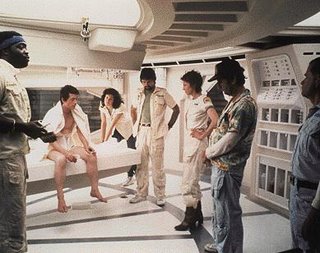
But beyond character, even plot, a horror film depends on mood. And watching it yesterday, I was reminded how much mood Alien has, thanks to the monster design, the music, the sets and costumes, the lighting and camera movement; and more than that the film's pacing, especially before the monster bursts (sorry) on the scene. Nothing you looked at or saw seemed innocent; and everything that did, seemed in imminent peril. In Alien's first fifteen minutes, Scott generates tension and dread, and a serviceable feeling of concern for its victims. Silent Hill just tosses CGI effects at you.

And that is the final failure of so many contemporary horror films. In the lazy decision that more is more, the filmmakers present us with a cavalcade of creeps dutifully marching across the screen, each more outlandishly blood-gushing than its predecessor--and all in the end merely empty blood fireworks displays, so unbelievable they become cartoonish (in a bad way) and dull. I'll admit some of Silent Hill's monsters seem almost beautiful in their surreal awfulness, but they tromp and jerk around in a movie without tension, without purpose, let alone pacing or integration with character and plot. At one point, we even get a "cinematic" of sorts, to outline the town's history. OK, it is cleverly presented as grainy newsreel or hidden video--and in itself is well-crafted--but, as in a game, the movie has to come to a dead stop to make room for a movie-within-a-movie to fill in for a real narrative. Now, I can understand the thinking behind the cut scenes in video games, but I'm always suspicious when the same thing happens in a film, even one based on a game. We're being told that the monster rally is all they have, and that any story--or idea behind the story--is incidental. And again, loading us up with mere visual excess is not enough. The scariest stuff in Silent Hill comes in the small touches: the lurch of a monster's gait, the mewling sounds of another, the sense that one is moving in a dream. Like Val Lewton with a budget. A good horror film is waiting there, but we don't get it.
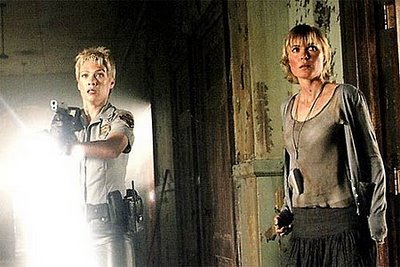
So my son and I watched Alien, and while it does depend on shocks, its commitment to mood and character makes it a much richer experience than Silent Hill. The crew of the Nostromo have distinct personalities--again, sketched quickly, but clearly. Geez, the two women (Rhada Mitchell and Laurie Holden) who search for the little girl in Silent Hill even look the same; but there's no way one is going to confuse Tom Skerritt with John Hurt or Ian Holm, or Sigourney Weaver with Veronica Cartwright, let alone Harry Dean Stanton with Yaphet Kotto. How smart to give us such disparate shapes and sizes, and to add to them variant senses of duty, humor, and morality. That way, when the monster shows up, we know who's in trouble, and we worry accordingly.

There's more to consider, not the least of which is the element of Freudian sexuality running through both movies, and which nicely illustrates their points of contact as well as differences. Good horror pictures do tend toward that crazy old Austrian; he provides an easy but potent (sorry again) subtextual machine, part organic, part cold logic--a regular cyborg--atop which the movie runs, as on slippery grease, keeping those diabolical wheels turning. Alien evokes male sexual fantasies (Sigourney Weaver) and fears (everything else), and capitalizes on misogynist views of orgasm (the sound editing is especially distressing, not to mention Weaver's brief encounter--sorry once more--with the alien at the film's climax--oh, I give up), while Silent Hill opts for Freud's assertion that women "laid the foundations of civilization by the claims of their love"--for their children and the maintenance of the home, since they have been "forced into the background by the claims of civilization" and have adopted "a hostile attitude towards it" (Civilization and Its Discontents).

This mother-urge in Silent Hill--strong as Ripley's in the first sequel, Aliens (but done with more depth and poignancy in the latter)--has potential, especially when we see that one of the sources of evil in Silent Hill is the witch-burning matriarch (Alice Krige), who seems to be the antithesis of the Freudian mother--or maybe, even better, simply its doppelganger--as she defends civilization by sacrificing its children, and thus becomes opposed to the maternal need to keep the family united; after all, one cannot build a civilization by staying at home all one's life (unless by "civilization" we mean chat rooms run by husky guys way past twenty, hunched over in their parents' basement rec room, Comicon t-shirt doubling as a napkin, stained with Cheetos-dust; and that may be the next step).

But as it stands, the Freudian element of Silent Hill does not generate much interest--unlike that of the horror-movie queen (if I may use the term) of all this, The Shining (1980). And heck, let's not forget that the computer in Alien is named "Mother," and is willing to kill the crew to save the alien--raising the question of whose mother the ship really is. Again, though, Silent Hill simply asserts mother-love, then tosses monsters and speeches at us. And I want more, even from a horror movie.


*I'd like to mention, though, that the real joy of this second viewing of Pirates of the Caribbean was assuring my son that pirates really did have a code--codes, really, depending on where you did your pirating, and with whom--and that some of them dressed as outlandishly as Jack Sparrow, and that others had the kinds of delusions of grandeur of Sparrow's nemesis, Barbossa (Geoffrey Rush)--and I want a movie in which both he and Ben Kingsley are villains; straight or camp, those two know how to make with the villainy--and that there really is a Tortuga, and that pirates really were hung and left to rot along the harbor. At least according to David Cordingly's Under the Black Flag, the only pirate history I've ever read--aside from some background information in a book I owned when I was a kid--and which I hope is still waiting patiently for me in a box in my basement--with, if I remember correctly, the self-evident how-to title, Hunt for Sunken Treasure.

Tuesday, August 22, 2006

125. "You know--for kids."

Well, I got my wish from the last posting, and saw The Hudsucker Proxy (1994) again. I've always thought of it as a movie nobody really liked, and confirmed my suspicions by checking out some reviews. Roger Ebert's is particularly telling: He frames it as a debate between the angel on one shoulder who loves the way the movie looks, and the devil on the other who complains it's "all surface and no substance." He gave the movie two stars, because the angel wanted to award it four and the devil wanted to punish it with zero. And so on.

Of course, as a comfort movie, such hollowness is not only unimportant, it is an asset. Like Seinfeld--heck, like Gilligan's Island--the best entertainments are about nothing. (And let's give credit where due: A good friend of mine, Gene the bigshot lawyer, a million years ago in college taught me to disdain "socially relevant" TV shows like All in the Family and M*A*S*H--at least those elements of the shows that aspired to seriousness--and to recognize that the fundamental image of the satisfied TV viewer is an enraptured kid wearing a coonskin cap. And I think comedy in general works best at this level. Seinfeld was on Letterman once, and said something simple and true: that his show was so successful because they held to a basic rule: Don't do anything that isn't funny. At first blush, that seems a bit reductive, like the classic advice on how to sculpt a horse: Get a block of marble, and remove everything that doesn't look like a horse. Or Steve Martin's breathless, excited revelation of how to become a millionaire: "OK, first, get a million dollars, then ..." But of course, Seinfeld is right. There are no moral dilemmas in the show--at least none that stop the comedy--no concerns outside of immediate, personal ones, no depth of thought whatsoever. And Seinfeld was always careful to point that out, as it inflicted all kinds of damage on individual selves and their communities, and at times the very fabric of society, without any qualms, without the slightest regrets. In this morally free space, one could go anywhere, ruthlessly cosmopolitan, and point and laugh at whatever, whoever, came one's way.

The Coen brothers have always known this. And this is one reason why I love their movies so much: They are a vacation from the moral universe, the "burden of freedom," the weight of tragedy--let alone the "eternal delight," as Blake would put it, of the ecstatic recognition of one's power and glory. And while the Coens pay attention to the comic possibilities of such weighty matters--consider the grave figures of their movies, watching the wheels turning, proclaiming a world bigger than any dope in a Coen brothers' picture could ever hope to recognize--those figures themselves are goofy, sometimes out of synch with the heartless machinations of the leading characters.

But wait; maybe the Coens make something more than Larry David and Jerry Seinfeld's "comedy about nothing." Because I find myself as attracted to those moral voices in the former's movies as I am the cads and dipsticks. And I think it is because the Coens have managed a pretty good trick: The integration of dazzling-but-meaningless stylistics with moral imperatives. I enjoy their hollow bounders because the Coens force them to lose, while doofuses like Tim Robbins' Muncie booster, Norville Barnes, end up on top. Yes, it's always some thunder-stealing deus ex machina--consider the cartoon-perfect stoppage of time in Hudsucker, as Norville's downward plummet is stopped--twice!--by the omniscient caretaker of the Big Clock, Moses (Bill Cobbs)--and for now let us pass over (ha ha) that name. This is a true comic world, open-hearted and optimistic, in which lovers are united, fortunes made--and even when the villains are punished, it often occurs with a grin, or at least a solid sense of righting things, of asserting the need not only to be funny but to do the right thing. I need a separate post for something with a bit more gravitas like Barton Fink (1991) or Fargo (1996), but it needs to be noted that even in their flat-out comedies the Coens remember that comedy works best when justice and mercy have as much say in matters as satire and glee.

The "all surface and no substance" charge, then, only works as far as one is willing to accept it--and the Coens do give the viewer ample opportunity to keep things light, to disregard all substance. But I've noticed that what makes me grin at their movies is not just the freedom of tennis without a net but the sweet joke of success, as silly as the losses suffered, but with the added advantage of rescuing one from the cruelty that is inevitable when the surface really is everything. And from the music the Coens choose to the performances they encourage, I think they find in their comedies a satisfying balance between heartless glee and order restored. One more look at Moses, the "Clock Man." His position at the top of the Hudsucker Building gives him the opportunity to know everything, and to observe the Coens' world with a rub of his chin and a slight shake of the head. It's silly, but it has rules, and it needs tending. And as he does, he exercises ridiculous powers that nonetheless tidy up the mess, and give everybody a break. Now that's comfort for you.

Wednesday, August 16, 2006

124. Uneasy as Pie

It seems every culture has its carb-based foundation-food, usually in the form of a flat cake or dumpling: tortillas and samosas, frybread and potstickers, hotcakes and crepes, gnocchi and kreplach, pierogi and spaetzle. Just typing them out makes me simultaneously hungry and full. They're simple, familiar, and easy--depending on who's doing the cooking in your house, of course, but you know what I mean. And cinema is full of movies like that, ones you could watch every week, old reliables always welcome. The genre doesn't matter, nor the country of origin nor year released. For me, it's The Maltese Falcon and Forrest Gump, Glengarry Glen Ross and White Heat, Alien and Diner, anything by the Coen Brothers or Hitchcock, Scorsese or Felinni, Kubrick or Lang. I can tuck 'em in over and over, good eatin' every time.

My wife has her own version of this: The Fifth Element and The Lord of the Rings, Fried Green Tomatoes and As Good as It Gets, Star Trek: First Contact and anything British, from the Age of Enlightenment, on through the general neighborhood of the Sepoy Rebellion, and stopping somewhere in the tree-dappled vicinity of Howard's End. I share some of her comfort movies--except a more recent one, Cast Away (2000). Twice was nice, three times OK. But it didn't seem to stick to my ribs; instead, it--oh, I don't know; I'm already beginning to feel trapped by this culinary analogy--skip it; I won't even make the attempt. Let's put it this way: I didn't want it on the repeat-viewing queue. From my first viewing, I insisted Cast Away would've been a better film if it had ended at the moment of Chuck Noland's rescue, with his hand raised into the frame, the ship gliding by, the alarms sounding. I felt the final act was simply a protracted epilogue that diminished the mythic power the movie had achieved in its long silence on the island, and Hanks' minimalist expressiveness. I still think his face works as hard in Cast Away as it ever will, but I'd always griped about the return, the loose ends tied up, the Gump-like ending, Noland's face staring, while a feather is pursued. Mighty labors--or labored.

And so of course, what happens: I come home from work, and my wife and two of my children are watching it. I walk in just as he loses Wilson on the open sea, and so the movie I get is practically all epilogue. But a funny thing happened: I found myself deeply moved by it, breathless in dismay. In his farewell to his wife, Chuck confronts death without paradise. He sees everything he loves taken from him, with nothing in its place. He remains as still as he can, stiff in the presence of a snake that is going to bite him--but it doesn't matter: He's already dead, and the only "afterlife" he's given is a brief parade of what he has lost, a futile embrace, and then the dark.

It scared me, that scene; and I realized that, in the final moment, in which he delivers the package and stands--as we all know, ready to follow the beautiful redhead--Cast Away grants a reprieve and becomes a movie once more, blessedly fictional, easy as a stack of flapjacks. But for one moment--at least today, seeing it divorced from the rest of the movie--Cast Away's epilogue made my heart stop, and asked it to contemplate the loss of everything it yearned for--specifically, the one I love, who for her part was calmly watching it for the umpteenth time, proud to say she was the only one who, albeit squinting, watched him ice-skate his tooth out. Ah, a movie moment, the lucky woman, and she wolfed it down. But the Cast Away I saw, twenty minutes long, told me it was all going to go, and I was going to have to take it. This will happen one day, and paradise has nothing to do with it because, as Socrates noted, you don't know if you're going to get it until you do. And as one's life moves, knowing only life, not knowing is simply not good enough. All the faith in the world--at least, all the faith I have--does not lessen the depth and dark of that hole into which--not you, but everything you love--must drop.

As Tom Waits sings, "Even Jesus wanted just a little more time / As He was walking Spanish down the hall." Cast Away, for a few minutes there, takes away that time, and gives me nothing but what must be. I think it's safe to say that this is the opposite of comfort food. Cripes; I really need to get myself in front of The Hudsucker Proxy or Coppola's Dracula or something; any silly dumpling will do.

Sunday, August 13, 2006

123. A Temporary Dream


Back on July 17, I wrote about Anthony Hopkins, starting with Magic in order to work my way toward The World's Fastest Indian. Well, after many years I finally watched Magic again (written by William Goldman, directed by Richard Attenborough). And my memory of it, at least those reflected in the July 17 post, seems to have been pretty accurate. Hopkins does do Karloffian pathos, but with a hyperactive vocal register, the Richard Harris-style "loud voice" so perfectly parodied many moons ago on SCTV. But in Magic it seems to fit, given the nervous in extremis situation. It was startling to watch Hopkins and the dummy yell at each other: Fats, the dummy/alter ego, raging in a keening voice that also managed to be as gravelly as Burgess Meredith's, who plays Corky/Fats' agent, Ben Greene--"Gangrene," as Fats calls him. All in all, another one of those 1978 creepy crawlers I mentioned the other day, Hollywood part-revolution, part-misfire oddities I will always have an affection for, especially if I "squint a bit."

Except for Ann-Margret. For the original kitten with a whip, it's eyes wide open. I'll admit I'd forgotten--sort of--how, ah, taken I was with her in that movie. Oh, let's be honest: not forgotten at all. In my late teens and early twenties she swam around in my head like Ahab's whale, except without all the, ahem, harpooning. No, Ann-Margret--and I am not telling anyone anything new here--exists in a rarefied atmosphere, the prettiest girl in school you--all right, I'll speak for myself--I would never have spoken to, let alone known. And so in 1978, three years after the Oedipal wigout of Tommy, there I was, watching Magic and finding myself identifying with Hopkins' character. Urg. Well, it was difficult to resist: in high school Corky had had a crush on her--loved her--but had never spoken to her. And then there he was, crazy as all get-out but finally getting lucky with--I kid you not--ex-cheerleader Peggy Ann Snow (Goldman, you have a twisted little mind). Again, if movies are dreams, and dreams are wish-fulfillment, this one came to me without metaphor, symbol, or sign, but unfiltered and flat out. Watching it today, I reminded myself how much I'd enjoyed those scenes of Corky and Peggy in love, and how temporarily soothing a movie can be. It's sad, I know, but it fits with every other emotion generated by the movies, no matter how awkward their origin or foolish their expression.

So when Corky falls apart, loses not merely his sanity but Peggy, it served me well, because his frustration was played out with such hysteria that I was able to leave the movie, in 1978 especially, with my own thoughts tucked away in relative safety--because I could feel I was not crazy like Corky, even though my mind had its own ripples and currents, not the least of which the illusionary movie-induced conviction that some guys have all the luck. Today, though, half a lifetime later, I can report that Magic provides merely the memory of a temporary dream--although I cannot deny its power, since it was a dream that held me over until my real life could begin.

Saturday, August 12, 2006

122. Squeak and Gibber


Appropriately enough, Edgar G. Ulmer's Strange Illusion (1945) begins with a dream: Paul Cartwright (Jimmy/James "Henry Aldrich" Lydon) walks with his mother and sister, while a shadowy father and Other go with them; and a train approaches, and sudden sentences are uttered, and anxiety builds. This is how I like to think of all of Ulmer's best movies, especially Detour (1945), The Strange Woman (1946--with a strange Hedy Lamarr performance), The Man from Planet X (1951), and his early masterpiece, The Black Cat (1934): dreams all, with a dream's low budget and big drop. Strange Illusion is perhaps the "lightest" of the films mentioned, although its smooth Hamlet references and queasy villain, Brett Curtis (part Bluebeard, part--believe it or not, in 1945--child molester, played with comforting '40s oiliness by Warren William, his pencil-thin mustache and low-rent Great Profile almost reassuring: after all, such an obvious cad--you know, more than kin and so on--looking like something Tex Avery might draw to chase around a hapless babe, is bound to be defeated--not to mention Paul's "sensitive" nature, played by Lydon with his usual gee-whiz faintness, all give Strange Illusion a decidedly tilted posture; like its dream-pursued, melancholy hero, it seems more than a little light-headed.

But chock-full of plot. The Hamlet-lifting serves it well: Paul's judge/criminologist father is killed in a train "accident," and Paul, markedly attached to him--and his mother (Sally Eilers, just hefty enough to look like a widow, but young enough to provide a Freudian whiff)--is haunted by a dream--which propels him to find his father's killer: Curtis, of course, pursuing Paul's mother, charming his sister--but creeping out his girlfriend, who suffers Curtis' deep-end affections in the pool--not shown, of course, but related to Paul as further evidence that Curtis is the movie's pre-nuptial Claudius, with an even bigger appetite than Shakespeare's killer. Curtis' confederate, a crooked psychiatrist, adds to the Ulmer-esque weirdness of the movie as he, Svengali-like, guides his former patient through the machinations necessary to get him married to the judge's widow--and thus ensconce him in the only family that could prove who and what he is (remember the dead father was a criminologist). Again, this is a plot that needs no thickening; from its dream beginning, it's one thing or another.

My only regret is that Strange Illusion ends up loving its plot too much, giving us, as one "bmacy from Western New York" put it on the Internet Movie Database, a "Hardy Boys" movie. I guess I wished for something more delirious, like Detour's clueless descent or The Black Cat's full-blown dementia. But Strange Illusion does provide a clear sense of Ulmer's strengths: his ability to keep things moving, his affinity for abnormal psychology, and his affection for shadows. And, in a Saturday-afternoon kind of way, it is enough, another Ulmer effort set "in the dead vast and the middle of the night."


From Lydon's 1941 high school yearbook: "A redhead Irishman who likes nothing better than a good argument. His aim is to be a pilot and a motion picture cameraman. Jim becomes positively poetic about roast lamb and apple pie." This is someone I would've liked to have known.

121. The Burden of Freedom


(WARNING: spoiler in 3rd paragraph)

Despite the title of this post, the topic today is not Kris Kristofferson--although, in its recognition of the slim thread by which our convictions hang, his song might not be a bad place to start. On the one hand, the one who seeks salvation is "bitterly" damned and condemned by those who "don't understand"; and on the verge of freedom--in the midst of its burden--he asks for the strength to forgive them. But by the end of the song, while he seems saved, he hopes to be forgiven for wounding "the last one who loved me," and himself ends up not understanding.

This song comes up a lot in my head, as it did last night, watching V for Vendetta. And here's another coincidence (although the film insists there are no coincidences): It ends with a song that contains excerpts from Malcolm X's "On Black Power," particularly those famous words about the virtues of self-defense "by any means necessary." While V for Vendetta presents some thoughtful ideas--the kinds Orwell handled so well in his seminal fables of totalitarianism--I'm made uneasy by V's (Hugo Weaving) dependence on violence, his appropriation of the enemy's strengths to assert not merely the truth but his need to revenge himself on those who unmade his life--and society at large. It is a simple objection I raise against the perpetuation of violence, "the chain reaction of evil," as Martin Luther King described war.

And then there is V's torture of Evey (Natalie Portman). Now, I won't deny the power gained by stripping oneself down, and the freedom earned through suffering. But Evey is not given a choice; and she is not punished for her convictions, but punished to create and hone said convictions. Martyrdom is one thing; coercion is another. And yes of course, V's society is venal, an opium-dispenser the likes of which Marx only glimpsed. But again, I'm simply unable to reconcile might with right. And I worry in these new nervous times whether terrorism--perpetuated not only by governments and groups but also individuals; the whole lot of them--should be extolled as a virtue. I'm not sure whether V's demolition of the Old Bailey or the Houses of Parliament is half as effective as his words. And there, then, is my last cliche: Speak the truth, live the truth, and you will give it to others, and make it so. Simple vendetta is not the truth, but an indulgence. You wouldn't have tragedy without the impulse for revenge, but you can accept the burden of freedom if you learn forgiveness.

And that leads me to one more thing: V for Vendetta is correct that death is not the worst fate. But I will not deal it out to others to achieve salvation; I cannot see the truth through such a curtain of blood. Instead, I hope, as in Kristofferson's song--and I guess I'm not just starting but ending with it--that I can be wounded and not succumb--or wound and be forgiven. C.S. Lewis' The Weight of Glory discusses some of this, including the joys of humility, in which one is pleased to please. At the end of Spike Lee's Malcolm X, Malcolm sends his bodyguard away, telling him he will not allow black men to kill black men; and in that final submission, in his own putting down of the sword, I think he shoulders freedom. And while V dies by his sword, I'm afraid the lasting image is the triumph of might.

I'll admit I'm still trying to decide exactly what to make of this movie. But I cannot deny the anxious voice I heard while watching it, the one that warns me against the misuse even of the truth and virtue. Maybe V for Vendetta loves Evey more than V; but she does cover his body with roses and propels the train toward Parliament. And the film seems too careful to portray it as a fireworks display rather than death and destruction. Someone must've been killed by such a use of force. And one is too many. That, too, is the burden of freedom.

Copyright Notice

Content copyright © 2005-2011 by Paul J. Marasa. No part of the written work displayed on this site may be reproduced, linked or distributed in any form without the author's express permission. All images, video, audio and other materials used are deliberately and solely for illustrative purposes connected with each article. Each accompanying element is intended as a research and reference tool with relation to each article. No challenge to pre-existing rights is implied. Aside from The Constant Viewer, the author claims no responsibility for websites which link to or from this website.