Tuesday, January 23, 2007

152. Rating Game Redux 4: Winners, Schminners


Just a quick and lazy posting:

The Oscar nominees were announced today, so I figured now's as good as time as any to unload yet another unpublished best-of local newspaper list, "Best Movies of 2006." (I submitted a little late, beat out by someone, a nice person in many respects, who nonetheless listed V for Vendetta among 2006's best. Are we still in the game? as one might ask in eXistenZ; 'fraid we are.) I will admit that (1) I didn't see many movies in the theater last year--I know, I know: despite the fact I can get in for free because one of my daughters regularly can be seen at our local octoplex wearing a bowtie and sweeping popcorn--and (2) these are really "favorite" rather than "best" movies. But here you go:

The Departed
Martin Scorsese proves once again that he is simply the best living American director, with a ferocious love of cinema matched only by the full-tilt performances he draws from his actors.

Rocky Balboa
An amazing accomplishment: Stallone induces audience-amnesia, allowing us to forget all those Rocky sequels, leaving us with a fond memory of 1976 and a new movie made up of sentiment, loss, and self-deprecating humor--as well as Stallone’s patented brick-wall uplift, absolutely. And remember: "It ain't how hard you hit; it's about how hard you can get hit, and keep moving forward."

Little Miss Sunshine
How does a story about drug addiction, monomania, attempted suicide, and sundry dysfunctions become the feel-good movie of the year? Simple: Just make sure that "No one gets left behind." In its own way, as filled with pity and love as Stallone’s movie.


Photo found on China View (www.chinaview.cn): "A person passes by models of the Oscar statue on sale in Hollywood in Los Angeles, the United States, Feb. 23, 2005. (Xinhua Photo/Qi Heng)" No doubt. But hey: Isn't that third one from the left in the second row Joseph Schildkraut's Best Supporting Actor award for The Life of Emile Zola? J'accuse!

Friday, January 19, 2007

151. Play and Pay, continued


"Flow my tears," the policeman said, running along the blade, scanning darkly. And how heavy the feeling was, like taking something made of poison--but not at first, just a little less breath and a weight on my chest, so that I find it--well, not difficult to move, just incidental to being right where I am.

And where am I? It seems small but free, like the high stool on which a Nowhere Man could sit, making his plans for nobody--except I'm lying down, one leg dangling, the foot on the floor, the couch scratchy on my forearms, my t-shirt bunching up beneath me, and the house quiet, while the traffic shivers outside, like small waves breaking. And the TV kept on, excited voices turned down but insistent, whittling at something until it becomes something else. So I crack one then two eyes open and see the flat familiar shapes on the screen sliding a little, like plate tectonics sped up--each million years a half-second, the jitter from millennia to millennia no longer discernible--and it's faces and cars and trees--and more faces, some dull, some shifty, all bearing down on whatever's in front of them--except some slip and shift forever, scrambled disguises, masks and altered tones until no one knows who's who. An undercover world.

And not quite real, rotoscoped and morphed, cartoons. Finally! some truth there on the screen, a cartoon at last. And they're all on something, "D" for Death, hilarious on the way down, until it's all bugs and funny looks from bystanders. And everyone I see is on the hit-list: Keanu and Winona, Woody, Junior and Rory, and even Philip. They keep remembering to swallow, and down they go--until, alone in the field, the second harvest peeks up, down there where the cornstalks meet the loam. And I quote:

"What does a scanner see? Into the head? Down into the heart? Does it see into me? Into us? Clearly or darkly? I hope it sees clearly because I can't any longer see into myself. I see only murk. I hope for everyone's sake the scanners do better, because if the scanner sees only darkly the way I do, then I'm cursed and cursed again."

But now I'm no longer on that couch, I'm on my own, and I see him, bending down; it is a moment without murk, almost joy--certainly relief, certainly one little piece of what should be--and he plucks a present for his friends at Thanksgiving. Almost death, then, but taken up and tucked away. And this gave me the strength to look it up, and one Frank C. Bertrand reminded me of something M.H. Abrams mentions about the Romantics in Natural Supernaturalism:

"Whether a man shall live his old life or a new one, in a universe of death or of life, cut off and alien or affiliated and at home, in a state of servitude or of genuine freedom ... all depends on his mind as it engages with the world in the act of perceiving."

Arctor loses his old life to live the new, plays and almost loses--maybe; we leave him in servitude with a chance of freedom slipped in his sock. I can see him, a clear and cleanly drawn object, flat and right there against the glass wall of my TV, breaking my heart at the thought of the way all that high-strung fun gets torn out of their heads by the absolute roots of it all. I'd laughed plenty, then knew it was time to turn over, curl up a little, cry over that long list of lost boys and girls. But the movie makes a little quavery toodle, like a theremin approached, and I smile at the spooky half-gift and almost-promise.

Monday, January 15, 2007

150. Play and Pay

Watching, while they lasted, the quick-jump joys of Francois Truffaut's Jules et Jim (1962)--as the two friends (Oskar Werner and Henri Serre) raced through their early adulthood, straight into World War I (on opposite sides) and the arms of the mad Catherine (Jeanne Moreau), where they held tight, released, and held again, squeezing until all breath was expelled--I was rueful in my assessment, if I may use so dull a phrase. On the one hand I envied their mad rush: They were using their strength while they had it, trying everything once--and finding much of it (some version or another of) good, running like children who whip their heads back and forth as they fly, heedless of destination, the terrain a veering blur, heads aching and mouths open in grins that refuse to become grimaces--but do, and that's the other hand: Senseless to the end, they dash toward their dooms; as Jim notes succinctly--always so, almost abrupt, whether in foolish whim or sudden certainty: "We played with life and lost."

I both yearned for and was appalled by the reckless course they run. I myself lived a much different third decade, having internalized an eminently useful yet--or should I say "and necessarily"?--deflating rule: If I do this or that now, what will "this or that" in turn do to me in ten years? Imagine being twenty and always caretaking some emerging thirty-year-old; one would have little time for one's current self, that unformed charge demanding so much, in silence but firm. Of course, sometimes I ignored my duties; but mostly I stopped, let the others make their pell-mell way, and stood--well, to rescue some pride let's say high on the windy hilltop, like a scout suddenly spotting a suspicious rustle--while less pensive heads rolled on, dizzy with the speed of their descent. So here I am, watching Jules et Jim, safe--thanks to that careful fellow thirty years ago--but again, sometimes rueful that I did not look up from the meticulous cataloguing of Needful Things to jump and be damned.

Then again, it worked. At twenty-four--after jerking around like a badly made tin toy,* mooning over one safely unattainable prize after another--thirteen days after I met my incredibly-soon-to-be wife, I asked her to marry me. We were both stunned, and I was not sure if I had thwarted my plans for the decade-away me--or whether after all I ever had any plans, just a hidden but essential impulse, and tried it out for sure that once--saving all untrammelled joy for one quick leap--and found out that if you take off just right, the ground does not rush up at you, but you almost become the air you're falling through, like Alice down the rabbit-hole, able to pluck from the shelves this and that as you go--and in the end it isn't falling, merely arriving. And so I have been arriving for the past twenty-five years--ahead of schedule, so to speak--and still playing with life, neither winning nor losing, but nonetheless in the game. It's a silly thing, but true: If you're lucky enough to have a roof over your head and meals in front of you and some measure of health, you are free enough to lose only when you quit. Catherine quits, because life will not let her play her particular game any more: She's been at it too long without a decisive move; so, like everything else in Jules et Jim, she loses quickly, with a look, a racing hurtle, and a fall.

Once again I've written myself into--I will not say for certain whether it is the truth or a reconciliation; maybe some of both, but mostly I've cast off my rue without plunging, but still loving Jules' et Jim's et Catherine's first high capering kicks, a part of me always playing, despite the fact that I'm not so much in the game as making it up as I go along, at long last letting the years do as they will, no longer ill at ease over the next move.


*Credit Where Credit Is Due Dept.: I have, ah, appropriated this simile from the final "British" chapter of Anthony Burgess' A Clockwork Orange, in which Alex, "cured all right," sees his old droog Pete, now married, "very nice, very pleasant, you know. Harmless"; and Alex, "both very very tired and also full of tingly energy," begins to see himself as another "clockwork"--this one, though, has no purpose or direction, but is "like one of these malenky toys you viddy being sold in the streets, like little chellovecks made out of tin and with a spring inside and then a winding handle on the outside and you wind it up grrr grrr grrr and off it itties, like walking, O my brothers. But it itties in a straight line and bangs straight into things bang bang and it cannot help what it is doing. Being young is like being like one of these malenky machines." Alex concludes it is necessary: "And so it would itty on to like the end of the world, round and round and round, like some bolshy gigantic like chelloveck, like old Bog Himself (by courtesy of Korova Milkbar) turning and turning and turning a vonny grahzny orange in his gigantic rookers." Alex's job, you see, is to become a real orange, all clockworks sprung, despite the "terrible grahzny vonny world."

Friday, January 12, 2007

149. Merrie Olde Woodie


I remember seeing Truman Capote on a talk show back in the '70s--Johnny Carson?--talking about Tennessee Williams' slipped reputation. Maybe Capote hadn't yet felt the full weight of In Cold Blood on his own career--or maybe he had, and Williams was just the beard--but I can still see Capote's insistent posture as he scolded the critical establishment for what he saw as a denigration of Williams via a sniping chorus of what-have-you-done-for-us-latelys. He asserted this would not happen to such a figure in France, that the French cherish their artists, that one such play as Williams wrote in his prime would be enough to enshrine the artist forever.

Well, so long after the fact I won't argue with Capote's assessment of French cultural loyalty; but I was--and still am--in complete accord with his impatience toward short memories and voracious appetites. Capote was right: a masterpiece is a masterpiece, a Golden Age never tarnishes, and if Williams never rose to later heights, the early and mid ones are still much more than simply enough.

Harumph.

Which leads me to Woody Allen. I feel like Capote when I think of the treatment he's received over the past decade. And by all quarters, not just the yodeling hyenas of the Media Press, having to sustain their Entertainments, both Tonight and Weekly, with whatever perpetual-motion machine they can cobble together. The Woody's-washed-up contraption clatters away upstairs and down, as though no one ever watched Manhattan or Crimes and Misdemeanors, Annie Hall or Sweet and Lowdown. I was Capote-ish in my chagrin when everybody allowed themselves both to gush over Match Point as well as slap him on the sinister side by "hailing" the film as a "return to form."

Sorry, closet cinephobes--so often disguised as movie-mavens or pundits, to me just a collective bowl of cold mush--but he's never been away, just running through various costume changes. I'm still smiling from his Match Point companion piece, that other Anglo-Saxon attitude, Scoop. Part Manhattan Murder Mystery, part Broadway Danny Rose, with a whisper of Manhattan and an occasional nod toward Woody-trails-along pictures like Mighty Aphrodite, Scoop fits into his career as comfortably as just about everything he's done. And who wants more from a filmmaker, and who would want to be anything more? Woody's 30+ movies are remarkably consistent for me, all springing from a post-'50s, middle-browed, buttoned-down-mind, as ready to spin a yarn as ruminate over a subtlety. I'm much happier simply comparing one Allen picture with another than one "Woody Allen" with another. We've been trying to commodify him for three decades or so, and the effort to package a one-Woody-fits-all seems to me infinitely less important, engaging, or simply entertaining than leaving him alone and letting him show us something every year.

And like Capote with Williams I'm willing to let Woody's masterpieces inform the doodles--and not to let one diminish the other. Life's too short--and I wanted to type, "and so's Allen"; let's just say, there's only one Woody Allen, and I'd rather treat him the way Danny Rose handled his audience: spluttering, sometimes befuddled, sometimes appalled, but always plugging away, asking for ages and Zodiac signs, smiling enough to keep us at bay and in our seats--where I'm staying until he tells me he's done.

Wednesday, January 10, 2007

148. "Then shalt thou count to three, no more, no less. Three shall be the number thou shalt count, and the number of the counting shall be three."

Note: This counts as Rating Game Redux 3

Our local paper's latest open call for best-of lists is "Best Movie Directors." As always, we can list only three. ("Four shalt thou not count, neither count thou two, excepting that thou then proceed to three. Five is right out." Sorry; I had to finish it.) I like the restriction; it leaves one with a haiku-sharp sense of economy, plus the anguish of having left out so many more. I'm not sure if my picks and commentary are going to make it (my word count is a bit high this time around) so I will not waste--wanting is always another matter--but post them here. Argue all you like; I'll probably agree with you. (Yes, I'm talking to you, you

Truffaut
Bergman
Ozu
Coppola
Wilder
Lean
Ford
Renoir
Chaplin
Hitchcock
Kubrick
Kurosawa

-o-philes; you're as right as could be. Especially the last three. Of course.)

Martin Scorsese
In the bomb-detonation business it's called a "controlled explosion": the bomb goes off, but only after the experts shoot at it or set off another bomb next to it or deflect the force of the explosion. This pretty much describes a Scorsese picture, as he manipulates the most incendiary human impulses with a master’s sure touch (and a mad bomber's glee), placing his actors--and us--just enough in harm's way to feel the heat of the blast but emerge in one piece (more or less).

Orson Welles
He made the best movie ever, then was punished for it the rest of his life. Prometheus, yes, but he invited his curse, and the tantalizing ruins he left behind--The Magnificent Ambersons, Macbeth, Mr. Arkadin, The Trial—as well as the still-standing monuments--The Lady from Shanghai, Touch of Evil--serve as remnants of an alternate movie-civilization in which Welles ruled, self-indulgent, -centered, and -satisfied, but never boring.

Federico Fellini
From his first film, Variety Lights (1950), to his last, Intervista (1987), Fellini calls our attention to a central truth of cinema: it is the most dream-like of the arts--that is, if one’s dreams are wish-fulfillments of cinema itself, watched in the dark but bathed in the glow of human memory and artifice, an imitation of "Action!" richer than the action itself. One part Da Vinci, one part P.T. Barnum, a master of mirror-writing and divine hokum, Fellini was God's jester, reminding Him that even forbidden fruit doesn't fall far from the Tree.

Monday, January 08, 2007

147. Rating Game Redux 2: Christmas Cavalcade:
On the 14th Day of Christmas ...


The following annotated lists were originally submitted to our local paper. The Best Holiday Movies appeared as a simple list with other contributors'; the Worst Holiday Movies list was not, I believe, ever published--I'm not always sure, since I do not read them in the paper, but just email them off. It's an odd arrangement, one that I only appreciate when, for instance, I'm at the bank drive-thru and the cashier recognizes me from my picture in the paper, or when I hear second-hand from my wife that someone likes the picks. Hence, "sheer egoism"--as Orwell puts it, listing the motives for writing--is satisfied without my poring over the actual printed version, scrap-booking it for those long winter nights or whatever.

In any case, here are my favorite ones, with notes added for this version:

It's a Wonderful Life As I wrote last year, the top of the heap: familiar and scary, heartwarming and edgy. A strange brew, suitable for sipping before the crackling fire--even if you don't have one.

A Christmas Story A close second (the others are not in any particular order), with enough repeated viewings by now that one can sing along, as it were, from verse to verse.

Miracle on 34th St. (1947 version) No better Santa than Edmund Gwenn. And Natalie Wood scowls perfectly, until the truth of Christmas sets her free. The movie doesn't talk down to her, but convinces in joyful increments.

How the Grinch Stole Christmas (TV version) Dr. Suess' signature style (crowded twirls and precarious topographies) filtered through Chuck Jones' signature style (perched silhouettes and delicate eyelashes), with Boris Karloff adding just the right note of semi-campy bah-humbug-ness.

A Charlie Brown Christmas Like A Christmas Story's permeating Jean Shepherd references, this one is packed with in-jokes for fans of Schulz--and with some true-blue late-'60s "commercialism"-bashing, plus some straightforward religion in the middle.

Holiday Inn Its race-consciousness is typically confused--Bing Crosby's black housekeeper profit-shares in the Holiday Inn while Bing does Lincoln's Birthday in blackface--but the Christmas and New Year's segments are postcard-perfect evocations of middle-class ideals. A nostalgia-piece set to (gratifyingly familiar) music.

Joyeux Noel A new favorite from 2005. Recounting the moment when Scottish, French and German soldiers emerged from their respective foxholes to spend Christmas together--and then catch hell for it later from their respective superiors--this movie allows you to wallow guilt-free in poignancy and aching sentiment--because it all happened, and one can let life break one's heart with joy and pity every once in a while. At least once a year.

A Christmas Carol (1951) Like Miracle on 34th St.'s Gwenn, this version soars with its lead. Alastair Sim's Scrooge is a sight to behold: He giggles--in both despair and uncontained glee--with such force that I cannot help giggling along with him, feeling my own feet hanging on the constant brink of Scrooge's losses. Sim makes Scrooge not an anomaly but ourselves, as ready to blame the past to excuse our present--and ruin our future. And just as ready, one hopes, to share our way out of doom.

The Nightmare Before Christmas OK, so it's just as much--maybe more--a Halloween movie (my middle daughter did watch it October 31). But just when I'm ready to suffocate beneath Christmas fluff, Tim Burton and Henry Selick toss a shrunken head in our laps, until ho-ho-ho and boo! sound happily alike.

The Homecoming I have not seen this for many years, but you wouldn't even be interested in this kind of list if you didn't agree with me that the Waltons knew how to be, well, the Waltons. And this Waltons' Christmas is as good as the '70s '30s-craze gets.

The paper also asked for the 3 Worst Holiday Movies. I avoided most recent big-budget ones for the true non-believers:

Santa Claus Conquers the Martians (1964) Almost too easy: goofy B-movie camp? Don't get your hopes up. It's a generally flat, slightly queasy attempt at a "spoof." Pia Zadora’s film debut, if that matters any more.

Eight Crazy Nights (2002) Punch-Drunk Love is Adam Sandler's best movie because it offers reasons to feel sorry for someone so damaged all he can manage is contempt, which is what Sandler seems to feel for his audience. Why else would he insist we share his obsession with anything that can be spewed out of bodily orifices, including heartless words? Somewhere in this sticky mess is Hanukah, the poor thing.

It Happened One Christmas (1977) Not a charitable pick, because it really isn't a "bad" movie, just a redundant one. Marlo Thomas' charms aside, there is no need to re-make It's a Wonderful Life, one of the best Holiday movies of all time. But that's for another list. [See above.]

I am now finished with painfully long-gone holidays. And please believe me: I'm happier about it than you are.

Thursday, January 04, 2007

146. Halloween Roundup (13-20): Done to Death


I have about another week of new-year energy left, and I've decided I simply cannot expend it by writing individual postings for horror films I saw two months ago. (Gee, what a rash decision.) But the Roundup will have its way with me, and so I will round it up all at once, right now:

13. Cronos (1993) Guillermo del Toro has a certain fearlessness to him. This may be due to his Latino verve (cultural stereotype #1) or comic-book-geek sensibility (cultural stereotype #2) or simply his big but nervous heart; in any case, his movies do not hesitate from, as Dr. Johnson might put it (metaphysically speaking), "the most heterogeneous ideas yoked by violence together." Consider the tenderness between the grandfather and granddaughter--while the former becomes a vampire and the latter empties her toy chest for his repose. And the ubiquitous Ron Perlman, forever since Quest for Fire part simian, part comic menace. And at the center of this the Cronos Device itself, as beautiful and horrible a mechanism as Gothicism has ever concocted. A glimpse into the "Pan's labyrinth" of del Toro's authentically outre mind.

14. Brides of Dracula (1960) Terence Fisher in ripe, Freudian form. The lasting image for me is the dark-haired Bride, for many years merely a still in Carlos Clarens' Illustrated History of the Horror Film, a truly delirious Terrible Teeny-Bopper on whom I had a troubling crush. Oh, the damage done by Hammer.

15. Ju-on: The Grudge (2003) I will forever insist that lovers of J-Horror need to look closely at Masaki Kobayashi's Kwaidan (1964), particularly its high-contrast colors and deep shadows, as well as its silent approaches and creeping pans, its left-handed framing--what is that in the corner? one wonders--and quick-cuts to the last thing you want, but have to take. Ju-on has learned those lessons, and added aural layers to Kobayashi's love of whispering wind and high-pitched keening.

16. Shaun of the Dead (2004) How does a movie filled with gore manage to make one grin without a grimace? Well, those cute British accents help, but what really works here is the matter-of-fact approach everyone takes: twentysomethings encounter zombies--sorry; not supposed to use "the zed-word"--and take advantage of the flesh-eaters' incredibly slow gait to make leisurely escapes, engage in lengthy conversations, enjoy a pint, all with time to spare for devising half-formed plans for survival, which are swept away by sheer military force. Plenty of bullets to go around, after all. Like Young Frankenstein, Shaun loves its source material enough to understand the proper way to spoof it.

17. The Other (1972) In his "User Comments" on the Internet Movie Database, one Keith Anderson writes, "[this movie] has haunted me for about 28 years now. I was 13 or 14 when I happened to catch it in its original theatrical run in 1972. For me, it's become one of those rare discoveries that truly feels [sic] like something of my own." Very strange; I was about the same age, and admit to similar feelings. Watching it again, it seemed less magical--although it retains its Bradbury-esque qualities--but remains a private screening, a hidden twin deep in the barn. In some ways built simply on a gimmick, The Other still manages to evoke a unique sense of nostalgic dread. Like Carnival of Souls, this is a movie that understands itself, and refuses to speak in other than its own voice.

18. The Changeling (1980) I know I've written about this before--I think--but I'm too tired or whatever to hunt around for it. Suffice to say it is a yearly Roundup entry. Best horrifying bouncing ball EVER! OK, so I checked: I mentioned it in an unpublished newspaper Best-Of list: Scariest Movie Moments or something, in which I wrote, "A small and innocent thing becomes a source of dread." True enough, despite the enormous hulk of George C. Scott puffing and glaring through it all. Still a tough (American) ghost movie to beat.

19. The Black Cat (1934) This is so fraught with amour fou I feel as though I've seen it many times, beginning in childhood. But I know it's only been twice, and in the last three years. Edgar G. Ulmer's '30s masterpiece, a dark fable in which Art Deco never looked so deco-dent.

20. The Texas Chainsaw Massacre (1974) Our one guest at the Roundup viewing of this movie was a nice young woman from work who seemed a lot less flustered that she was watching it than I was having her watch it. I kept apologizing to her, while Tobe Hooper carved the roughest Jack-o'-Lantern of the Roundup. I had forgotten the last twenty minutes is composed of uninterrupted screaming. People from two rooms away waited with uneasy patience for it to be done with. It still bludgeons; to be honest, I'm not sure I can watch it again.

Well, I'm sure I've left out one or two, but the id-lid must come down, kiddies, and the year must renew itself. My middle daughter wants to watch what one--maybe me--would consider the greatest films of all time, and I hope we can see all 10,000 or so of them. In the meantime a tentative list of what might be our first ten:

A Hard Day's Night
North by Northwest
Jules et Jim
House of Games
It's a Gift
Sweet Smell of Success
8 1/2
Full Metal Jacket
Ikiru
Bonnie and Clyde


As usual, I'm aiming for a foolish inconsistency, the hobgoblin of expansive minds.

Wednesday, January 03, 2007

145. Prime


When The Godfather was released, I resented its insistence that it understood Sicilians. My father was Sicilian, and I knew a lot of Italian guys in my high school; some of them were junior goodfellas, and I felt a somehow adolescent irritation with the way they identified with the Corleones. I admit I was filled with an indignation that wasn't sure what it was indignant about; what I do recall was how satisfied I was--smug? oh, I hope not--with the awful descent Michael undergoes in Godfather II; something in me wanted to punish all those Sicilians. Maybe it was because a few of those guys in my high school were smug themselves, casual bullies who had it all figured out. And I didn't want them to be at the table on Sundays, where my father's parents fed us with expected excess. It was a world in which two helpings were barely eating, and three barely enough to convince Grandmom she didn't have to shout Mangia!--and I'll admit it; she really did that, like a Mama mia in a bad movie. And OK, Basta pasta! we cousins would yell, not really knowing any Italian but pleased with the rhyme. This wasn't a movie, though, just Sunday. But by the mid-'70s those helpings were dwindling, as Grandpop died and the family began to drift away from each other. I seemed to be losing my Sicilian-ness just as every other ticketholder in America was discovering/inventing its own.

So was my irritation with the Godfather cult a form of mourning, or the simple need to maintain a hold on a simple claim: the way my father's side of the family lived? I guess I felt that Coppola was stealing a little something and giving it to those potato-heads who thought it was cool to be Italian--when all it should've been was who they were, not an instant movie moment. These were not the best combination of half-thoughts and impulses for careful film-watching; I'm surprised I could stand the two Godfathers.

By 1976, though, something good had happened: I was two years out of high school; and, like those South Park guys mention in Bowling for Columbine, it's amazing how quickly high school falls off your shoulders. Besides, at twenty I was a bit--just a bit--less confused than at fourteen, and able to move outside the constricting circle of psuedo-goombahs with too much money and not enough brains. In fact, I found myself completely understanding Rocky--and now that I think of it, thirty years later and having just seen Rocky Balboa, maybe Stallone gave me an Italian I understood: Not a phony winner, all wing collar and sneer, but a more hesitant variety of knuckle-breaker, as ready to call pet birds "flying candy" as to shout with bitter hope, "I had no prime! I had nothin'!" Rocky filled me with joy despite myself, because there I was, still trying to figure out if movies were art or pure satisfaction--and how bad are things in your head when those two seem mutually exclusive?--and I saw in Rocky a chance to enjoy the movies without sacrificing anything. It was written and acted with a startling tenderness and excess, unafraid to be sentimental but unwilling to deny its characters their uncontrollable desires. Just consider the always-dangerous Burt Young. Stallone seems to know exactly what to do with him, this wild hair who always frightens me a little; you're never sure what Young might do: hit the other actor, or start to cry, or sing a song, or just walk off and wander into another movie. But in Rocky and Rocky Balboa he is at home, another palooka refusing to go down.

And so, protective of the delicate/brutal balance of Rocky in my head, I was unsure whether to see the new picture. Those campy sequels are emabarrassing--anyone who likes them does so because they get to laugh at them while, for instance, insisting Mr. T is awwwwwe-some; I didn't want one last smudge on my memory of 1976. But Rocky Balboa pulls off a neat trick--more like breathes a final relieved sigh--as it erases all memory of those sequels and reaches back and clamps onto the first picture with love and joy--and sorrow and regret--and makes me a present of, if not the best picture of the year, my favorite one, a brick wall of a movie that never lets itself look foolish, and keeps itself alive with enough self-deprecation to soften the blow of Stallone's patented uplift. But even that, the Bill Conti fanfare of Rocky-ism, sounds clear and unashamed. When Rocky tells his son, "It ain't how hard you hit; it's about how hard you can get hit, and keep moving forward," I heard Stallone explaining most of himself--as well as Rocky--without an easy out. And as Rocky leaves the ring, turning his back on it--to face the crowd--I was reminded that, while the past does follow you, you can stop looking over your shoulder, at least long enough to raise your arm in both hail and farewell, and visit your Adrian's grave to recognize how solid you can make yourself, despite time and lost favor.

Saturday, December 30, 2006

144. Orphans in the Storm


I've been away--Christmas-time at my house is full and grinning, like Dickens' second Ghost--and maybe with those scary children clinging to its ankles; but we're too busy cooking and making music and grading papers and getting it all done so we can do it* to notice our Ignorance and Want. All we see is light and expectation. Then we get sick--this year, a stomach flu coursing like reindeer for twenty-four hours straight through us, no waiting (and I cannot resist: all things must pass)--then bang! it's gone and we're hungry again, but never again for what we ate at Christmas. (Without a keen--and forgiving--sense of irony, one can neither believe in nor put up with God and His little jokes.) But I'm back again, just for a word or two, then gone for a few days. I think.

I'm finally getting the true grownup present--you know, the good feeling of giving things to other people; that gift, and no kidding. But I am also blessed with children who know me well, and one gave me a remarkable Springsteen book, more like a museum installment, packed with photos and removable inserts and reproductions of tickets and backstage passes and programs. A Compleatist Fan's scrapbook. And another gave me Tom Waits' Orphans, three dreamy, spinning discs of "Brawlers, Bawlers, and Bastards." And listening to them--some "Bastards" first, now "Bawlers"--led me here, ruminative at the tail-end of the year, with James Brown, Gerald Ford, and Saddam Hussein suddenly now, if I can say it, the same. You may not agree that we are all guilty of everything--and I'll admit that sometimes I'm not sure what Dostoyevsky and I mean by that assertion of not-so-original sin--and you may yourself assert that one should not derive moral equivalencies too hastily, but some equivalencies are more equivalent than others, and looking back over the past few queasy days I'm not sure if I see Soul Brother Number One's white-horse ride to the Apollo, or hear Ford's artillery, or Saddam's--what? I didn't wait around to see if they really would air his execution--CNN and Fox were both promising it, there in the watches of the blue-glow TV night; all I have in my head are those wide-eyed shots of him, looking a bit perplexed, a bit angry, sometimes with his (rueful? exasperated?) hand alongside his cheek, an opposite-number Jack Benny--to be or not to be, with a (literal) vengeance--almost as if he were unsure exactly what all the fuss was about: After all, God is great, and what can happen as long as the cameras are rolling?

So here I am, driven by the sentimental confluence of Waits' growl and the flu and other ailment recoveries and onsets while the year wanes and the Way of All Flesh works its lasting charms on the good, the bad, and the ugly. Tom just sang, "There's somethin' to be said for sayin' nothin' at all." An easy exit cue, one I'm willing to follow, "down there by the train." Happy New Year, then; one more swift digit further up the twenty-first century.


*And OK, watching movies; but kiddies, I gotta finish the Halloween Roundup (and imagine that: You had simply to read those words; I had to write them) before I can parade through the Christmas Cavalcade.

Thursday, December 14, 2006

143. Halloween Roundup (12):
Round and Round


In an ecstatic moment of combined hyper-self-awareness and displaced cultural identification, David Lynch swooned like a lady with the vapors and woke up in Uzumaki/Spiral (2000), onetime music video director Higuchinsky's manga-inspired debut, dedicated to sliming--literally--the shiny veneer of small-town life, while mourning its demise, as slippery to the touch as a swatch of blue velvet. I watched this one last year, and it seems destined to become a regular at the Roundup. Like Mulholland Drive and Eraserhead, Uzumaki lives in its own world, even though we recognize almost every individual object from our waking life--even the ubiquitous spirals that herald the town's lurching transformation into, I kid you not, giant snails. Wandering its streets, catching out of the corner of spinning eyes spirals along walkways, in the clouds, on the water's surface, we come upon the secret town, the one that turns and turns. But more than that, this dream vibrates with its manga origins, as full of sudden exclamations and blackouts as snail-slow approaches toward terror and sickening revelation.

The humor of this film lies in its willingness to be absurd (the spiral-coiffed high school girls are a hoot); but of course in the best of the absurd lies revelation, true visions almost impossible to describe, as clear as they may be right there before you. A childhood friend of mine once told us about a dream he had: One by one, his seven brothers and sisters start disappearing. Eventually, he makes his way to where all dreams show their secrets, the basement, and sees his mother standing triumphantly over an open washing machine. He looks in, and, as he described it to us, saw a kind of oatmeal slopping to the brim: his siblings, mashed into domestic annihilation down there. Like Jack Torrance's dream in The Shining, the parent "corrects" and goes mad.

At one point in Uzumaki, a man obsessed with spirals finds himself unable to resist the interior of his washing machine. He is discovered by his son's girlfriend, wrapped like a meaty beachtowel round and round the wringer's curl, his face staring, his tongue suddenly popping out of his mouth in a curl, a spiral within a spiral within a spiral. Not the thin gruel of my friend's dream, but a turnaround, if you will forgive the term, in which the parent's obsession punishes the parent--again, "corrects" his shape into the inevitable spiral. Even the smoke rising from the man's cremation assumes the same shape, snaking down into a resevoir--the town's drinking water?--weather and geography combined to force the dream into what's left of the rational day, darkening the skies and leaving us with a "widening gyre" as solid as a snail's shell, as pervasive as any teen culture trend--which it seems for a while, until it rights itself as a full-tilt possession, making everyone's head spin.

For better or worse, this is why movies like this matter so much to me. I may be viewing them in my cozy armchair, but first someone dreamed them in the cellar, and had a hard time of it, as giddy as it sometimes may appear. Turnabout, as always, may be fair play, but, at least in Uzumaki, remains a dirty job for all of us.


I've always promised myself that this blog would not descend too far into cutesy self-reference (and I don't want to know how wrong I am about this), but searching for images to use for this posting, I was led to a Japanese site devoted to Pugs--and realized with horror that we own a dog, Frank, with an uzumaki growing out of him.

Wednesday, December 13, 2006

142. Halloween Roundup (11):
Diabolikally Dangerous


... and speaking of promises made, then long after fulfilled: First there were the glories of living near a (now-departed) Movies Unlimited rental megastore in New Jersey during the late '80s; the darn thing was as big as a chain drugstore, cowboys, with both retail delights and rental rarities--and true video-geeks behind the counter, as ready to wax rhapsodic about Enemy from Space (1957)* as they were Touch of Evil (1958)--both of which I was able to see courtesy of Movies Unlimited's (near-)unlimited movies. And then DVDs, and Netflix, and the flood after. As The Beatles sing--about something much more important--it's all too much for me to take. But I'm not complaining; in fact, I'm belly-up to the bar, downing one straight-no-chaser after another.

Take Mario Bava. When I was a kid with Carlos Clarens' book in my trembling hands, the ghostly, irresistible still from Terrore nello spazio/Planet of the Vampires (1965) drew me in like--well, like a vampire mesmerizing the soft neck closer--and I do think I may have caught it on UHF TV in the early '70s--or did that still simply work its way into my semiconsciousness, another cinematic deja vu, certain yet slipping away, at once something I knew and something I knew I'd lost? In any case, I finally saw it a few years ago on DVD, and have since viewed more Mario Bava, including both the "straight" and MST3K versions of Danger:Diabolik! (1968), with John Phillip Law's krazed-kat eyes and Spy vs. Spy pointy chin sweeping along the diagonal of Bava's go-man-go tomorrow-today sets. Durable goods, as long as you don't handle them too much.

For the Roundup this year it was Blood and Black Lace (1964), a true giallo--and once and for all I found out why Italian serial-killer-spree movies are called "yellows": The source material came from Italian pulps featuring yellow covers. More than a penny, mates, but still dreadful. The point of this arched-eyebrow subgenre is outlandish deaths--and so many American movies have followed suit, from My Bloody Valentine and Happy Birthday to Me (both 1981) to the Friday the 13th and Final Destination series. What remains with me most strongly from Bava's picture is the varied faults, sins and depravities of the victims--all of whom begin as suspects, until these little Italian Indians fall down, leaving us with the ugliest of them all unveiled and dispatched. The backdrop is a house of couture, a wild scene, baby, that is punished for being its rotten little self. There is something almost smug in such fatal reprimands; Blood and Black Lace follows the genre in this by playing all sides, enthrallingly shot, admonishingly disapproving of our indiscretions, and leeringly attentive to detail, all of it soaked in titular red and black. None of the giallo pictures quite adds up, but that defines their slippery nature, and one must give either in or up. I sometimes want to be done with them and move on to less uncomfortable surroundings, because, at least in Bava's theater, the aesthete, the moralist, and the hedonist have to put up with each others' ugly giggles, tsk-tsks, and gasps, as Bava, like a mad-genius pastry chef, makes delicious dainties in shapes one would prefer not to put in one's mouth.


*I still remember a conversation with one fellow who was originally from England and insisted the radio show devoted to the SF/horror adventures of Professor Quatermass was even better than the movies; this was an opinion I found at once intriguing in its aesthetic possibilities as well as indicative of the fine state of radio in Great Britain.

Friday, December 01, 2006

141. Halloween Roundup (10):
Dark Shadows


I know somewhere or other I've already written about Carlos Clarens' An Illustrated History of the Horror Film, but I'm more than willing to do so again; it's importance to my movie life cannot be overestimated. I still have my original copy from 1968, when I was at the sloppy cusp of adolescence, trying to muster interest in playing with toy soldiers, solemnly committed to afternoon cartoons--all to no avail, as I noticed with dismay that I had lost interest in the little land of counterpane and that the new almost-'70s generation of cartoons had nothing to them--or in them, or on them; "blank and pitiless" in their banality. One glossy sheet of illustrations from the Clarens book is missing--and I'm not sure what was on those two pages, why the pictures were so--what? compelling? "illustrative"?--that I removed them; and I like not knowing. A long-held book lives its own life, shared with its owner. And if the two of them stay together long enough, of course they begin to keep secrets from one another, sometimes even from themselves. So I will let those pages go, and the wherefores can be what they want.

Clarens taught me that movies were special effects--every one of them, at least as the product of an odd mechanism that flies and folds images until they achieve sequence, juxtaposing shot and reverse-shot, angle and length and depth, effecting more than observation of actualities and actors, set and scenario--and more than "reality" (I've been more or less reading Derrida, which puts one in the mood to hold at arm's length such hapless terms), but instead some kind of special truth, an object that works its way into the eyes and ears until it becomes a subject, a breathless thing as beautiful as black and white and shades of grey. And Clarens also taught me that such beauty often comes toward the viewer with an odd gait, a touch of evil, so to speak, that arrives slowly--like Lugosi toward Jonathan Harker or feline Simone Simon along the swimming pool's edge--or abruptly--like Spielberg's night-visiting shark or Tobe Hooper's Leatherface--until beauty and horror merge, of course in shadow. And best--or worst--of all, Clarens held out to me promises, but ones that at the time neither of us could keep: Dreyer's Vampyre, Murnau's Nosferatu, Jacques Tourneur and Mario Bava. But reading his book, I prepared rooms for them, and he gave me a sharper eye and more attentive posture as I've watched every day since.

And naturally many have kept at it, especially behind the camera. These days I see it again and again in Japanese horror films, such as Kiyoshi Kurosawa's Kairo/Pulse (2001), which manages to sustain the dim glories of the expressionst/noir vision, particularly in its subterranean uncertainties. The movie is offhand in its exposition, incidentally plotted, like Caligari or Cat People, and demands that the viewer almost constantly strain to see exactly what is that in the frame's periphery, and why it scares one so. Like so many of its late '70s-early '80s American progenitors, Pulse features young friends in peril, and holds out thwarted hopes of rescue and safety, until the world itself grows indistinct and silent, while everyone recedes into a whispering gloom.

As Clarens points out in many of his overviews of such films, narrative gestures may be perfunctory in this "certain tendency" of horror--"vague," indeed, in the English sense--but one must forgive such lapses with a barely apologetic shrug. After all, as Clarens writes of Val Lewton and Jacques Tourneur's approach, "for the night creatures themselves, these films substituted our dread for them." So the last special effect is produced by the viewers, consuming indistinct objects but never completely understanding them, even as they are held in the hands and brought up to the face, as close as one's shadow, and in the deepening gloom indistinguishable from the self. Pulse sees eventually the whole world this way, one in which there are no more stories, just the open sea and the fog rolling in.

Tuesday, November 28, 2006

140. Rating Game Redux 1: 3 '70s


In an effort to encourage my natural laziness, I have decided to use this blog for occasional reprints of "Ratings Game" lists that I've assembled for our local paper, The Register-Mail. Some of these have been in non-movie categories, but I will offer here only the cinematic lists. (And as proof of my simultaneously industrious and self-indulgent nature, I will supply addenda in boldface.)


Three Greatest '70s Stars

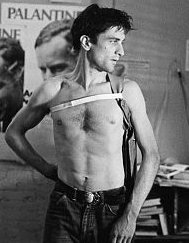
Robert DeNiro
If these days he seems content to mug his way through comedies, it's easy to argue it's because he burnt out in the '70s; just consider the roles he tackled: Bang the Drum Slowly, Mean Streets, The Godfather II, Taxi Driver, The Deer Hunter, and in 1980, Raging Bull. I'm exhausted just looking at the titles.

Of course, he always seems on the verge of a major commitment; his upcoming CIA movie may not be the King Lear I've been hoping from him, but at least it reveals he knows he can do more than Focker-baiting--even though he's awfully good at it. Then again, the real strength he may be showing here is as a director. So I'm still waiting.

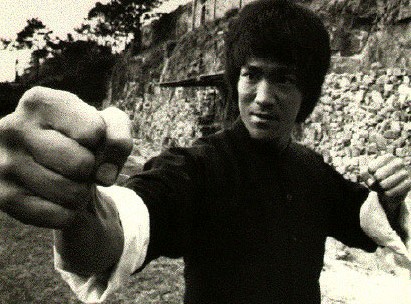
Bruce Lee
With about six appearances on film in his entire career--as many as DeNiro in this one decade--Lee still completely remade cinema’s notion of what an action picture could look like or be about, let alone how it could move.

I must admit, though, that my real affection for Bruce Lee lies in the genre he helped create--and which is at its best when it waxes poetic (Hidden Croucher, Dragging Tiger, or whatever the heck it is) or hysteric (Kung Fu Hustle); and better yet, in the memory of seeing one of his movies thirty years or so ago in a Cuban neighborhood movie theater. With my abuelita, no less, who screamed hysterically and wondered loudly--as did the entire audience about everything they had to exclaim--where they managed to get all that ketchup.

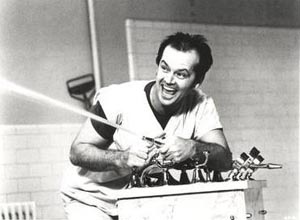
Jack Nicholson
Smilin' Jack. Jack--make that Knave--of Hearts. The big grin and the bigger trouble that came with it. In other words, the real '70s show.

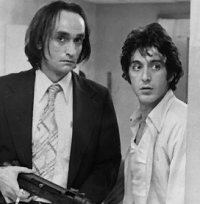
Nicholson belongs here most of all; originally, I realized that such a list also demanded Burt Reynolds, Karen Black, Al Pacino, Gene Hackman, George C. Scott, Dustin Hoffman, John Cazale--not to mention Richard Roundtree and Pam Grier, Alex Rocco and Richard Conte. But "The Ratings Game" calls for three and no more; a cruel mistress in a small paper. So I now make partial amends.

Monday, November 27, 2006

139. Halloween Roundup (9):
Lonely Dreams

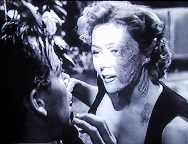
In blissful ignorance I hold in my mind what I prefer to think of as a private truth: that Annette Bening is lovely because she brushed, ever so lightly, against the soft cheek of Gloria Grahame, whose eyes flashed just a moment before returning the caress, a softly shadowed almost-wave as the past took her in black and white. I have no critical faculties--OK, maybe hardly ever, but never with Grahame, from It's a Wonderful Life (1946) and Crossfire (1947) to In a Lonely Place (1950) and, of course, The Big Heat (1953), in which Lee Marvin--such perfect casting; point blank, if I may indulge--swept up the boiling carafe in his long meaty hands and splashed rough pleats into her lovely cheek. And somehow Annette Bening (actually two years younger than me, but always seeming all grown up) smoothed that cheek, and wears it as her own.

You can see Grahame's bequest to Bening all over in the latter's work, especially in the wide-eyed outbursts of Neil Jordan's* In Dreams (1999), where Bening's hysteria seems as big-heat raw as Grahame's. Her daughter has been killed, and her dreams lead her to the murderer, played by Robert Downey Jr. with lips as pursed as Lee Marvin's--not, though, in snarls but kisses, each rotten-sweet, like the apples piled high in which he hides. It is in fact one squashed mess of a movie, beautiful and dumb--but never sitting still long enough to let you go. And while Downey, as usual, demands my attention, it is Bening I lean toward--tentatively, because her sometimes-nasty panic is dangerous, more than an echo all the way back to the late '40s, when her long-gone twin receded into the shadows, ashamed of what's happened to her face, but refusing to leave. Bening re-invents that tendency in Grahame, but adds a less jaundiced eye, and in doing so becomes not so much Grahame's savvy dame as her agitated double, vibrating with violence. It's odd, in a way: Despite her vigorous performance, Bening seems less capable than Grahame--and I do not mean as an actor, but in her character's response to evil: She scraps with it, topples over the edge with it, makes it happen. Grahame seemed to flow more, sometimes right into the rocks, but never openly rushing toward the growl of the rapids. In fact, in her headlong plunges, Bening often seems scarier than Downey.

I am not sure where the seam shows between the two, but it might be in Bening's aggressive posture, convincing and uncontrolled. She may, then, be giving us both Grahame and her nemeses, rough men who hardly ever stop to see if she's going to get up, but shoulder past her down the hall, slamming the door shut--all, of course, except George Bailey, who saw she needed attention. And in such a "protected station" she was able to find the breathing room to give us Annette Bening, a Hollywood pro-/re-creation that urges me to keep my eye on that soft cheek, unwilling though I may be now to raise my hand to it, because Bening might slap it away; and that too draws my gaze, a little afraid but thankful that I can see the shadow of her twin, lonely but not forgotten.


*This is a director whose "body" of work is a sprawling--mercurial? chimerical?--hybrid, all jammed onto the screen with a spliced-diced sensibility, including Breakfast on Pluto (2005), The Good Thief (2002), The End of the Affair (1999), The Butcher Boy (1997), Michael Collins (1996), Interview with the Vampire (1994), The Crying Game (1992), Mona Lisa (1986), and The Company of Wolves (1984). All of them up to something or other.

Tuesday, November 21, 2006

138. "One tough gazooka
that hates all palookas
that ain't on the up and square":
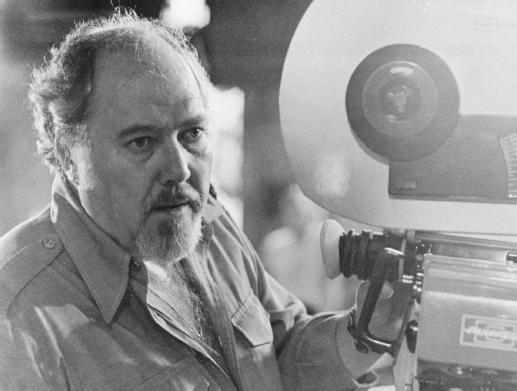
Robert Altman, 1925-2006


I will simultaneously arise from weeks-long silence and pause the (still-running) Halloween Roundup to pay my respects to Robert Altman, the original meatball surgeon. It's hard to imagine him being born a year before my father: The former's sensibilities seemed so much a part of the good-bad chemicals of post-modern cut-out/up culture, while my Dad was, if I'm to be stuck with this line of comparison at least for another sentence or two, a High Modernist, full of the whiz-bang optimism of a world defined by change. He enjoyed the fact that he was born in a Philadelphia where horse-drawn wagons were common, and was approaching a (never-to-be-realized) old age (gone at 70) in which microchips (and -waves) were as ubiquitous as boredom over space travel. Positivist flux, "all the way down the line."

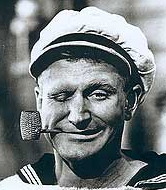
Altman, on the other hand, seemed in some ways to have sprung out of the '60s forehead both brand-new and all grown up--and gleefully outraged at It All--with M*A*S*H in 1970. And he didn't seem to look back much, barreling along with both guns blazing--and sometimes out of true, wild shots often, all smoke and noise and beautiful overlap, like Buffalo Bill (someone he and Paul Newman took apart messily in 1976, by way of Arthur Kopit's 1969 play) giving Mad Hatter history lessons. As the '70s circus rolled on, I found myself missing his bulls'-eyes (McCabe and Mrs. Miller/1971, Nashville/1975, Three Women/1977), instead lingering on the ones that sometimes seemed like feature-length outtakes fiercely proud that no one was watching (Quintet, 1979)--or unashamed if everyone was, but jeeringly (Popeye, 1980).

The Altman I held was one slippery fish, and either too big to hold on to or too ugly to handle. I didn't always love his movies, but I did always want to see them. And although I still cannot forgive him for trashing Chandler/Marlowe in 1973's The Long Goodbye, at long last I can admire how thoroughly he did so. (Two horrifying words: Elliot. Gould.) So when I saw his beautifully crafted TV version of The Caine Mutiny Court-Martial (1988) or the light-infused, deliberately paced and patched Short Cuts (1993), I would point to them as signs of his greatness, until after a while, it seemed I didn't need Nashville and company, while something like The Player (1992) seemed an Altman movie only marginally, as much his as The Thing from Another World (1951) was Howard Hawks'--which might mean mostly, but only in the set-ups and punchlines. The "real" Altman, you understand, was not interested in filling theaters, just the screen.

I'm glad this is my perception of him: a sideshow of import, an iconoclast who irritated his own generation by encouraging the noisy habits of their children. But a quick glance at Altman's TV work belies another take, with all those episodes of Route 66, Bonanza, Combat!, Maverick, Whirleybirds, Peter Gunn. Perhaps not simply Altman the blissed-out pest, but after all just one of those aspiring Americans reaching adulthood after World War II, often dazed and confused themselves, but workin' on it every day, and hard; the evening lineup as palliative and preamble. So go ahead, now that he's gone: look at Quintet's frozen beauty and the first real live-action cartoon, Popeye, and relax just a little bit in the fit-filled glow of Altman's long and bittersweet grin-and-grimace. (And, while we're on the subject of Buffalo Bills, ask, along with e.e. cummings, "how do you like your blueeyed boy / Mister Death.")

Wednesday, November 01, 2006

137. Halloween Roundup (8):
To Die For


(I know it's November 1, but the Roundup is--OK, has become--atemporal; I have a good dozen or so movies to cover before I can wave those bony fingers and bid a cackling "Bye-bye, kiddies!" to Halloween. Besides--and as usual with this Humble Viewer--such mundane details interfere with the flickering rush of one movie after another, unhindered by the labor of marking time. So let us speak no more of it.)

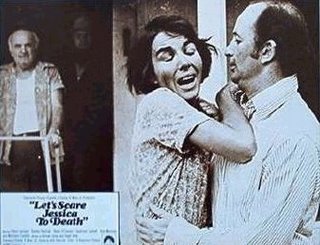
Twenty seconds into Let's Scare Jessica to Death (1971) and I remembered--what? Not that I'd seen it before; another five minutes and I was pretty sure I hadn't--although already it's happening again, a strange cinema deja vu: I choose a movie I'm not sure I've seen before; I watch it, assuring myself I haven't; I think about it afterward--or (and this works even better) start writing about it--and the feeling slips along my forehead, like a trailing damp breeze, that I have seen it before. It's happening right now, as I think about the opening shot, the canoe in the water, Jessica's voice-over wondering if it all really happened or is she mad and was it a dream, and so on. And the rest of the movie is a flashback, returning at the end to the canoe; so is that the moment of deja vu, simply seeing the scene twice? Or does it trigger a real memory? Or is it simply reminiscent of other horror films I've seen that feature a small boat in the water, from Friday the 13th to Humanoids from the Deep (both 1980)? Persistence of vision, the notion that the eye is fooled into seeing a series of still pictures as a single moving one, has been pretty thoroughly dismissed as a way of describing how movies are processed by the brain; but it remains an apt phrase for this refusal growing within myself over the past few years to tell one movie from another. Of course, I can still make such differentiations--but not at the level of memory, not after seeing it. So while I hope I will never confuse the three films I've mentioned so far, I know they have confused themselves in me, so to speak, these simply filmed observations of a simple thing: A woman sits in a rowboat while the bad moment waits to happen. So maybe I remember the movie only now; or maybe I've never seen it before, but watching it means I now have seen it, at least this one time (whatever could be, I wonder, the right verb tense for such uncertainty?); and so, at this stage in a life of movies, it at long last becomes one I've seen before, and gets to sidle up and insinuate itself into other films. The vision that persists, then, is not that I have seen every movie, but that I want to remember having seen them all. As Joseph and Barbara Anderson put it in "The Myth of Persistence of Vision Revisited" (1993), "we process movement in active meaning-seeking ways." This is, at least, how I process, if not movement, then at least movies: actively, seeking meaning (or at least recognition)--but also passively, succumbing to the myth/vision that every movie persists, somewhere. Well, I have silenced myself with this; better to just keep watching, and let them all be repeat viewings.

But what I do know I saw was Jessica herself, played by Zohra Lampert, an actor I immediately recalled--better yet, a face, a form, a set of mannerisms that never went away, not since I first saw them on some TV show or other. I checked the IMDb, and she was on TV a lot, in episodes of Route 66, The Defenders, The Alfred Hitchcock Hour, Dr. Kildare, The Man from U.N.C.L.E., I Spy, The Bob Newhart Show, Kojak, Hawaii Five-0, plus appearances in various movies. A face that invites deja vu if only because it must've darted and shimmered across my line of sight for a decade or so as I consumed TV with foolish nonchalance; after all, it was on.

Zohra Lampert, though, was no mere who-was-that bit player, a lost '70s face in the crowd. No, if you saw her at all, she stayed with you, if only because, as even my son noticed, you cannot read her. She seemed perpetually undecided whether the world was laughing with or at her, whether she wanted to grin or flinch, stay or go. She was like some kind of gangly land-bird just about ready to dart off. In some ways, playing in Let's Scare Jessica to Death a recovering head-case with a chuck-it-all-and-start-a-farm husband (with a remarkably sideburned friend in tow), Lampert found a perfect role: She really did look crazy, and maybe was, in an effectively indeterminate way. She made Jessica seem trapped in a particularly damaging emotional-memory exercise, star pupil of an unbalanced acting coach who didn't care how much harm all this stress was doing her; so Jessica herself didn't seem to know exactly where things were or who she could trust or whether the small-town vampires were real or, like everything else increasingly seemed, figments of a constructed imagination.

In other words, I couldn't stop watching her. For ninety nervous minutes, Lampert captured the essence of that first nameless sap who gets it just so we can glimpse the monster--except Lampert is forced to hang on, to walk the dark corridor the whole way, to creep along the hedge for an hour-and-a-half, to listen at the too-thin door far too long. And in her hands the effect is not unrelenting suspense, but exhausting explication of victimhood. But don't get me wrong: Lampert is no limp rag wrung in the anxious hands of whatever and blah-blah-blah (to tell you the truth, every once in a while even I get tired of writing like me), but a performance artist, if I may mix metaphors (or occupations), turning toward the viewer a self-conscious eye, a direct request that the audience watch her acting. It was fun but disconcerting, a true tall tale about horror's fractal pattern, lightning clawed across the sky, cliched but still making you jump. And at the very end, as Jessica slumps suddenly below the gunnels, she has been so indecipherable that all we can do is refer to the title to make sure what has happened: that they have indeed scared Jessica to death, something that, as I look back on the film--suddenly remembering it--Lampert had been insisting all along.

Copyright Notice

Content copyright © 2005-2011 by Paul J. Marasa. No part of the written work displayed on this site may be reproduced, linked or distributed in any form without the author's express permission. All images, video, audio and other materials used are deliberately and solely for illustrative purposes connected with each article. Each accompanying element is intended as a research and reference tool with relation to each article. No challenge to pre-existing rights is implied. Aside from The Constant Viewer, the author claims no responsibility for websites which link to or from this website.