Thursday, December 01, 2005

In a Panic


The mystical-psychological-surrealistical-comical-tragical filmmaker Alejandro Jodorowsky is one of those freakout cool cats of the old school who can say things like, "I ask of cinema what most North Americans ask of psychedelic drugs"; or, better yet, "The apocalypse is now! Americans know this, that the only hope is the flying saucers. Do you know how I see the world? Like a person who is dying. It's a worm who is dying to make a butterfly." Standing all on their lonesome like this, naked and exposed, such utterances seem, to put it mildly, screwy babblings. But the house has many mansions, and it would be a grave error to exclude Jodorowsky. Like David Lynch--and others; let's never forget the mad puppeteer of Prague, Jan Svankmajer--Jodorowsky has always insisted on an alchemical view of things, which means that he can be always be found scooping up dross by the fistful in anticipation of the day when it all turns gold. Hence the world as a worm, the idea of film as a drug: the center of the experience of making--and watching--films is transformation. And for the surrealists, it is a moment's work, a transubstantiation jumpcut. Don't blink or you'll stay a worm.

In 1968 he released Fando and Lis, a quest fable about a man and woman who seek the mystical city of Tar. The movie sprung directly, like Zeus' children, from his involvement in surrealist theater in Mexico: it is a filmed "memory" of a Francisco Arrabal play Jodorowsky had directed for the "Theater of Panic" (with an emphasis, I think, on "Pan"). He worked without a script, on weekends--like Night of the Living Dead, also released in 1968; so there: now stop asking whether the universe has meaning--and perhaps on drugs himself. It is a giddy, glorious mess about which I won't go into details, save two.

(1) Lis is unable to walk; we see this idea of disability, sometimes to the point of amputation, in other Jodorowsky characters--most notably for me in Santa Sangre (1989), in which an armless woman essentially enslaves her son, who stands behind her and acts as surrogate hands; this is the only other of his films I've seen. ( And I suppose that's a problem, since that excludes from my discussion El Topo (1970), which many seem to regard as his most extreme film; does that make it a masterpiece?) She is sometimes pushed along in a cart by Fando, but he also often carries her in a strange manner: he holds her horizontally behind him, like an oblong bundle, his arms crooked around her to keep her pressed against his back. It seems the least efficient way of carrying her, but Fando manages to bear the burden for long stretches, sometimes in surprisingly lengthy uninterrupted shots.

(2) Early in their travels, they come upon a devastated city--according to the DVD commentary by Jodorowsky, actually the site of a lunatic asylum that had been demolished. I want this to be the truth; it suppports my orderly universe theory. Amid the rubble, well-dressed people listen to a jazz combo, dance, play blind man's bluff. The central image of this episode is a man playing an upright piano that is on fire. Jodorowsky said it was his homage to Bunuel--and by the way, I'll be watching his film L'Age d'or (1930) tomorrow or Saturday; this is a pretty dizzying week for Your Humble Viewer--but as I watched, another image sprang to mind: In his concert film Big Time (1988), Tom Waits begins a song in closeup, holding upright a thin pole of some sort. The camera slowly recedes, until we realize he is holding onto an umbrella--which is on fire. He continues to sing, while the flames and smoke rise.

While the movie Jodorowsky made is sometimes a bit silly--like the man himself, from what I saw on the DVD extras--I found Fando and Lis compelling, just as I find Jodorowsky indispensable. Elements of surrealism have always peeked from the dark corners of art, from the masks and robes of Greek tragedy to the keening yelps of Japanese theater, from the cautionary grotesques of Bosch's paintings to the dancing bananas of Busby Berkeley's MGM musicals. Panic, indeed: Watching Fando and Lis is like witnessing Pan-rites: goofy but mythopoetic, pretentious but archetypical. Again, there's a line that stretches from the hidden rites of alchemy to Mullholland Drive (2001), and I think we break that line at our peril, because Jodorowsky's right: the world is a worm, but the butterfly is immanent; and when we let it slip away, the surrealists rush up with card tricks and fireworks, and rouse us to attention with stupefying non sequiturs.

Wednesday, November 30, 2005

"Learn That Poem, Learn That Poem"


I gave in to a fond indulgence: a DVD filled with Hal Roach's "Little Rascals" shorts, in all their cheerfully brutal glory, with enough nascent racism to make one squirm--but still enter laughing, buoyed by Stymie's doggedly insistent hunger that will never be sated, no matter how many sizzling frypans of eggs and ham or smorgasbord handouts--complete with Arty-choking artichokes and dog biscuits--or sagging sacks of candy--OK, here it comes: Yum, yum, eatumup--he can wolf down. Watching those long-gone children scampering around their nondescript edge-of-Hollywood early-morning locations--scraggly fields, stagnant ponds, dirt paths, alleys and culverts cluttered with handy brickbats suitable for bouncing off dog catchers' and truant officers' bald pates, and of course home to inexplicably available mules--I am once again filled with nervous excitement as they race between the legs of cruel adults, some of whom are actually armed, others merely squinting with Edgar Kennedy-esque certainty of delinquency; and I am filled as well with Stymie's hunger, broad and blatant, but real, even when he literally licks his lips in anticipation, because I understand the feeling: Anything--everything!--but mush.

When I was a kid myself, the Little Rascals were easily recognizable as real children, albeit inhabiting an idealized--or at least stylized--world, particularly because of their appetites: for food, of course, constantly, but also each other. They know how vital it is for children to, like good revolutionaries, hang together to avoid hanging separately. Exclusion from the gang is a bitter, tearful, panicky business; and their friendships demand a calm port after the storms of school and romance, capture and flight. While some adults extend affectionate or charitable hands--the nice ladies whose back porches Stymie approaches to beg for food, or shopkeepers and passers-by who indulge the children's whims--"borrowing" apples for an unsuccessful lesson in arithmetic (doomed to failure because of the apples' presence; they are, after all, food, not academic abstractions)--and of course the lovely Miss Crabtree, still the single most charismatic educator in film history (goodbye, Mr. Chips, you betcha)--most grownups in the Little Rascals world are active threats, far removed from the absolute values of childhood: appetite and loyalty.

The DVD I watched seemed determined to offer a thesis about those values: that they were best expressed in terms of the Rascals' relationships to dogs--particularly the phenomenal Petey, of course, but also a number of other crossbreeds tumbling around, fellow children--or at least creatures of the same world, pursued with ugly unrelenting violence by adults posing as dog catchers simply to make easier their acts of aggression in the War on Children. Petey is even featured in a weird silent short that chronicles in flashback his decision to commit suicide by hanging--assisted by a sympathetic fellow canine--in a telling turn of events, due to his master's betrayal. And true to form it's cherchez la femme, another appetite encountered--but the pursuit of the girl is an adult yearning; no wonder it spells doom. And Petey actually goes through with it, twisting at the literal end of his rope, but is rescued by his repentant master. If you want order--true, of a noisy sort, borne aloft by misunderstandings and a skewed child's-eye view, but order nonetheless--you have to turn your back on the adult world, or it can be lethal: Petey is gassed at the dog pound in another episode--and the fact that the gas canisters were empty does nothing to lessen the cruel extremes Hal Roach's series resorts to in order to test the absolutes that bind the Little Rascals.

The more I watch them, and the older I get--and doesn't that work out nicely?--I become convinced that, as stiff and formulaic as they are, these little films resonate. Yes, the Rascals are deeply caught up in bodily functions, material gain (Consider the truant wannabe, Brisbane, who, speaking out of the corner of his mouth--yet another Rascal visual trope--disdains his mother's plans for him to become President in favor of his own dream to become a street car conductor: "Boy, do they take in the nickels!" He listens to a hardworking man at his "grim forge" describing how he dutifully studied and was first in his class, all in the service of his own aspiration to reside in the White House. But as Brisbane observes with finality, "And you ended up a punk blacksmith."), and of course the joys of the chase. But they also seem to yearn for a perfected state, one that provides a justification for their appetites, a kind of vacant-lot-as-Pure-Form, a Rascal-ness, Professor, if you please, that places them out of the reach of starched shirts and outraged dowagers and allows them room to see the world as it is really is--or at least as they are always imagining it, which by the end of the second reel means a full belly, a safe pooch, and arms draped over each others' shoulders, as ready to give one another a kiss as a razzberry, in the safety and freedom of a partly hidden world at knee-level, little but not forlorn.

As Brisbane regrets his truancy, weeping as the Rascals often do--and not only because he has let down his mother and the radiant Miss Crabtree, but because, as an expelled student, he may be free but he is also divorced from the gang--he accepts his punishment: to recite a sickly sentimental poem, a rapturous ode to his teacher. He stands at the front of the room, torturously expelling the awful words, while the other kids howl their cleansing derision, drawing him back--and I don't think into simple conformity to adult authority, but to a far better place, where the clubhouse leans and Petey waits with Spanky--so fond of pointing out deviations from the Code of Loyalty with a sarcastic, drawn-out, "My pal"--and Stymie and Weezer and Farina, while that theme music, surprisingly plaintive, more goodbye than hello, reworks my childhood in its own grainy, mugging, double-take image.

Tuesday, November 29, 2005

A Year in Movies Begins


I've been writing pretty regularly this year; I started with the intent to write every week, and slacked off, then vowed to write every day, then slacked again. Eventually, I settled into a fairly regular schedule, intermittent but ongoing. I have come to realize that this current run has been a prelude to a kind of mission: to watch a movie a day for a year, and to write about that movie every day. Vanity, vanity, all is vanity. Fair enough; nonethless, I shall arise and go now, I shall strike the board and cry, "More!" I shall stand in the mead-hall and make my vow, swearing neither by my hand nor my head, neither by Jehovah nor Moses nor Allah nor the Buddha, neither by my mother nor my father--God rest them--nor wife nor children, but by my word, saying Yea. The rest is the opposite of silence.

I entertained the notion of beginning this journal with some sort of grand entrance--a discussion of Bruce Posner's Unseen Cinema seven-DVD collection, for instance; on the first disk, early motion picture cameras settle their gaze on direct and unadorned Life as it slides along a river or outside a train; or I could have raised a fitting paean to a classic film, touched unmistakably by the force of its own artistry as well as my memory of the experience of watching it. I thought of The Maltese Falcon, I believe the first movie I saw on the big screen after four or five scratchy viewings on television. I wanted to convey the sense of revelation I had, and how it has clouded the following decades of watching movies on TV, which I love to do, though it diminishes them - especially ones that deserve pilgrimage out of the damn house, like The Aviator or Eyes Wide Shut or Minority Report, all movies I have seen only on TV, what a shame. Some sort of fitting entree should occur; after all, I'm standing at the threshold of a movie a day, and of writing about each one; I'm already crowded with jobs and kith and kin, so I should open strong, at least for luck.

But I want this to have an element of the incidental about it, of the found--although I admit I'm getting all the movies through Netflix, lined up in a Queue I can unerringly manipulate with the aid of "Netflix Freak," a program that allows me to treat my Netflix account as though it were an iPod playlist--oh, the sleek and softly audible undertones of the Macworld, where everything's as smooth as a VW Beetle's behind and sharp as a Michael Graves teakettle. So I won't kid any of us with blather about accidental movie tourism. And yet: Here I go jumping off early, so to speak, writing today in late November, when I had planned to start January 1, run straight through to the last day of 2006's December. But I'm impatient for once; it is a rare enough feeling that I should take advantage of it, and start now. So I will.

Today I watched Time of the Wolf (2002), a French film about the post-apocalypse--nuclear, I think: I spotted a drawing on a wall that looked like a mushroom cloud; but the details are hazy. What is clear is that this film prompted me to start now. I’m weak-minded enough to appreciate the faux cleverness of beginning this journal with a movie about The End, and eager enough to get started, and to start with a sense of simultaneous discovery and intentionality. Time of the Wolf is a murky wander in the dark, a listlessly brutal and sonorous mediation on society's eagerness to slough off its civilized skin.

I won't get too smarmy and snide, but last weekend I watched Spielberg's War of the Worlds, twice (and one I did catch at the octoplex), and he covered much of the same ground as Time of the Wolf in two or three scenes that managed their own confluence of the brutal and the banal with intense and intimate attention. Time of the Wolf often seems disengaged; even its long-drawn-out scenes of tears and hoping against hopelessness failed to resonate, particularly because we were never asked to care about the people who passed through those dark vales. At one point I muttered, "This is why one can watch the evening news and not weep." This movie is like that: By keeping everything static, at arm's length, we are never asked to engage our moral sense. In fact, like the news, such an approach is immoral, allowing us to stare blankly while babies die and old women wail, as young men sit poleaxed at the crossroads, struck down and doomed.

I teach college classes at a nearby correctional facility. This term it's Introduction to Drama, and we began by spending many hours with Aristotle and Oedipus--exhausting company--and looking closely at the heart of tragedy, its bursting arteries clogged with irony, and I ask them to consider that the act of touching such a heart can break your own, what with all that fear and pity. I am always eager to present Oedipus to them, the story of a man who searches for the cause of all his troubles, and realizes it's him. It is something I leave hanging in the air before them as long as I can manage. And I find it now standing here in front of me; I have to look through it as I write about Time of the Wolf, and in all fairness I begin to see an effort at catharsis in its climax, as a young boy, driven to despair much too early in his life, grasps at suicidal straws, but is saved at the last moment by a stranger, who hugs the boy--whose father was shot and killed in the movie's opening scene in, I will admit, an affecting moment of shock and open-mouthed horror--and reassures him that everything could very well be restored, that perhaps even the dead will rise.

So wait a moment; where am I now? Time of the Wolf was a frustrating experience, so much so that I--the Will Rogers of movie-watchers--perversely wanted to use it to start this journal: a movie I met and didn't like. But here I am ready to accept it as tragedy, almost, its hamartia not hubris but hollowness--and, here it comes, hollowness immolated, as the boy intended, as a sacrifice to make things right again--but eating its own ashes to live again; and it emerges as a movie whose faults do not disappear but are transcended, the more I think about it (and I guess that was my first mistake), as the final shot unveils: a train makes its way through the countryside, which is beautifully quiet, but rushes past us because we are on the train, you see--and most of the movie is spent at an abandoned train station, a desperate locus of the urge to connect and establish order--and if we are on the train--which everyone wanted to get on, if only it would come--and, if the train did arrive, if only it would stop . . . Again, if we are on the train, then we are safe, and the world is coming back after all.

And we're off.

Monday, November 21, 2005

The Gazing Game, Part 3

Do you see what I see? Right here:

Solaris (1972)

The famous inky depths of outer space should reward the viewer with a solid emptiness that is so slow to change that one must hurtle through it to remember difference; but on Solaris one can simply stare at the curve of a hallway and everything moves, but at the periphery, and with a subtle hand at the elbow to drive one into the past, where a constant shifting seems necessary to keep the memories one step ahead of the anticipation of the next moment, which does not come, leaving only Solaris wherever one looks.

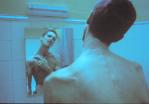
The Machinist (2004)

The face in the mirror advances like Romero's dead--but not with solipsistic cool; instead, the more the face approaches itself, the more its skeleton-stench fades in order to flesh out the necessary truth, until the self is nothing, the truth everything, and the forehead cracks the mirror.

Shadowlands (1993)

His bright and level eyes are fixed on God, but he does this without blinking, which is why they fill with blinding tears, and his gaze becomes a straining bursting mask of insistence and importuning, completely useless until he blinks and relieves the unnecessary effort, so that he can see again--if not so clearly, at least for longer stretches, and with joy.

Monday, November 07, 2005

It's a Wonderful Christmas Story

(NOTE: This is a revision of something I wrote last year for my previous website. File under "Redundancy Department of Redundancy")

In terms of decorating this blogsite with a Christmas piece, I know I'm as early as a Wal-Mart, but I want to be among the first to check in with my obvious picks for The Two Greatest Christmas Movies: It's a Wonderful Life (1946) and A Christmas Story (1983).

Let me quickly add Honorable Mentions: Miracle on 34th Street (1947), The Nightmare Before Christmas (1993) -- really more of a Halloween movie, though -- and the Chuck Jones version of How the Grinch Stole Christmas! (1966). Fine work all, but I think my two picks are the gems in the crown that shine more deeply, and tell us more about American Christmas and the thin red (and green?) line of the Season itself, than any others.

Any heft these movies possess comes from a dual source: (1) the brains of their creators--Jean Shepherd (and OK, the director, Bob Clark, who does get many things right) and Frank Capra--and (2) the faces of their protagonists--Ralphie (Peter Billingsley) and George Bailey (James Stewart).

In the Shepard/Clark movie, Christmas is bracketed and bookended by a variety of mishaps, malfeasances, and garden-variety meannesses. In fact, Christmas itself is forgotten for relatively lengthy stretches, as Flick's tongue gets glued to a flag pole -- and it hurts to watch, doesn't it? -- and Scut Farkus dishes it out (and takes it), and Randy roots among the cabbages, and a Major Award gets its fifteen minutes of fame, and lug nuts fly like sparks in the night air, while profanities bark and all of one's hard work results in a decoded "crummy commercial."

Despite these diversions, what places this movie on the list is its willingness to dip into Shepard's canon and fill out these mock-epic lives, to make us feel they deserve a perfect Christmas morning, with its granting of the wish for once --including of course an eye getting (more or less) shot out --as well as that amazing sequence that moves from innocent delight at a decapitated duck to a still and glowing and perfectly natural moment before the tree.

All of it becomes more than whimsy and farce--which good Christmas movies are wont to serve up--and more than heartstrings tugged, but an implanted memory, like all lasting family stories, retold so often the tale becomes the truth; and fiction, you need to know, is truer than fact.

Through it all, Billingsley's Hummel-figurine face, at turns beaten down by the adult world -- can anyone ever forget Santa's foot applying just the right pressure to Ralph's forehead to send him sailing down the Horrendously Happy Slide? -- and heart-breakingly confident it will all work out -- and he is right, after all -- reminds us that there is something at stake here: simply the rest of Ralphie's life, which I am convinced will take a course dependent on his foolish Christmas wish, ocular jeopardy or not.

All this, plus true hilarity, and flawless performances by Billingsley, Melinda Dillon, and that rough gem, Darren McGavin. I know you've seen this one way too many times, but I triple-dog-dare you to catch it once more between now and the Big Day, and treat yourself to a careful examination of all their faces. Not a single false note, just like a Christmas choir. As Shepard intones about the Official Red Ryder Carbine-Action Two-Hundred-Shot Range Model Air Rifle (with a compass in the stock, for some reason an ineffably beautiful detail), the movie itself becomes "the greatest Christmas gift I ever did or will receive."

As for It's a Wonderful Life, it too ignores Christmas for quite a while -- in fact, is in many ways not a Christmas movie at all. This is part of its greatness, in that Christmas is entwined in the fabric of George's story, where it becomes more than another episode, but the arena for the deciding moment in George's life. Unlike Ralphie, though, for George the moment is not the granting of a Christmas wish, but the relinquishing of a wish to be - actually, to have ever been at all. Ah, such Buddhistic bliss, to be allowed to meander off into stillness, quietude, and eventual nothingness, a cozy paradox where wakefulness is no longer required because there is no one to awaken. Like the clouds and the birds in "The Walrus and the Carpenter," one would not see George, for there would be no George to see.

Of course, George is not allowed to not be. He has lives to save, including his own. Somewhere or other, that sometimes-enlightening curmudgeon of a film critic, David Thompson, argues that It's a Wonderful Life is about the tenuousness of the American Dream, that a small sum of money can spell real ruin, and that George's violent panic, as wide-eyed and horrific as any Greek mask of tragedy, is averted only by a deus ex machina--or would that be populus ex machina, as his neighbors literally heap his salvation before him?

The moment is joyful, to be sure, but Thompson rightly points out its hysteria, with barely time to hear the bell tinkling out Clarence the angel's ascendancy. George must go on; the evidence of his necessity is too overwhelming, almost as shocking as George's earlier urge to tear it all apart.

I think, though, that this film is about something more than a close call. Like A Christmas Story, it insists that Christmas is a culminating moment, or better yet, a fitting space to work out wishes made with conviction AND in haste. For me there is something deeply attractive about the snow scenes of both movies, like Robert Frost's snowy woods--except their snow does not distract from the promises to keep, but punctuates those promises, with an exclamation point or an ellipses, and promises further promises, if you follow me. This is the faith to which these movies testify. Clarence and his twinkly eyes and all that are not where faith rests; they are cute catalysts to get George careening down Main Street, delirious, first with pain, and then joy. And as any moralist will tell you, it's always pain first.

I suppose what I love most about these two movies is their willingness to surrender to the notion that one can be both an idealist and a dope. Ralphie and George believe in what the poet G.M. Hopkins calls "the habit of perfection"; the fact that they walk into all kinds of walls because of that belief does not deter them--nor does it detract from the value of cultivating that habit in their drafty, perfect little living rooms.

The Last Man (Standing)

(SPOILER WARNING/APOLOGY: I'm sorry, but I cannot write what I want about this film without giving away the ending. I know I'm breaking The First Rule of Moviegoing, but I cannot avoid it. Feel free to Netflix this movie and watch it before reading; I'll wait. Humbly, as always.)

F.W. Murnau's The Last Laugh (1924) is one of those silent films you should watch if you (a) love movies but (b) are wary of silent ones. Let me assure you that there is a list--I should show you mine one day--of silent movies that will cure you of your not-entirely-unwarranted hesitation, and The Last Laugh is one of them.

Still, depending on your age, the silent era is two or three generations removed from your experience, so I will not be such a snob as to scold you for a perfectly natural apprehension. Let's keep in mind that plenty of avid, even serious readers have to take a deep breath before reading Shakespeare, or Chaucer, or Homer, let alone most poetry. So we'll agree that the problem exists. Now, let me try to solve it.

The director of The Last Laugh is best known for Nosferatu (1922), his "unathorized" version of Dracula. But he also directed other remarkable films, most notably a version of Faust (1926) followed by Sunrise (1927) and Tabu (1931), all noteworthy because of their collective commitment to fluid camerawork and expressive set design that work together to reflect his characters' personalities and perspectives.

Watching Murnau is a curiously "modern" experience, if only because, in a variety of classic and contemporary films, from Citizen Kane (1941) and Night of the Hunter (1955) to Scorsese's and Spielberg's restless cameras, we see Murnau's influence. Consider the sharp slanting light that cuts through the shot compositions of film noir, the subjective perspective as the camera moves smoothly through the bar scene in Mean Streets, or the swooping glance across the audience in The Age of Innocence. And let's not forget the giddy low-tech stunts that got Barry Sonnenfeld (as cinematographer for Raising Arizona) and Sam Raimi (Evil Dead) noticed, not to mention the dizzying tracking, dolly, and handheld shots that thrust us headlong onto the beach in Saving Private Ryan. One can see Murnau's hand at work everywhere a director wants to carry us with and into the action.

In The Last Laugh (German title: Der Letzte Mann, literally, "the last man"), Murnau brings his bold acrobatics to a painfully simple story. An anonymous hotel porter/doorman (played by the formidable Emil Jannings, who came to Hollywood, was made unemployable by talkies, and returned to Germany, where he became a leading figure in Hitler's film industry), whose identity derives exclusively from his position--even more specifically his uniform, with its heavy square shoulders, epaulets, and shining buttons. He lives among the working poor, but works among the gaiety of Germany's Roaring '20s. Preening, flirting, manfully hoisting luggage, he gains all his status via the irony of his job: He is the fanciest laborer in his neighborhood.

But he is getting on in years, and the hotel manager notices how he struggles with a trunk perched high upon a rain-swept taxi, and the bit of a sit-down he needs afterwards, and immediately demotes him. He is now a washroom attendant, spending his days underground, brushing dinner jackets, supplying towels, accepting small tips. He even takes his meals in the bathroom.

Ashamed, he attempts to keep his demotion a secret, stealing his confiscated uniform and donning it as he approaches home, where he climbs the stairs past the other tenants, who as usual cease beating rugs and emptying garbage pails in deference to his uniform. While his pride, his very identity, has been sullied and soiled, the uniform is spared.

Eventually, the truth emerges, and the neighbors who had given him such respect turn on him, jeering at his diminished state. He is now their equal, and the object of their scorn.

The ex-porter reels from these humiliations, casting himself down even lower than the hotel manager and his neighbors ever could. Alone, completely extinguished, he slumps in the dimness of the lavatory.

Murnau tells the story without the intertitles we often depend on in silent films--so that it is more fitting to state that he does not "tell," but truly "shows." The action occurs in a special kind of silence: All of the exposition and character development is physical, down to Jannings' remarkably expressive face.

It is a pantomime of epic proportions, set amid looming skyscrapers--at one point the hotel where he works, now an object of dread, literally bends toward him like a great, leaning monolith, threatening to crush him--and increasingly darkened streets and rooms. This alone is enough to give this movie a special place in film history.

Something else, though, occurs in its last ten minutes that struck me deeply the first time I saw it, when I was in college, and has haunted my attitude toward film ever since.

It is a turn of events that Roger Ebert finds "improbable and unsatisfying." The ex-doorman is alone in the bathroom, so still he might as well be dead, and the scene fades. Suddenly, the film's only intertitle appears, and states, "Here the story should really end, for, in real life, the forlorn old man would have little to look forward to but death. The author took pity on him and has provided a quite improbable epilogue." As Ebert tells it in his "The Great Movies" essay, "The doorman accidentally inherits a fortune, returns to the hotel in glory and treats all his friends to champagne and caviar, while his old enemies glower and gnash their teeth."

Ebert complains it is a painfully obvious tacked-on happy ending to soothe the sensibilities of the day. Perhaps; but even on its own, it is a remarkable sequence, filled with glorious excess, scenes of eating and gleeful consumerism, punctuated by not only gnashed teeth but the delighted, and I think condescending, smiles of the other hotel guests.

When I first saw this film I was stunned. But unlike Ebert I did not feel cheated by the ending; instead, it taught me a simple but fundamental lesson about film storytelling that I have never forgotten. In that moment when Murnau--better yet, as the intertitle puts it, "the author" (shades of auteur!) steps in and yanks the story out from under us, he completely undermines our trust in film narrative--a trust that is at once immediate but fleeting, because as the images roll on, we are forced to watch closely, lest we miss something. And we expect that attention to be rewarded with a recognizable narrative arc, rising and falling as all narrative has since we hunched around the fire and told our stories--and then of course drew the tale on the walls (I like to think of them as the first storyboards).

But the film punishes us for paying such close attention, for trusting "the author" so much, and reminds us of the power of storytellers to do what they please. It is unfair but, in a stinging Socratic way, instructive: The Last Laugh sets us up to thwart us. All of our intellectual and emotional investments derive from the choice we've made to be manipulated by the film; if so, we have no right to complain when the manipulation continues counter to our expectations. After seeing The Last Laugh I learned that I can trust myself as I watched movies, but need to be on guard. Dangers lurk in a great movie because it's freer than my needs; in fact, it may even have an agenda counter to those needs.

Over the years, I've found the caution that Murnau taught me to be a good thing. It has increased my pleasure when my expectations have been fulfilled, and thrilled me like a roller-coaster when thwarted. In either case, I'm reminded I'm merely one of those "little people out there in the dark"; but there's nowhere else I'd rather be.

Friday, October 28, 2005

The Gazing Game, Part 2

Once more I stop and stare. Like this:

Citizen Kane (1941)

He cannot believe what he sees: As he makes a gracious gesture of invitation to the wide world to love him--a kind of wave of the hand, almost like a magician--he is rebuffed, as though he had raised his hand to strike, not offer; and his outrage seethes and contests the verdict, certain someone has him all wrong, but there it is behind his eyes, the near-panic, while a simple but monumental thing, a child's moment, looms and burns.

Peeping Tom (1960)

You wonder what is that godawful thing you're looking at, that curving face, the whole thing like a blurry smile, concave--convex?--and leaning into you--and you realize it's you, your eyes wide, your mouth open, and without any breath left you know you should be screaming, because the sharp point has touched, and more than touched, and continues to approach.

Eyes without a Face (Les Yeux sans visage) (1960)

The car races, its headlights slicing the night like Dali's razor--or Bunuel's cloud--toward the girl in the mask, her eyes impassive as she watches the scalpel flash and the flesh fail beneath the weight of her father's desperate guilt, strong enough to fling him into the jaws of Cerberus.

Thursday, October 13, 2005

Good Luck, Last Night

Our fair town received a rare treat last night: We hosted the Midwestern premiere of George Clooney's Good Night, and Good Luck in the remarkable Orpheum Theatre. So here we are, finally exactly like New York and Los Angeles. At least as far as Clooney movies go. Galesburg is the home of Knox College, whose journalism program boasts Marilyn Webb among its faculty; one of her professors was Fred Friendly, played by Clooney in the film, and we were further honored to have it introduced by Knox's own Bob Jamieson. All in all, a regular single-entry movie festival.

The film itself has a beautiful consistency in terms of its subject matter and visual and acting styles. While Edward R. Murrow's on-air joust with Senator Joseph McCarthy is the stuff of TV journalism legend, it was played with an understatement that today seems almost morose. Good Night, and Good Luck is valuable because it reminds us of what American Cool really means. Like Miles Davis and Chet Baker, Murrow and associates perform straight-faced, level-eyed; nobody sweats, and the deadpan wisecrack becomes the only discernible measure of emotion. Watching the film, I was reminded of Apollo 13, another movie in which monumental acts of heroism are performed by semi- (and not so semi-) nerdy guys (and gals, in Clooney's movie) with horn-rimmed glasses and white shirts, people who know their jobs well and do them without drawing undue attention. These are rock-solid types who may be seething underneath, but on top give us only a square shoulder and a frank gaze. I once saw Miles Davis perform; he wandered around the stage, eventually making his way behind the drumkit, out of sight of the audience. The horn never wavered, but the performer slipped away, never missing a beat. This attitude is captured perfectly in Good Night, and Good Luck, particularly by David Strathairn. While he allows his Murrow an occasional tic of the eye or drawn corner of the mouth, mostly it all comes down to a deep concentration nothing can break. It is an attitude that seems long gone; and the film seems to imply that we are in trouble without this cool in the face of the marching morons of politics and cable news punditry.

There is so much to admire about this low-key movie; other reviewers will tell you of the beauties of its black and white--more like nuanced shades of gray--and the single exuberant touch of the vocal jazz combo whose musical numbers throughout the film punctuate key moments. What struck me last night was the movie's ability to make me long for a return to cool in the face of fire. We are always under one Blitz or another; I wish I could take mine with half of Murrow's reassuring immobility.

Wednesday, October 12, 2005

Bob Clark Shouldn't Play with Dead Things


It's instructive, I think, to note that the director of Children Shouldn't Play with Dead Things, Bob Clark, gave us A Christmas Story (1983), which is, along with It's a Wonderful Life (1946), among the greatest Christmas movies. But he has also helmed two Porky's movies, as well as Rhinestone (1984), Loose Cannons (1990) and a couple of Baby Geniuses movies. Yikes.

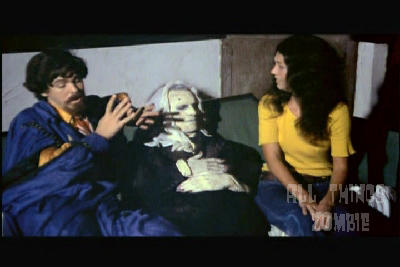
But Clark's checkered career is only the tip of this nasty little iceberg. Children Shouldn't ... may boast a great title in a genre that prides itself on titular extravagance--consider The Incredibly Strange Creatures Who Gave Up Living and Became Mixed-Up Zombies (1963)--but I'm afraid that's not enough. I'll admit I watch movies like this in part for the unintentional humor, but I have such a genuine affection for horror and SF films that, as much as I enjoy Mystery Science Theater's smug jibes, in the end they seem too easy. And I don't feel I have to lower my sights to appreciate low-budget films. Most fans agree that these movies are of the hand-made variety, so it's OK if a few seams are crooked, so to speak. And besides, to judge them by Hollywood fare marks a surrender to imposed "standards" that Hollywood itself is hard-pressed to live up to. Just ask anyone who's seen Battlefield Earth (2000). No, as many others insist, the Grade-Z genre pictures of the 1970s and before mark a true independent movement; by being cut off from big budgets, they had to rely on actual creativity and imagination.

Unfortunately, though, Children Shouldn't ..., well, doesn't. Have any creativity or much of an imagination, that is. I admit it did have just enough budget to produce Night of the Living Dead-style makeup effects (although Night's effects do look better, in large part because they're in B&W. See? Budget isn't the problem). And it had an intriguing story: An egotistical theater director (played by Alan Ormsby, who also wrote the screenplay and the one for Paul Schrader's remake of Cat People; how's that for a tangled web?) and his troupe go to a cemetary island, play with dead things, and naturally get more than they bargained for. There're just enough ideas here to get us through set-up, chills, and The Goods--that is, zombie massacre/just desserts. But I had the instructive experience of watching this last night with someone who has little patience with low-budget horror films, and her silent disapproval and impatience with it all influenced my own reaction. And I must admit she was right. Children Shouldn't ... is annoying, tedious, inappropriately hysterical, and self-indulgent. In a bad way.

Let me stress that low budgets and mediocre acting are NOT the problem. The semi-independents of the 1940s and '50s--Val Lewton, Ida Lupino--produced some real gems; and of course any number of filmmakers--George Romero, Tobe Hooper, Chris Kentis (Open Water, 2003), the Blair Witch phenomenon, to name the famous few--have done remarkable work with little time and less money. And let's not forget documentarians and animators, from Errol Morris to Mike Judge, who began their careers on the proverbial shoestring. So "quality" at the surface level is not the issue. Just look at Roger Ebert's list of Worst Movies. Most of them are Hollywood pictures with huge budgets. I agree with him that what we need to see on screen are living breathing imaginations at work.

Which is where Children Shouldn't ... falls apart for me. It didn't trust its premise enough and was too self-indulgent, spending much of its overly long (almost 90 minutes) running time hammering us with character "development" and "conflict," when all it needed to do was establish the mood, sketch out the characters, provide space for three short speeches--one for the egoist, another for the rebellious actor, a third for the submissive one--and keep hinting that things are going wrong. Then fifteen minutes of mayhem at the end. Clark only gets the last right; but by then we've been bored and frustrated by the need for his cast to chew up their particular corner of the scenery.

Maybe the real problem is timing: Right before Children Shouldn't ... I watched Val Lewton's The Seventh Victim (1943), about bored intellectuals in NYC who become Satanists. The director, Mark Robson, needed only 70 minutes to immerse us completely in a world dominated by a jaded disregard for life, where suicide hangs--literally--in the air, a constant promise and threat, and where no one wins. The movie kills three people in an almost casual manner that is both despairing and subtle, all in the service of a Poe-like concentration on its "single effect": the dreadful inevitability of death. I will at some point devote a separate posting to The Seventh Victim; I bring it up now only to remind we lovers of low-budget horror that one needs talent as well as desire, vision as well as determination. Look at poor Ed Wood. I think Tim Burton gets it right in his biopic: he portays Wood as a man completely dedicated to something for which he had no talent. The so-called "turkeys" that resulted were foregone conclusions, and although they might not deserve our scorn, I don't think they can be praised. I'm afraid I have to say the same for Bob Clark's debut film.

(NOTE: Believe it or not, someone seems to be backing a remake of Children Shouldn't ... . I look forward to being proved wrong.) ED/PUB:LM

Friday, October 07, 2005

When "International Cinema" Was "Foreign Films"

(Note: This is an essay that originally appeared on a website I used to manage. I'm trying to use this present blogsite as an archive for earlier writings.)
The first time I saw Fancois Truffaut's The 400 Blows (1959) was on television in the 1970s. During my high school years and the first few of college, I saw a number of films from France, Italy, Poland, and Japan that indelibly marked my halting departure from childhood and descent into what seemed at times a grinding emotional poverty, in which I cultivated disdain mingled with sentimental yearning; my friends at the time and I were of like minds--sardonic and spiritual all at once, self-righteous and -deprecating in a single breath. Amid this confusion I consumed revelatory films, all in the public space of our family room, in the rush and panic of various domestic tremors and a medley of uncertainties whose whimpers--if not whines--were drowned by Nixon's noisy mastication of the last scraps of civics class. How I clung to those foreign lessons in loss: aside from Truffaut's debut, there were Loves of a Blond (Forman/1965), La Belle et La Bete (Cocteau/1946), Knife in the Water (Polanski/1962), Rashomon (Kurosawa/1950) and La Strada (Fellini/1954). My memory of these films has been shaped by my post-adolescent mood of suppressed passion and idle threat; beyond that, I simply allowed the movies to handle all the rough stuff and heavy lifting.

It makes sense to begin with The 400 Blows, if only because, of the movies I watched, it sits closest to childhood. Truffaut's persistent alter-ego, Antoine Doinel, makes his first appearance here at age fourteen, essentially abandoned, both physically, at least to an extent, and emotionally by his parents. This abandonment, though not deliberate or even entirely conscious, allows him to enter, even propels him to, a life of careless, minor crime--but, more important, a miniature underworld in which he lives without adults, an anti-Romantic Huck Finn whose Mississippi is the vicissitudes of city life without a direction home. And while Huck had the force of the river, and of Jim's moral compass, to mark his way, Antoine flees indiscriminately, wandering through a nervous, gray, and ultimately unconcerned Paris, until he too arrives at water's edge; for him, though, it is merely the unresolved end of his journey, not its beginning and motivation.

At first I responded to Truffaut's movie with a great deal of discomfort. Doinel seemed "bad" in an unattractive way; most of the kids I'd seen in the movies were absolutely safe; they were "little rascals" who formed "our gang" and enjoyed noisy vacations from parents and school. Truffaut's boy would or could not recognize he was just fooling around; for him, his crimes and the resultant reform school became an integral part of his identity. And nothing came of it but an almost absurdist journey-quest away from nothing in particular and toward the same. A few years later, listlessly fooling around myself in graduate school, I encountered "The Wanderer," who also stood on the shingle and considered his lowly, lonely state. An image rises in my mind: Antoine Doinel on the beach, his gaze, anxious yet blank, staring at the end of his childhood and, like the Wanderer, keeping it to himself. At fourteen, his foot had slid, and the abyss into which he called did not call back. I was only a year or two older than Antoine when I watched this movie, and the word "discomfort," which I mildly placed at the top of this paragraph, belies the feeling, something almost like anger, but closer to knee-wobbling anxiety, with which I greeted this film. Surely that isn't all there is? Today, I say there's more and hope I'm right. At fifteen or so, it was tough to keep everything from falling off the shelf.

Still, the younger you are, the easier it can be to conjure hope, especially in terms of love. Now, let's be clear here: Actual love is not the issue. We all live in a secret, but the older secrets of childhood and adolescence are large and manifold, culminating, at least for me, in early adulthood, where for a brief time I held, or so I thought, a monumental open secret from others, one that the kinder, less confident of us can be trusted to keep: That we do not know how to be adults, and are simply imitating each other--and there's another irony for you--as we make our way; if we're lucky, eventually we can breathe a little easier, having cobbled together what will suffice as our identity, at least until some later shock to the system forces us into a second adolescence. God forbid; one was almost too much, yes? But before the wearying subterfuges of early adulthood come the richer secrets of love--or, to be more or less honest, its lies.
And the greatest lie we tell about love is that everyone is meant to have their portion, their "beautiful reward," as Springsteen puts it. About the time I first saw these films, I also was reading that master teller of small but devastating truths, Sherwood Anderson. I was stricken by the story of Alice Hindman, a woman who at twenty-five "began trying to force herself to face bravely the fact that many people must live and die alone." Anderson told such a convincing truth about loss that I rebelled and wished it a lie. Milos Forman in Loves of a Blond captures a little piece of that. His young Czech girl, trapped in a dull factory town, enamored of a young man from Prague, faces the truth of loneliness when she follows him to his home, arriving suddenly at the apartment he shares with his parents, who in his absence treat her to the most painful and simultaneously bitterly amusing--and protracted--cold shoulder in the history of film. Her dogged determination to be loved, and their stolid refusal--especially the mother--to provide even a crumb of false hope, sets her up for her dreary epiphany. All my life, I have entertained the hope that we do indeed deserve love, that it is one task in our job--the other, and perhaps the better, is to love, of course; but Forman's movie all too accurately portrays the world's general position on this: If one deserves anything, it's whipping. I must mention that Forman's film is not so violent in its approach. It's actually a rather quiet, matter-of-fact meanderer; nonetheless, it does arrive at a kind of humiliation, at least on the part of its viewers, in that one's assumptions about how much one is loved are tenuous at best. At nineteen or so, I was able to understand the blonde's assumptions and to feel horrified at her embarrassment of having to "face bravely the fact that many people must live and die alone," and sometimes in the presence of strangers.

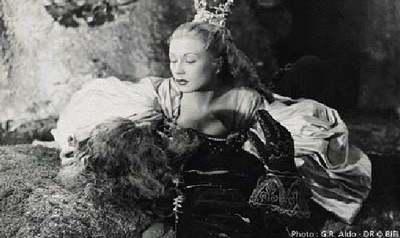
Pardon the disgusting imagery, as Woody Allen says somewhere, but that plunge into love has the force of an archetype, and the rough-stroke feel of a fable. Both Cocteau's La Belle et La Bete and Polanski's Knife in the Water gave me a language for the dangers of such a force. I must admit, though, that much of Cocteau's version of the fairy tale impressed me because of its style: he used the camera aggressively to generate an air of the fabulous. The images glowed, the camera followed Beauty down those surreal corridors with insinuating familiarity. Magic occurred simply by reversing the action, allowing figures to fall with unnerving smoothness up into the midst of the story's simple but deep conflicts and resolutions. Along the way, Beauty had to drop from her hands things she loved--family, home--to pick up the Beast, to lean into his breath. The tale gives her hard choices, but I wished I had the same opportunity to bargain away everything just to be loved. I have revisited this movie only once since then, and my memory of its details is aptly limited to its famously arresting images, but what remains is a conviction that in Cocteau's world, a hungry heart can be satisfied only after one is willing to surrender and sacrifice.
One difficulty with watching these films during my post-adolescence was that they sometimes posited problems that were at least two steps ahead of me. I had too narrow a frame of reference, for instance, for Knife in the Water. How could I understand the murder of fidelity when I had not yet lived inside such fidelity? The bored and irritated wife who sides with the young stranger--whom the overbearing, bourgeois-assertive husband thought he had killed--and the young man himself, his knife always out, so to speak, his confidence both a perceived threat and a promise; these were people I did not know, except in the abstract, or by inclination. (After all, many teenagers stand every day--at least I did--on the narrow deck of a pleasure boat, ready and willing, albeit often alone.) Like La Belle et La Bete, Polanski's film lays out a stylized space in which to work out these concerns, a neverland that is Minimalist/Abstract to Cocteau's Romantic/Gothic. Just a few years later, I would watch the bad craziness, as Dr. Thompson would put it, of Polanski's Repulsion (1965), the Freudian hybrid of La Belle et La Bete and Knife in the Water, in which the anxieties of both films are pressure-cooked in Catherine Deneuve's homicidally repressed brain. I am thankful that I was almost old enough to watch this without cracking, because with the previous two films lurching around in there, my own brain seemed a little squeezed.
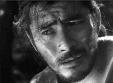
I was not, however, always alienated from these films. I understood with frustrating clarity the loss of truth in Kurosawa's Rashomon. I knew that the world is a haunted forest, and under those "dark, wet boughs" we do evil to one another, and once again often in full sight of witnesses. But their presence does not provoke justice; in fact, some of them turn out to be perpetrators, while the rest are so afraid, they lie--first to themselves, to make easier the lying to others. These were the political lessons of the 1970s, as well as the personal lessons of my life back then. I knew that the truth was both powerful and elusive, but I was too uncertain to make use of that power and too confused to grasp it firmly. It is fitting that the print I saw of Rashomon was faded and damaged; it matches the mood of the film and its post-adolescent viewer.

Felinni's La Strada is aptly titled here: for me it is the end of the road, the last way, where fading memories assert, not the details, but the lasting impression. The more I reflect, the more I must admit that this movie has become my cinematic acid test. If a film does not move me as La Strada did, it diminishes. I was most struck by two things in Felinni's movie: the cruelty of Anthony Quinn's Zampano, a strong man who bullies the diminutive Gelsomina, played with mime-like perfection by Giulietta Masina; and his love for her, repressed and deflected, until he loses her and is left alone, like Antoine Doinel before him so many years ago in this present foreign film autobiography, like that Anglo-Saxon Wanderer and Forman's Blonde--even, for a time, like La Bete and Polanski's foolish bourgeoisie, not to mention Rashomon's panicked truthful liars.

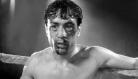
I have nothing new to say here: this loneliness simply breaks one's heart. Again, whenever a movie catches me by surprise and dizzies me with a sudden drop, it is the same howl of impotent rage I heard in La Strada. It is beyond Brando's "Stella!" and Welles' "I'm Charles Foster Kane!" but I feel it in those films, and some that came afterward, even if only in a long shot or short burst. Scorsese knows this moment, and has approached it many times, from Taxi Driver to The Aviator. To be honest, I think I keep insisting that Scorsese is our greatest living director because he hears clearly the sound of loss, and tries to ring its changes when he can.

Having written all this, I have come to realize that I still haven't watched The Passion of the Christ from the fear that it is a two-hour version of the last ten minutes of the films I've been discussing. I hesitate to offer any real commentary on a movie I haven't seen, but I would suggest that the sadism and gore that many have complained of, been repulsed by, jeered at, are nothing more than Gethsemane's legacy. All those lonely people staring blankly, raging, wandering off, lost in one Mirkwood or another, have asked for the cup to be taken from them--have asked, in the universal Last Temptation, to be human only, and left out of the business of God, which can seem cruel, divorced from what we want. And, of course, it often is just that, which is why in my adolescence I was drawn to those foreign films, whose images--of the water's edge, the menacing clearing in the wood, the road, the dimly lit corridor--provided "special mirrors," as Brecht says of the theater, of my own imploring posture and eventual, albeit partial, surrender to the dangerous joys of the will to love.

(9/20/2004)
Thursday, October 06, 2005

Shocking Evidence


I was thinking about my childhood experiences at the movies and in front of the TV (I'm old enough to remember Saturday matinees and life without cable), and the memory of Famous Studios cartoons landed in my head with a sickening thud. These were hard-hearted animations: post-Fleischer Popeye, Little Lulu (or Little Audrey), Casper the Friendly Ghost, Baby Huey--and worst of all Herman and Catnip, I swear the real models for The Simpsons' Itchy n Scratchy. If you're interested in some background you can go here to Don Markstein's admirable Toonopedia website to see this dubious Murderer's Row deceptively smiling, sunny and pure. For your own sake, though, don't be fooled; who knows what evil lurks...

When I was a little kid the denizens of the semi-psychotic netherworld of Famous Studios left me with a sense of unease greater than that of The Outer Limits, but at least the latter was supposed to fill me with dread. Cartoons were meant to reinforce joy, of one kind or another. There were, for instance, certain happy alliances, as when Sniffles the mouse and the little bookworm partnered up to get out of one scrape or another. And of course the joy of chaos: Tex Avery's growth-serum-swigging cats, dogs, and mice, Daffy Duck's stints as mustache fiend, draft-dodger, pet and prey. And so OK, the joy of predation; just ask Yosemite Sam or Elmer Fudd.

But in the low-rent sub-basement of Famous Studios, the antagonist's sadistic rictus remained frozen amid the Bosch-like excesses of all that tearing and rending and dynamiting. These 'toons meant business, with some truly creepy forays into pathological behaviors:

Cannibalism-by-Proxy I can still see the wolf salivating with a child molester's single-mindedness as he coveted the plump flanks of Baby Huey.

Tag-Team Date Rape In the hands of Famous Studios, the rivalry between Popeye and Bluto degenerated into a circle of abuse, as Olive Oyl was limply tossed from one to the other, her warbling cries for help sometimes stilled by a blow or a fall.

In-Denial Stalking Casper's search for "friends" was always accompanied by a glaring ignorance on his part that HE WAS A GHOST, for godssake. As he wandered through the gloom, his very presence dismembered the hapless, caught in a literally eye-popping orgy of terror, until some innocent--a puppy or small child--was seduced into accompanying Casper in a misadventure that often included physical harm, even gunplay.
(NOTE: I'll admit to taking some creative liberties here; in reality, I was a huge Casper fan when I was six or so. Still, now that I think of it I'm not sure this redeems the Friendly Ghost; after all, I was a pretty spooky (ha ha) kid, happy to sit alone for long periods in my rocking chair, listening to Meet the Beatles over and over, pretending I was at once a DJ on an all-Beatles station and a Beatle--obviously, Paul. "If I only had a friend"; worra worra worra.)

Unashamed Reciprocal Sadism What I remember most were the opportunities for Mutually Assured Destruction: the gleeful snarl of Catnip as he stuffed wriggling masses of mice into hero sandwiches, followed by Herman the Mouse's Bronx-cheer vendetta, cramming Catnip's face--swollen by the beating he always had to take--with explosives, and bouncing him in a barrel down a rocky hill and into a chasm, or shoving him, his arms pinwheeling, into the one-way jaws of some impossibly lethal DIS-assembly line. The final image was more often than not Herman on the shoulders of a pack of squirming mice, their cheers gleefully heartless.

Maybe because it's October, the month when I give myself up to horror films, but these cartoons trail me like the doppelganger of the kid I once was: clownish and bookish, simultaneously attracted to and repulsed by the Continuous Showings of Life's Chiller Theatre. I was, metaphorically speaking, willing to stick my finger in the electric socket--all right, maybe not metaphorically: I actually did this once as a kid, knowing full well you weren't supposed to, but compelled to check out why. And so goes Famous Studios: a shock that throws you like a rag doll, but one you invite.

Tuesday, October 04, 2005

The Gazing Game, Part 1


The essential nature of film is expressed through the act of gazing. Great films demand a fixed attention; the real strength of that contraption, the motion picture projector, is to generate the illusion that pictures move. Movies, though, are not captured in mimetic amber, and so can shed--sometimes with an almost audible sigh of relief--the demands of dramatic exposition, conflict, and resolution. Like those early Edison studies, or "actualities" (and how's that for poetry?), of bodies going through simple motions--with titles like "Newark Athlete" and "Men Boxing"--the movies that stay with me are primarily visual "experiences" of the act of gazing. Film, unlike the free, three-dimensional space of live theatre, holds us in place and levels and narrows our ken, until, like Alex in A Clockwork Orange, we can do nothing but viddy well our voluntary Lodovico Treatments.

Unfortunately, I cannot find a way--or, to woo your confidence in my abilities, I should say I have chosen not to find a way--to string such films together in a logical fashion. To convey the primacy of gazing (a still and silent occupation) over the intellectual perception of plot, I will abandon all semblance of order, and simply strew these along your way. I'll supply the prose poems, to misuse a moment from Citizen Kane; you provide the war.

(Note: In a meaningless act of masochistic restriction, to play The Gazing Game I have entrusted each entry to the reckless architecture of a single compound-complex sentence. Read 'em in a single breath!)

Apocalypse Now (1979)

Pressed down by the last wet sandbag against the flood, his outraged heart thudding like a fist on jailhouse concrete, Capt. Willard gazes at Coppola's Vietnam, his fevered brow at times smooth and flat, like a child's, at others furrowed and shining, while his river trip--in its own way as baffling and overblown as Huck's--slowly uncoils its fist to show him a crushed black horror stinking like a field of gardenias.

Ponette (1996)

The camera operator stubbornly refuses to stand up, dust off his knees, and walk away from this little child whose mother has died in her presence and whose father, angry at the loss, blaming the mother, is unable to lift the child with conviction and carry her to her rest; and so we are alone with Ponette, and mark the trail of every wet globe that breaks and falls from the brimful of her eyelids.

2001: A Space Odyssey (1968)

To answer the question, "How long does it take to walk from the Dawn of Man to Beyond the Infinite?" Kubrick hands God the camera, who makes us keep impassive watch as Dave Bowman trudges, weightless, through drifts of black and light and memory, the relentless Panavision, its bulk forced grudgingly into the role of Steadicam, jamming at the end, quadruple-exposing Dave, older Dave, dying Dave, and uber-Dave, while cold triumph rings in our ears.

I'm exhausted already. I'll gaze more at another date.

Tuesday, September 27, 2005

Clouds of Gory: Perfection and Eraserhead


Considering David Lynch's 2003 DVD transfer of Eraserhead (1976), I am struck with the obsessive determination to achieve perfection that imbues every aspect of the effort. I have read that Lynch took control over the already-laborious restoration process, cleaning the film frame by frame, removing everything that was not a pure, straight-into-the-lens image. If the camera didn't see it, neither would the DVD viewer. And of course I am duly impressed by the result: The movie, which has always been a dark and shadowed thing, is nonetheless clear and deep on DVD. I've seen some gorgeous B&W on DVD, and Lynch matches the best, including some of The Criterion Collection's beautiful work--as well as Something Weird Video's fanatically frightening perfectionism for the happy dregs of exploitation movies. Even the marketing and packaging of Eraserhead mirrors this compulsion: you can buy it only from davidlynch.com (check out this site; in its own uneasily grimacing way, it too is The Happiest Place on Earth), which mails it to you in an ominous black box worthy of the Necronomicon (or a pair of top-of-the-line athletic shoes). The disc comes in an arresting, odd-sized (I assume so that it cannot rest comfortably with other DVDs) fold-out display case. The on-screen menu features a deleted scene in which Henry's pants-cuff gets entangled by some wire and indefinable drek--and what seems to be the infamous dead cat that Lynch procured from an understandably nervous veterinarian and took apart over a period of time, freezing it, I believe, between examinations. But I digress. This menu scene goes on for a creepily long time until we are presented with three unadorned options: the movie--without chapters, a Lynch trademark; no jumping around for you, you nosy home viewer--the trailer, and a commentary. The last involves David himself rambling on quite entertainingly about the years spent making the film, providing not only minute details of production but deadpan homespun yarns about food, driving, cat dissection, and so on--all overlaid, of course, with the distinct fascination of a fetish discovered. I hate to put it this way, but the whole affair is perfectly Lynchian.

Perfect, indeed; on the back of the DVD box the Woman in the Radiator assures us that "everything is fine in Heaven." Well, on one level we, the Lynch faithful, are indeed at last in Heaven. The arrival of Eraserhead on video--at least, video that isn't a pirated, murky mess--has been twenty-plus years in the making, and this Humble Viewer is suitably breathless. But how close do we get to Heaven while watching the film? For the sake of those who have not seen the movie, allow me to provide a brief synopsis (SPOILER WARNING--which you really don't have to worry about; plot is NOT why one watches this movie):

Henry X, a nervous, apprehensive, and uncertain young man, discovers that his girlfriend, Mary X, who is even more nervous, apprehensive, and uncertain, if that is possible, has had a baby--at least they think it's a baby. Reluctantly, Henry settles down with Mary and the "baby"--a special effect of eerie realism combined with the hysteria of denial (that's as close as I can get to a description, unless you're willing to accept "baby-sized truncated worm/sperm thing"); he then descends into a miserable fantasy world in which a seductive neighbor lady, small grimy objects, tiny worms, and a Woman in the Radiator--actually, behind the radiator, standing on a little stage, either sweetly singing or gleefully squishing falling worm/sperm things; I'm really trying to help you here--combine to alternately increase and alleviate (the latter unsuccessfully) the tension and eventual panic of marriage and fatherhood. The baby gets sick--loudly, wetly, relentlessly--Mary goes home to Mother, and Henry literally loses his head over the whole mess, first becoming a resource for pencil erasers and then finding himself drawn within the radiator, locked in a chaste embrace with the Woman. It ends in a blinding whiteout.

Where does all this come from? Well, there is an old Daffy Duck cartoon in which, as Duck Twacy, he is confronted with a number of villains, including one "Eraserhead," who announces, "I'm going to r-r-r-rub you out" (by the way, a line echoed somewhere--help me out, Humble Readers--in a Clash song). I'd like to think Lynch knows the Daffy cartoon (considering this is a man who once purchased a string of win-'em-at-the-carny-sized Woody Woopeckers); it would provide some comic relief from the unease that permeates most of the film. And maybe he does know the Daffy version; there is some comedy in Eraserhead, especially in Jack Nance's perfectly (that word again) controlled performance. His first scene has a Chaplinesque quality as he meanders through an industrial waste-landscape, skittering up and down dirt mounds, around--and in--puddles, and so on. His face, topped with that groundbreaking hairdo, seems plucked straight from a Mack Sennet comedy; I can see him as a hapless truant officer or innocent bystander, there only to await a brick on his head or pie in his face. There is also the Woman in the Radiator, who, despite her ghastly, deformed, Kewpie-doll simper, does sing beautifully; Lynch has reminded us time and again that the female upper register, so to speak, hath charms.

But I think the real source of Eraserhead is a deeply engrained, post-adolescent fear of adulthood, in which jobs--Henry, when asked what he does, replies that he's on vacation--marriage, and parenthood seem equivalent to a loss of freedom, youth, even life. Lynch captures this basic--perhaps we should admit adolescent--fear with repellent simplicity. I won't go into details, but there are a number of scenes--at Mary X's house, in Henry's apartment--in which emergent sexuality is seen not as fulfillment but as a trap; the snare is hairy, gooey, sweaty adulthood itself. This kind of sexual/body dread is taken up by David Cronenberg in the late '70s, and of course Lynch himself right after, beginning with The Elephant Man (1980), which also explores body issues, to put it mildly.

The fear Lynch dissects is in some ways an "American fear"; baby boomers especially have been encouraged to sustain adolescence indefinitely. There is an entire culture dedicated to campy, kitschy, self-conscious memorializing of the trivial minutiae of one set of "happy days" or another. I must admit I suffer from this as much as, if not more than, many. How else can I explain my minor satisfaction in hearing a Hanna-Barbera sound effect in a Ren and Stimpy cartoon--or my more-than-minor satisfaction in Ren and Stimpy themselves--or my covetous relationship with a small but prominently displayed collection of childhood toys--a few Matchbox cars, a tattered Popeye doll, a Wham-O Air Blaster--right in my living room, or my insistence that Ray Bradbury is one of the greatest writers who ever lived? (Although I might be right on that last one, if you squint a bit.) And let us not linger too long on the American attitude toward sexuality, at least as it is filtered through the lens of basic cable, which sees men as flatulent cholesterol-aholics who peer through life's peephole at Girls Gone Wild, and which asks women to perform for the peephole while indulging their own body-needs via conspicuous consumption--sometimes of men, a la "reality" TV (those weird Sadie Hawkins experiments in mating-as-a-game-show) but more often of cosmetics and cosmetic surgery.

Eraserhead expresses this fear as a nightmare, a wish-fulfillment of nauseating thoroughness, and in so doing edges us closer to not only awful understanding, to be sure, but also, to some extent, resolution. However. When Wordsworth--with, of course, lots more delicacy--examines the loss of childhood, he offers consolation via faith, communion--he uses the phrase, "primal sympathy"--and "years that bring the philosophic mind." He even seems determined to accept adulthood, asserting that he will not grieve over the loss of that "splendour in the grass," and is willing to accept "the light of common day." Lynch's resolutions, on the other hand, tend to occur in a perfected landscape, one often explicitly depicted as a kind of Heaven or childhood. (It's reverse Wordsworthian Romanticism; for Wordsworth, one begins in Heaven, "trailing clouds of glory," and ends up in an almost-equally glorious early childhood before entering a hopefully resolved adulthood in which one can, for instance, love a brook more so than when one could run as quickly as one.) Even death itself--as in The Elephant Man and (I think) Twin Peaks: Fire Walk With Me (1992) and Mulholland Drive (2001)--can become an entrance to childhood. John Merrick chooses to sleep like other people, particularly like the painting of the child that hangs above his bed. In so doing, he spells his doom, for to lie down is to stop that tortured breathing. But he finds rest, and his mother. Sailor in Wild at Heart (1993) bypasses biology and finds his fairy godmother. A robin, albeit an obviously mechanical one--more on that in the next paragraph--sings at the end of Blue Velvet (1986); the female voice once again rises in welcome in Mulholland Drive; and, shorn of his usual awful adornments, all the stars come out to shine on the reunited brothers in The Straight Story (1999).

I would suggest that Eraserhead, in its own slippery way, marks the recurring Lynchian desire to resolve adolescent dread without making the resultant adult irresolute. But if the means of resolution is childhood or death/entrance into Heaven, then the operating principle of resolution is surrender to innocence. Simply put (and at that word you may sigh or yelp your relief), the way to resolve adolescent dread is, as Springsteen says, to be "ready to grow young again." We're back in the radiator, Heaven, in which the morass of adolescence is cleared by a simple--but at its best not simple-minded--acceptance of innocence, though tempered by uncertainty: we return to the fake robin, the unmistakable whiff--sometimes reek--of irony in Lynch's tone. But I would argue that when his endings express uncertainty of the value of the innocence gained, it is a hesitation that does not negate his conviction that we need to be like little children. After I watched The Straight Story, I felt deeply justified for crying at the end of Lynch movies. I've always been one of those who feel that Lynch may be cruel, but he is not jaded. He knows how bad things can get, and he worries about this all the time. Scoff if you must, but he expresses toward his characters a parental level of concern, as well as helplessness. In Scorsese's The Last Temptation of Christ (1988), Jesus is asked if he loves humanity, and he replies that he pities it. The questioner comments that pity may be enough. At the least, it is indispensable to a tragedy worth the name; at the most, it can "build a Heaven in Hell's despite," to quote another master of irony, crazy Bill Blake, who also nonetheless tells straight stories, in his own way.

In reaching this point--where Eraserhead stands at the front of a long line of films that dip deeply into ugliness in order to extract, rescue, even reward anything that could remain innocent in all that "muck and mire," and does so with an unflinching but pitying gaze--I am reminded of Tom Kromer's semi-autobiographical, unforgettable book, Waiting for Nothing, which chronicles the harrowing experiences he and others suffered on the road during the Great Depression. In one vignette, he is in the lavatory of a mission flophouse with another "stiff," one who will soon blow out his brains in a toilet stall. During an exchange that over the years for me has become almost scriptural, the two agree, "She sure is a tough life, buddy." That expression of mutual pity shows up in the oddest places, including Kromer's flophouses, but also outside Lynch's kitchen windows, on his front porches, atop his car hoods--and even behind the occasional radiator.

Tuesday, September 20, 2005

I Sing the Projector Electric


The Walt Whitman Theatre in Camden, NJ--actually, right across the city line in Pennsauken--was the only pre-mall movie theater I went to in New Jersey, as opposed to traveling across the river to Philadelphia, where the Goldwyn and other richly lobbied wonders still stood through my college years in the '70s. You can go here if you're really interested in seeing and reading about virtually every old-time theater in Camden, including peripherally the Whitman; however, poor man's Proust that I am, I'm not concerned with a sense of history as much as of remembrance. Only two visits to the Whitman remain with me. Both mark a bridge between the dimming past of my childhood and my clearer, albeit less formative, perceptions of adolescence and adulthood. For now, I'll write about one of those visits.

When I was a child it was not unusual to have "movie parties," relatively low-maintenance affairs for the parents, who only provided transportation to and from the Saturday matinee--and, given my memories of the experience, minimal supervision--followed by a half hour of cake and present-opening back at the house. I actually remember only one of these--not my party, but, I think, my friend Louie's. The Whitman, high-ceilinged, dun-colored, and dim, was jammed with screaming, flailing kids, liberated not only by the absence of their parents but by all that space and darkness, and the glory of the mob. After a few hard-hearted cartoons--maybe Little Lulu (or Little Audrey), Casper, or Baby Huey--or worst of all Herman and Catnip, denizens of the semi-psychotic netherworld of Famous Studios, in which the antagonist's sadistic rictus remains frozen amid the Bosch-like excess of all that tearing and rending and dynamiting--Louie and his guests, as well as another kid's party, were forced to stand before the screen to allow the audience to sing "Happy Birthday." Of course, we slunk up there reluctantly, knowing full well that this was definitely not an opportunity for rousing fellowship but for ridicule and target practice--the disconnect between adults and kids being yet again a source of literal pain--and, half-crouching, our shoulders raised, our faces averted, we were pelted by the crowd with popcorn, Milk Duds, empty Sno-Caps boxes, and eye-threatening Jujubees, all the while derided by their squawking rendition of the natal hymn--you know the version, of course: Louie was unflatteringly compared to one of our primate cousins, with insulting olfactory references. And in true kid fashion, this misery did not bond us with foxhole fellowship to the other party; no, somehow we managed to form a mutual enmity, promising pain and ignominious defeat apres-theatre (which of course never came to be).The movie itself was King Kong vs. Godzilla (1962); what I remember most was that we cheered wildly whenever King Kong, by default the "American monster," was on screen--or better yet, besting Godzilla, the Japanese monster, whom we booed and jeered, perpetuating old antagonisms. I guess the memory of the Bataan Death March died hard for eleven-year-olds in 1967.

Looking back, I will confess I have, as usual, romanticized the event almost beyond recognition. On the other hand, to assert that it was actually just another everyday childhood experience belies the deep weirdness of childhood, the isolated imbroglio down there at hip level in which such impromptu parodies of adult sturm und drang were indeed everyday occurrences, played out with, again, minimal chaperoning and arbitrary convictions. Jammed into the Whitman and left on our own, we were vigorously shaken like bees in a jar; little wonder we emerged tumbling, squinting like Plato's imbeciles in the sun for the first time, unaware we had invented the world once again, this time in the cacophonic darkness of a matinee.

Thursday, September 15, 2005

Ripley's Believe It or Not


I still own an old paperback copy of Carlos Clarens' Illustrated History of Horror Films. (According to Amazon, it's still in print, with "Science Fiction" added to the title.) I read it when I was in seventh or eighth grade, right around the time Karloff died. I'd like to write about both Clarens and Karloff in more depth some time, but for now the image that floats to the surface is one of the book's stills, a shot of Jason sword-fighting a skeleton in Jason and the Argonauts (1963--and how lucky was I to have been seven years old when it was released?); the caption simply reads, SUSPENSION OF DISBELIEF. And while the intent is to indicate the sense of wonder such images conjure, for me it was all about the shocking disconnect between what I knew as I watched a horror film and what I could not help but feel: electrifying fear, a soul-deep shiver that forced me to wince, to look away, to flee. Scary movies erased all comfort, all cozy certainty. At such moments, I was abandoned by everything in and around me that could reassure. A truly instinctual response.

I've written about this fear before, and will probably do so again, but as the years passed I began to suffer from a different fear: that I had lost the ability to suspend disbelief, at least in terms of the breathless terror movie images could once so easily churn up. And I'm not sure when the fear waned to the point that I noticed it had done so; but I know it happened late, well into adulthood (even though a dry whispering voice tells me in uneasily reassuring tones that It isn't done with me yet; but more on that later). All I'm certain of is that I began to have to will myself into that feeling, give myself reasons to be very afraid. And that marked the beginning of the end; once I had intellectualized fear, I snarled the primal throughline, maybe for good and all, into an oxymoronic knot I'd never unravel. All I was left with was the memory of fear, and for someone attracted to horror films, that's like showing a picture of a steak to a hungry man. I already needed my imagination to be afraid of a movie; how was I going to imagine that I was afraid? A dead end, boos and ghouls.

Again, my only consolation was that the feeling had lasted so long. I can still recall, with embarrassment but also queasy joy, how deeply afraid I was in 1979--at age twenty-three!--watching Alien. My sister--three years older than me but even more firmly strapped into the electric chair of movie fear--and a friend of hers went with me, at my insistence. I remember when things got really ugly, I glanced over, worried I had asked her to take on too much--I still recalled my sister walking out of a movie theater in Miami midway through A Clockwork Orange. But silly me: Kubrick's movie is not scary, simply morally nauseating. Neatly done, of course, but not much fun.After all, she was the one who only four years earlier had orchestrated her Summer of Jaws, seeing it over and over with any poor innocent who hadn't gone yet--including a younger cousin whose eye I believe is still twitching a bit. (And let's not forget that Alien has been called "Jaws in outer space.") She looked back at me, as Ripley (the dogged Sigourney Weaver, who stuck with the character through an alarming number of sequels) and the crew of the Nostromo* recovered as best they could from the sight of Kane's (John Hurt) exploding chest; I saw the shine in my sister's eyes, the grin/grimace of suspended disbelief in the service of giddy terror. Everything was fine. Afterwards, we laughed and shook ourselves like people coming off a roller-coaster ride. What fun, ho ho. But she wouldn't drive us home until we'd popped the trunk to make sure nothing lurked, and checked in the back seat--and under the seats--lest, well, you never know. And even though you do know, you allow your intellect to take a break, at least until you peer into the glove compartment.

As I hinted at earlier, the loss of such terrors has recently not seemed absolute. Maybe it's the jump-cuts, shadows, and ongoing ominous hum of the Japanese horror films I've been watching. Maybe I'm getting old enough to remind myself that one should respect the dark. Maybe it's because I continue to see movies with people--my children and spouse--who still twist and shout when It arrives onscreen. Because there I was with my twelve-year-old watching The X-Files on DVD the other night, and Mulder and Scully were in an underground mining facility, the tunnels lined with filing cabinets--puzzling evidence, elided once again--and of course the light fails and they separate; and Scully is alone in the dark when a gaggle of little Somethings scurries by, bulbous heads bobbing, while violin strings are plucked atonally and she stands saucer-eyed. I had no choice but to stiffen and draw back a little; and what an unwholesome relief to be reminded that I still had It in me.


*By the way, the connections between Joseph Conrad's novel of the same name and Alien can be intricate, if a bit frayed at the edges.

Thursday, September 08, 2005

Now Is the Time to Act


Watching Stanley Tucci act is like reading a universal truth: you recognize something good any old time, real and acceptable as needed, comfortable in its own skin. I can easily imagine Tucci in The General (1927) fruitlessly pursuing Keaton, in Casablanca (1942) shaking cocktails for Bogart behind the bar, imposing on Jack Lemmon in The Apartment (1960), even leaning into the microphone to sternly inquire into Al Pacino's ties to organized crime in The Godfather (1972). His career reflects this universality, although early on he seemed mostly to fit snugly into pinstripes; he pops up as Lucky Luciano in Billy Bathgate(1991), and in the early '90s seemed to play swarthy or oily--a tendency he transcended with Big Night (1996), which he co-directed, -wrote, and also -starred in with another "ethnic type," Tony Shaloub, playing an Italian restauranteur with a underappreciated chef brother in Atlantic City circa 1955. It is a small and perfect world, dominated by food, loss, and love. I am so attached to this movie that I fear I am suspicious of anyone who doesn't have at least some affection for it. Like Kevin Spacey, Tucci brings a precision to his performances, an almost clipped reserve that opens doors into the insecurities and hopes of his characters.

Tucci's strengths are evident in Big Night, but the movie I can't stay away from is The Imposters (1998), in large part an homage to the Marx Brothers by way of Mel Brooks. Tucci and Oliver Platt play out-of-work actors who flee the misguided ire of another, more successful, actor (played by Alfred Molina) to a passenger ship--on which, of course, is Molina's Sir Jeremy Burtom. There we meet an almost-too-crowded collection: con artists, a Sheik, a dowager and her spinsterish daughter, a saboteur, a suicidal lounge singer, a "veiled queen"--that's what it says in the credits--and a variety of oddball crewmembers. The cast is a who's-who of indie films--Tony Shaloub again, with Lili Taylor, Steve Buscemi, Campbell Scott, Billy Connolly, Hope Davis, and the forever-amber Isabella Rossellini--and the set used for the ship has a cozy artificiality that invites us into the joke. All in all, a wide-eyed romp that sometimes stumbles, but always manages a Pee-Wee-Herman-like, "I meant to do that," and scrambles on.

But The Imposters' deepest value lies in the way it both interrogates and celebrates the idea of performance. From its opening scene, in which Arthur (Tucci) and Maurice (Platt) sit opposite one another and perform acting exercises, silently expressing emotions on command ("No hands," Platt is warned)--we are immersed in lives sustained by performance. As Lynne Anne Blom and L. Tarin Chaplin remind us in their 1989 book on dance improvisation, The Moment of Movement, "the senses are not verbal." And gosh, wasn't it just a few years earlier that Aristotle pointed out that action reveals character? In a pivotal moment in The Imposters, Tucci and Platt agree, "Now is the time to act," setting in motion a furious round of saves, near-misses, couplings and uncouplings, and revelations of the movie's central conceit: We reveal ourselves via the disguises we adopt. These double-plus entendres are often punctuated by musical interludes, the most emblematic of which are two renditions of "Parlez-Moi D'Amour," one surreal (Platt and Tucci disguised beneath harem veils execute a pas de trois with the Sheik as the Victrola plays Edith Piaf's immortal version), the other sweetly yearning (Hope Davis' lonelyheart serenades Steve Buscemi's suicidal singer, Happy Franks). I mention the music because song of one kind or another floats and flings itself around this movie, underlining the need for movement, performance, pretense, as a release from inertia and a relief from despair. At the end, like the Blazing Saddles fistfight that extends through the Warner Bros. backlot, while the credits roll the cast of The Imposters dances in Groucho-esque abandon through the set--then off it, past the cameras and crew, and across the soundstage.

The Imposters always makes me happy. Case in point: Oliver Platt has been running around in drag, attracting the attention of the aggressively sexually ambiguous Mr. Sparks (Billy Connolly)--shades of Some Like It Hot--and finally confronts Sparks with the truth, tearing off his wig and, Jack-Lemmon-like, shouting, "I'm a man!" to which Sparks lustily cries, "And so am I!" It is a line I can't stop finding hilarious, if only because it not only reveals the toothy-grin core of Sparks' character but also speaks to The Imposters' general air of whoopsy-daisy--or is it topsy-turvy? No matter, for while some moments seem a bit forced, Tucci still runs Arthur gleefully through the movie, befuddled but eager, Platt exploits Maurice's quirky uncertainties and sporadic commitments, and everyone, even the stop-or-I'll-jump Happy Franks, has fun, including me.

Copyright Notice

Content copyright © 2005-2011 by Paul J. Marasa. No part of the written work displayed on this site may be reproduced, linked or distributed in any form without the author's express permission. All images, video, audio and other materials used are deliberately and solely for illustrative purposes connected with each article. Each accompanying element is intended as a research and reference tool with relation to each article. No challenge to pre-existing rights is implied. Aside from The Constant Viewer, the author claims no responsibility for websites which link to or from this website.